A foldable phone does something that should be impossible: it bends in half, hundreds of times a day, and keeps working. The screen folds, the battery is split in two, and the whole phone opens and closes like a book. The part that makes it possible is smaller than a finger and easy to overlook — the hinge. It is a tiny machine of gears, springs, and steel plates that must fold smoothly, hold the phone open at any angle, and survive years of daily use without ever going loose or stiff.
Inside the factory that builds the foldable phone hinge, the work is done at a scale where a speck of dust is a serious problem. The parts are machined to tolerances thinner than a hair, assembled by hand under bright lights, and tested by machines that fold them again and again, day and night. A hinge that fails would ruin a phone worth a thousand dollars, so every unit is tested before it leaves — and the test is simple: fold it, unfold it, and do it again, tens of thousands of times.
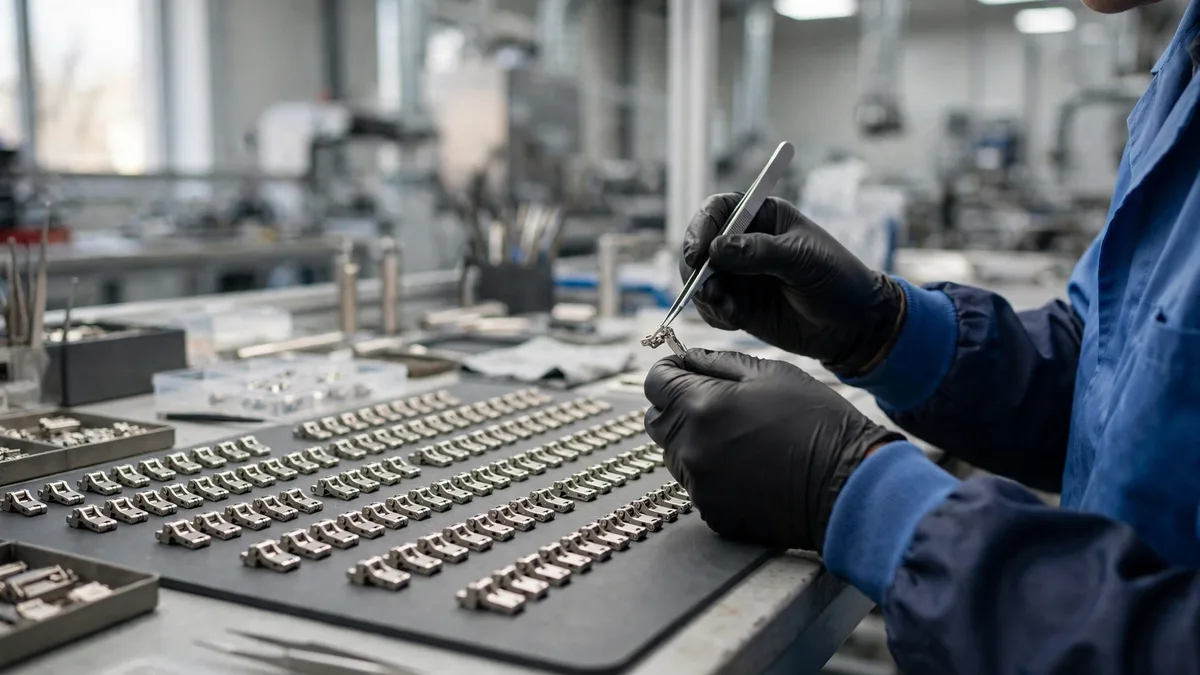
Inside the Production
Step 1: Machining the hinge parts
Production begins with small blocks of stainless steel and aluminium, machined into the hinge’s parts: plates, gears, cams, and shafts. The machining is done on computer-controlled mills that cut to tolerances of a few microns — thinner than a human hair — because the parts must fit together with almost no play. Each part is measured after machining, and any part outside tolerance is scrapped. A hinge with a loose part would wobble; a hinge with a tight part would grind, so there is no room for error at this stage.
Step 2: Polishing and coating
The machined parts are polished until their surfaces are smooth enough to slide against each other thousands of times without wearing out. Some parts are coated with a thin layer of hard material to reduce friction further, and others are given a light oil that will stay in place for the life of the phone. The parts are cleaned in ultrasonic baths to remove every trace of metal dust, because a single speck of grit inside a hinge would scratch the polished surfaces and make the fold feel rough.
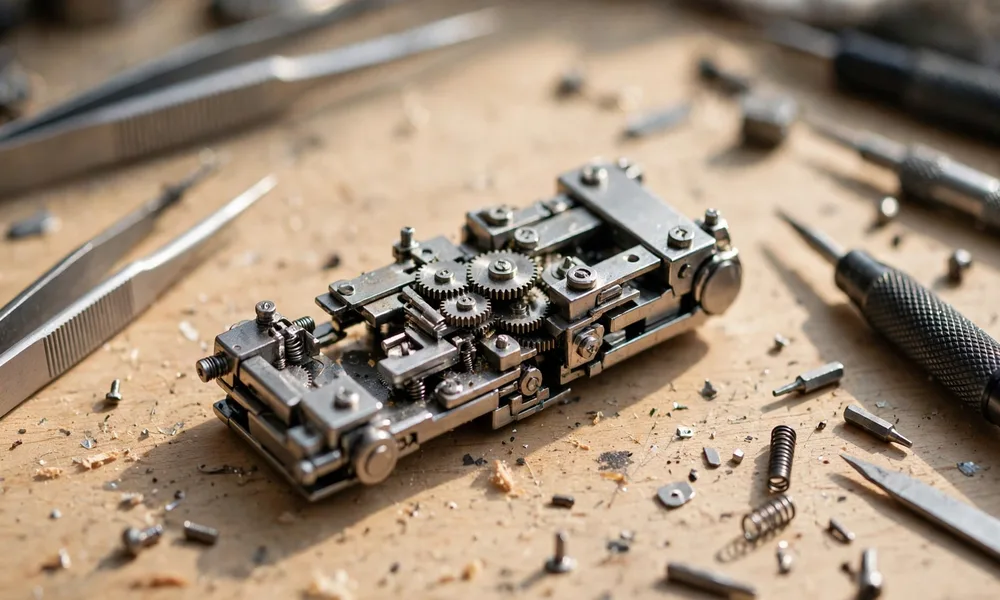
Step 3: Assembling the hinge
Assembly is done by hand, under magnifiers and bright lights. Workers fit the gears, springs, and plates together in a strict order, using tweezers and tiny screwdrivers, and each hinge is checked as it is built. The springs are the heart of the mechanism: they hold the phone open at any angle and give the fold its smooth, satisfying feel. A spring that is too strong would make the phone hard to close; one that is too weak would let it flop open, so the springs are matched and tested before they are fitted.
Step 4: Lubricating and sealing
Once assembled, the hinge is lubricated with a special grease that will not dry out, leak, or stiffen in cold weather, and the mechanism is sealed against dust. The seal matters because a phone hinge lives in pockets and bags, where dust is everywhere. A dust cover is fitted over the moving parts, and the whole hinge is wiped clean and inspected under a light. Any hinge with a scratch, a mark, or a rough spot in its movement is taken apart and rebuilt.
Step 5: The first fold test
Every hinge is folded by hand before it goes to the machines. A worker opens and closes it slowly, feeling for any catch, grind, or looseness, and checks that it holds steady at several angles. A hinge that passes the hand test goes on to the automated test rigs, where machines fold it thousands of times. The way the hinge is built to survive that testing is part of what how a foldable phone hinge is made describes, and the hand test is where a machine becomes a product a person will touch every day.
Step 6: The endurance test
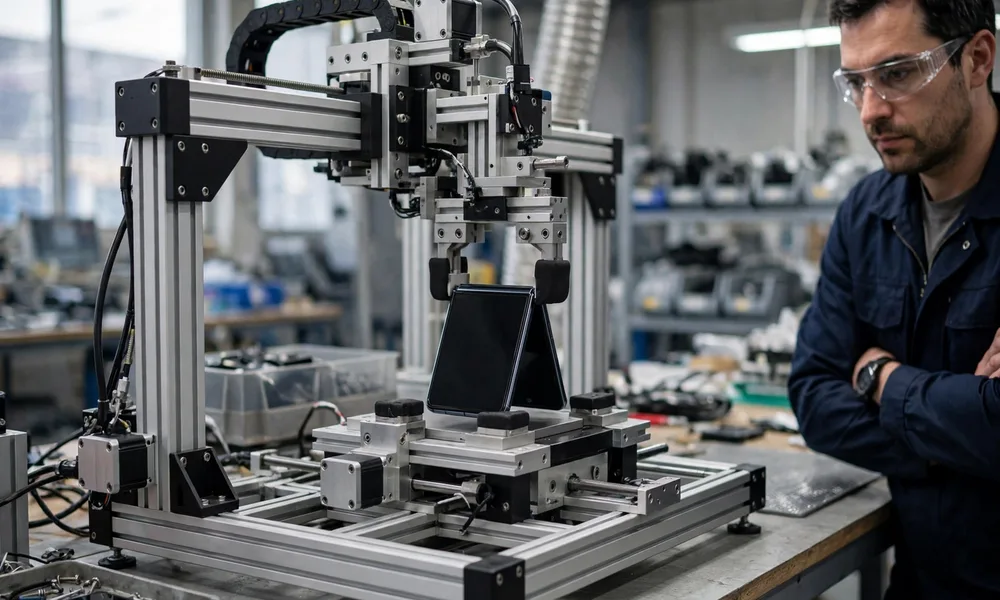
The final test is endurance. Each hinge is mounted on a test machine that folds and unfolds it again and again — typically 200,000 times or more, the equivalent of years of daily use — while sensors watch for changes in force, noise, and movement. A hinge that gets loose, stiff, or noisy during the test is rejected. Only a hinge that still folds smoothly after the full test is cleared for the phone factory, where it will be fitted into a new foldable phone and folded by its owner, hundreds of times a day, for years.
Specs
| Specification | Typical figure |
|---|---|
| Hinge material | Stainless steel and aluminium alloy |
| Machining tolerance | A few microns, thinner than a hair |
| Parts per hinge | Dozens of plates, gears, springs, and shafts |
| Fold angles | Holds steady at many angles, not just open and shut |
| Endurance test | 200,000 folds or more per hinge |
| Lubrication | Special grease, sealed against dust |
| Assembly | Built by hand under magnifiers |
| Cleaning | Ultrasonic baths to remove all metal dust |
| Testing | Hand fold test, then automated endurance test |
Price
The hinge is one of the most expensive parts of a foldable phone, and its price is usually given as an estimate. As an estimate, a single foldable phone hinge costs roughly $20 to $40 to make, and the hinge assembly — including its covers, seals, and fitting — adds roughly $50 to $100 to the cost of the phone. These are estimates, and the real figure varies with design, materials, and volume — but the rule holds: the hinge is a small part with a large price, because it is the part that decides whether a foldable phone feels like a precision instrument or a toy.
A Rare Fact
A foldable phone hinge is tested by folding it more times in a few days than its owner will fold it in years. The test machines run day and night, folding a hinge every few seconds, and the engineers count the folds in the hundreds of thousands. Some makers test to 200,000 folds, others to 400,000 or more — the equivalent of opening and closing the phone a hundred times a day for a decade. It is one of the strangest facts in phone engineering — a part smaller than a finger, folded more times in a factory than it will ever be folded in a pocket, so that the one fold that matters, the next one, always feels exactly right.
The hinge is the heart of the foldable phone, but it only makes sense alongside the screen it protects. The materials behind its steel and gears are laid out in the foldable phone hinge materials engineering guide, and the screen that folds with it is explained in the materials behind the foldable display. The next time a foldable phone snaps open, remember the machined gears, the matched springs, and the hinge that was folded two hundred thousand times before it ever reached a hand.


