Two hundred metres below the surface, there is no light at all. The water around the hull is black, cold, and silent to a human ear. Yet the boat is not blind. Along its bow, down its flanks, and trailing behind it like a thread, an array of listening ears is wide open. Every creak of a distant hull, every turn of a propeller, every whale call rolling across the ocean arrives as a tremor in the water — and the submarine hears it all.
The crew in the control room do not look out of a window; there is nothing to see. They watch a screen where sound becomes shape: a faint line that rises and falls, a bearing creeping across a dial. That line might be a fishing trawler ten kilometres away, or another submarine running silent, hoping never to be found. The difference can be a matter of life and death, and it is decided entirely by listening.
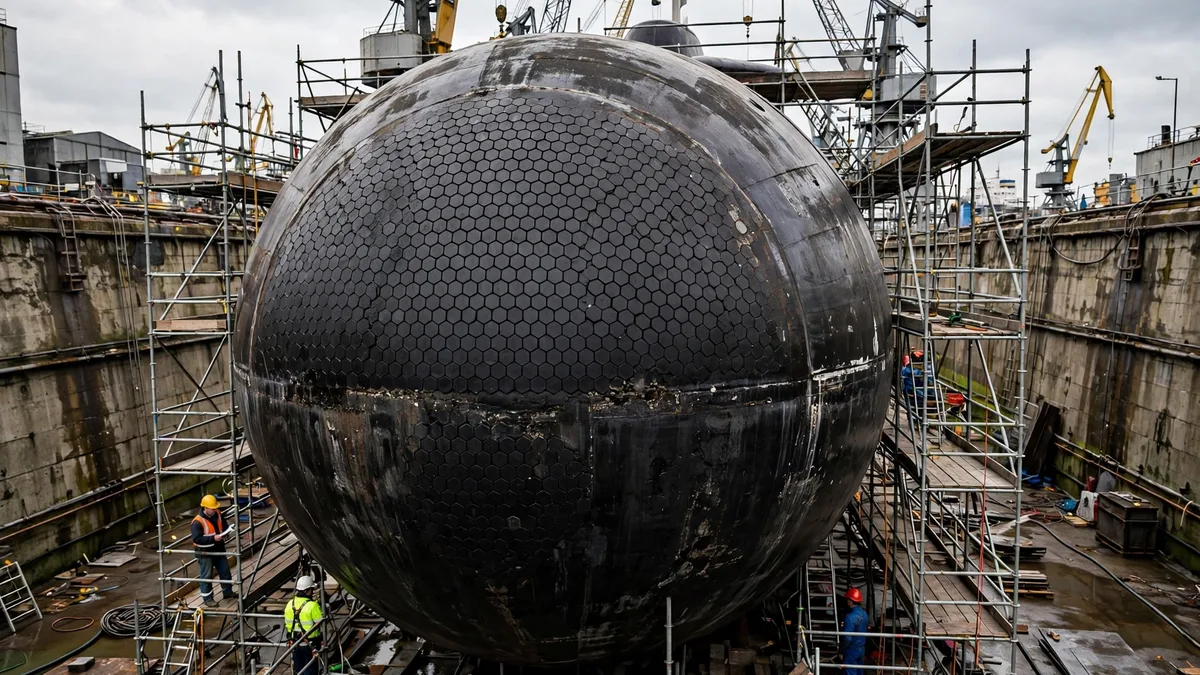
This is the job of the submarine sonar array, the most sensitive set of ears fitted to a machine: hundreds of hydrophones — underwater microphones — arranged around the hull and towed behind the boat, wired into processors that turn vibrations into a picture of the ocean. Here is how it works, and what the numbers on the specification sheet mean.
How It Works
Step 1: The hydrophones feel the water move
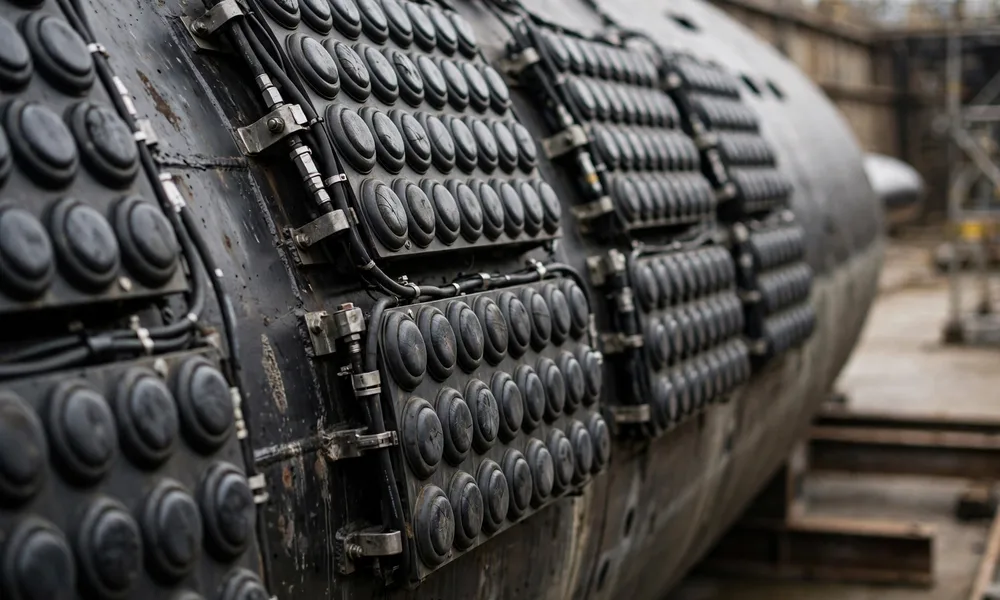
At the heart of every sonar array is the hydrophone, a small transducer that turns pressure into electricity. Sound in water is a travelling wave of pressure, and each hydrophone holds a ceramic element that generates a tiny voltage whenever that pressure changes. One hydrophone alone hears everything and knows nothing about where it came from. But hundreds of them, spread across a bow dome or along the hull, can compare the exact instant a sound wave reaches each one, and that comparison turns noise into direction. Fitting them to survive crushing pressure is its own discipline, as shown by the titanium pressure sphere of the Alvin submersible.
Step 2: Passive listening does the real work
Most of the time, a submarine listens and says nothing. Passive sonar simply receives, drinking in the sounds the ocean makes on its own: the thrum of a merchant ship’s propeller, the hiss of water over a hull, the click of a whale, the rumble of a distant earthquake. Because the boat emits nothing, it gives away nothing about its own position — silence is its camouflage. The flank arrays along the hull are especially good at this, catching faint, low-frequency sounds that travel enormous distances underwater. A skilled operator can recognise a ship by the rhythm of its machinery, the way you might recognise a friend by their footsteps.
Step 3: Active pings measure distance
Sometimes listening is not enough, and the submarine must ping. Active sonar fires a sharp pulse of sound into the water and times how long its echo takes to return — the same trick a bat uses, except the sound travels through water at roughly 1,500 metres per second, about four and a half times faster than in air. The echo reveals the range and bearing of whatever it bounced off. The price of a ping is exposure: every other listener in the ocean hears it too, so active sonar is used sparingly, like switching on a torch in a dark room.
Step 4: Beamforming sharpens the picture
A hundred hydrophones hearing the same sound is only useful if their signals can be combined intelligently, and that is the job of beamforming. By adding tiny, precisely calculated delays to each hydrophone’s signal before adding them together, the processor makes sounds from one chosen direction reinforce each other while sounds from every other direction cancel out. The array can thus “point” its hearing in any direction without moving a single piece of hardware. Modern arrays steer dozens of these beams at once, watching the whole ocean around the boat in parallel, each beam only a degree or two wide.
Step 5: Signal processing separates signal from sea
The raw output of the array is a mess. The ocean is full of sound: waves breaking at the surface, rain pattering overhead, shrimp snapping, ice cracking, and the submarine’s own machinery humming through the hull. Signal processing pulls one faint, meaningful sound out of that wall of noise. Computers filter the signals into narrow frequency bands and compare them against libraries of known sound signatures — the acoustic fingerprints of different ships and submarines. The whole chain, from the precision machining of the transducer housings to the racks of processors in the control room, exists to make a whisper audible against a roar.
Step 6: The towed array listens from behind
The longest ear on a modern submarine is not on the hull at all. It is a towed array: a flexible cable, sometimes more than a kilometre long, spooled out behind the boat and filled with hydrophones along its length. Trailing far behind the submarine’s own noisy machinery, it listens in much quieter water and at very low frequencies, which travel furthest underwater. Its great length gives it an enormous listening aperture, so it can pin down a contact’s bearing with remarkable precision. The same modular thinking that lets shipyards build a vessel in sections, as in modular ship construction, is what lets a towed array be reeled in, repaired, and redeployed without dry-docking the boat.
Submarine Sonar Array Specs
| Specification | Typical range |
|---|---|
| Array type | Spherical bow array, flank arrays, towed array |
| Frequency range | About 10 Hz to 10 kHz |
| Number of hydrophones | Several hundred in the bow array, hundreds more elsewhere |
| Detection range | Tens of kilometres, over 100 km in ideal conditions |
| Beam width | About 1 to 3 degrees |
| Operating depth | Down to about 400 to 600 metres |
| Active ping power | Roughly 1 to 10 kilowatts |
| Towed array length | About 200 to 1,000 metres |
What Does a Submarine Sonar Array Cost?
A submarine sonar suite is one of the most expensive systems on the boat, and its price is rarely published. Industry estimates put a modern integrated sonar suite — bow, flank, and towed arrays together with their processors — at roughly $50 million to $150 million per submarine, the towed array alone estimated at several million dollars. Prices are estimates only and vary enormously with the class of submarine. The cost reflects what the array really is: hundreds of precision sensors, kilometres of specialised cable, and computing power that must work flawlessly, silently, hundreds of metres underwater.
A Rare Fact
In 1968, the American submarine USS Scorpion was lost with all hands in the Atlantic, and no one knew where she had gone down. The search area covered thousands of square kilometres of empty ocean — until analysts turned to a secret network of seabed hydrophone arrays called SOSUS, built to listen for Soviet submarines. The arrays had recorded the sound of the Scorpion imploding, and by comparing arrival times at different listening stations, the Navy triangulated the wreck to within a few hundred metres. SOSUS stayed classified for decades; the ocean had been wired for sound long before the public knew.
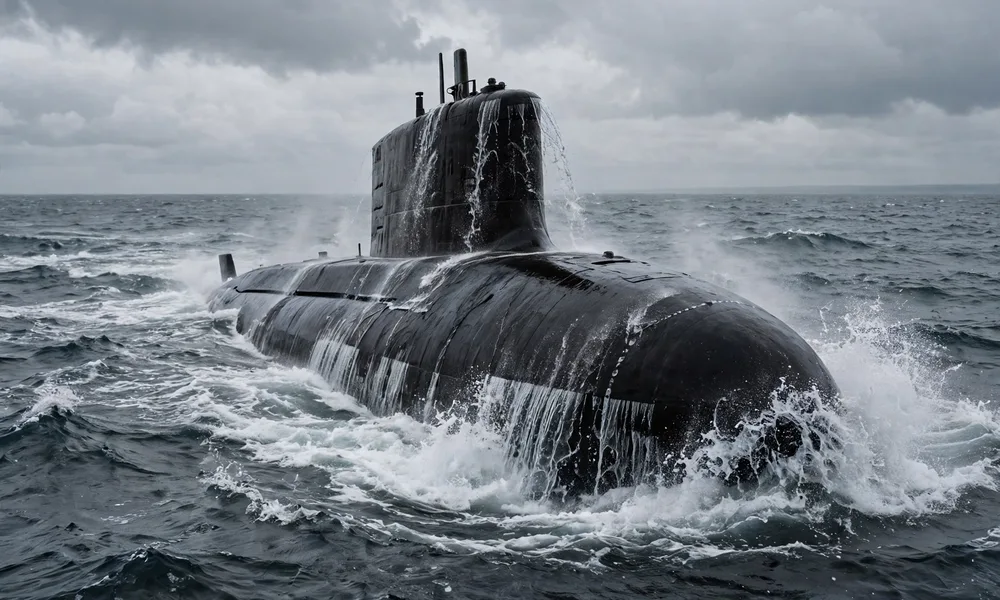
The sonar array is a reminder that the most important sense on a submarine is not sight but hearing. It listens without light and without giving itself away, and from the trembling of the water it builds a map of everything around it. In the deep, the boat that hears best is the boat that survives.