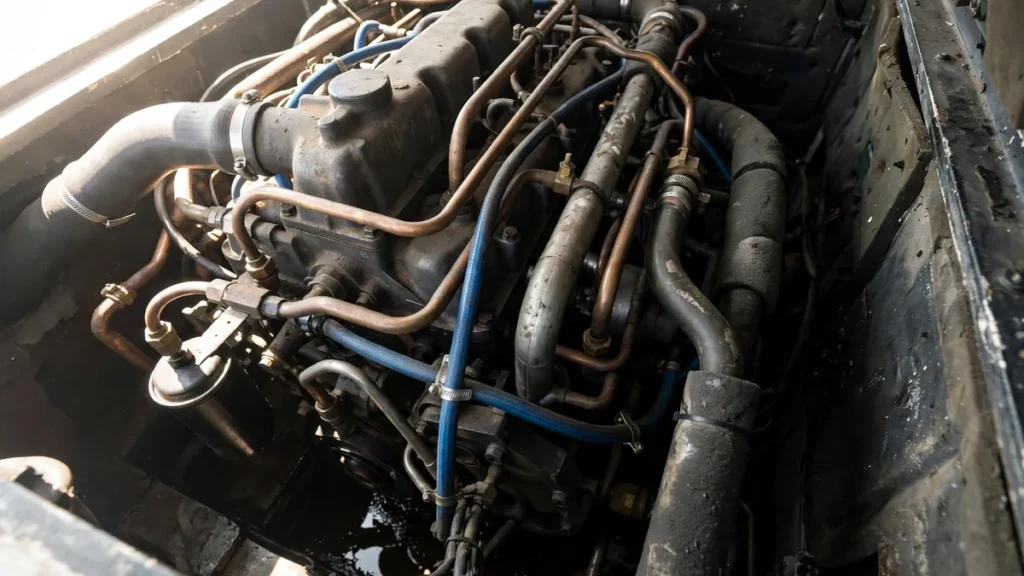
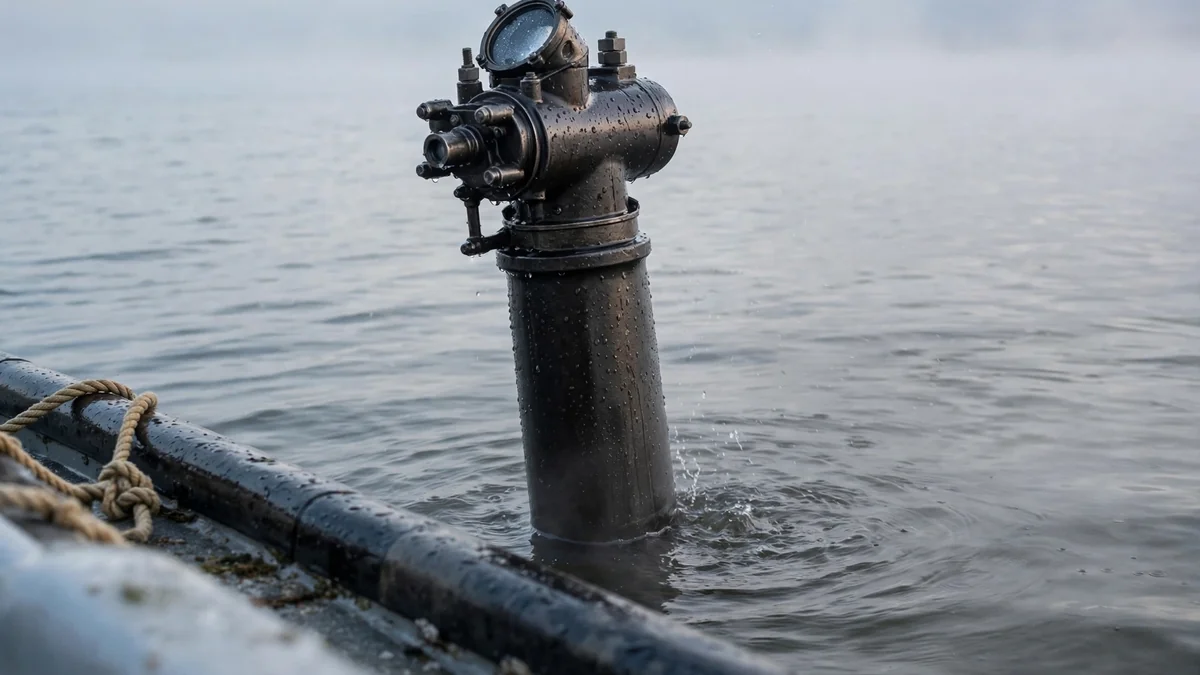
From the surface, the sea looks empty. A few hundred metres below, a submarine is moving through the dark, and the only part of it that ever breaks the surface is a steel tube no wider than a dinner plate. That tube is the periscope, and for more than a century it has been a submarine crew’s only window on the world above the waves.
A periscope is not a simple telescope. It is a precision optical instrument that must survive crushing pressure, salt water, and the shock of a vessel manoeuvring at depth, while still delivering a clear, magnified image to an eye deep inside the hull. The numbers on its spec sheet describe that balancing act: how far it can see, how much it magnifies, how wide its view is, and how little of itself it shows to the enemy.
This guide explains the key numbers on a submarine periscope spec sheet in plain English: what magnification really means at sea, why the diameter of the tube matters, how far a periscope can actually see, and which figures are worth comparing between boats.
Inside the Numbers: What a Periscope Spec Sheet Really Says
1. Magnification: how close the horizon comes
Magnification is the number most people look at first, and it is usually quoted as two figures, such as 1.5x and 6x, because a modern periscope has a low-power wide view and a high-power narrow view. At 1.5x the world looks almost natural, which is what a watch officer wants when scanning for ships in every direction. At 6x, a distant vessel jumps close enough to read its shape, its course, and sometimes even its name. The way the image is gathered and focused is closely related to the sonar that listens while the periscope watches, and the two systems together are covered in the submarine sonar array specs.
2. Field of view: how much sea you see at once
Field of view is measured in degrees, and it is the width of the slice of horizon the periscope shows at any moment. A typical attack periscope shows around 30 to 40 degrees at low magnification and only about 6 to 8 degrees at high magnification. That sounds narrow, and it is — scanning a full 360 degrees means turning the periscope slowly through a complete circle, which is why a good watch officer works in a steady rhythm.
3. Diameter and length: the tube that must stay hidden
The diameter of a periscope’s head is usually between 150 and 200 millimetres, and the whole mast can be 10 to 18 metres long, reaching from the control room up through the sail and above the waves. Every millimetre of diameter matters, because a wider head is easier to spot on radar and easier to see with the naked eye. The pressure the hull endures while the periscope is raised is the same pressure the rest of the boat faces, and that story is told in how a submarine pressure hull is made.
4. Raising and lowering: speed against exposure
A periscope spends as little time above the surface as possible. Modern masts raise in a few seconds and lower just as fast, and a watch officer’s exposure is measured in seconds, not minutes. The spec sheet quotes hoist speed and maximum raised height above the waterline, typically one to two metres of the head showing, because every extra centimetre of steel above the waves is another centimetre a lookout on another ship might spot.
5. Optical quality and low-light performance: seeing at dusk
A periscope is judged by the worst light it can work in, not the best. The spec sheet quotes the size of the objective lens, the light transmission of the glass, and the performance of any image intensifier fitted for night use. A large objective lens, typically 100 to 150 millimetres across, gathers enough light to keep the image usable at dawn and dusk, when the sea is at its busiest and the light is at its weakest. Modern masts add thermal imaging and low-light cameras alongside the glass optics, so the watch officer can switch between a daylight view and a heat picture of the same patch of sea without lowering the mast.
6. Stabilisation: holding the image still
A submarine never sits still. It rolls, pitches, and yaws with the sea, and the periscope must cancel that motion or the image would swing wildly. The spec sheet quotes stabilisation accuracy, often in fractions of a degree, and it is one of the most demanding numbers on the whole sheet. Gyroscopes sense the boat’s movement and tilt the optics in the opposite direction many times a second, so the image stays fixed on the horizon even as the hull moves beneath it.
7. Range and bearing accuracy: the periscope as a weapon sensor
A periscope is not only for looking. It is a targeting instrument, and the spec sheet quotes bearing accuracy, often to within a fraction of a degree, and the range-finding method, whether by measuring the height of a known ship or by laser. The factory that builds these instruments works to tolerances more often found in telescopes than in shipbuilding, and that build is shown in inside submarine periscope production.

Submarine Periscope Specs
| Specification | Typical range |
|---|---|
| Magnification | 1.5x low power, 6x high power |
| Field of view | 30 to 40 degrees low power, 6 to 8 degrees high power |
| Head diameter | 150 to 200 mm |
| Mast length | 10 to 18 m |
| Raised height above water | 1 to 2 m |
| Objective lens diameter | 100 to 150 mm |
| Stabilisation accuracy | Within a fraction of a degree |
| Bearing accuracy | Within a fraction of a degree |
What Does a Submarine Periscope Cost?
A modern submarine periscope system is estimated at roughly $1 million to $5 million, and a full photonics mast with thermal imaging, laser rangefinding, and electronic sensors can be estimated at $5 million to $15 million or more. All prices are estimates only and vary widely by type, capability, and country. The cost is the reason periscopes are repaired, re-polished, and re-used for decades rather than replaced.
A Rare Fact
The first periscopes were fitted to submarines in the early 1900s, but the idea is older: the French inventor Marie Davey built one in the 1850s, and an early version was used to look over the walls of a besieged fort. During the First World War, a periscope could be the difference between a submarine that found its target and one that was found first — and a lookout on a surface ship who spotted the thin feather of spray at a periscope’s head could end a patrol in seconds. That feather of spray is still what every periscope designer tries to erase.

The spec sheet is the honest version of the sailor’s story. Magnification tells you how close the horizon comes, the diameter tells you how hard the mast is to spot, stabilisation tells you whether the image can be trusted, and bearing accuracy tells you whether the numbers are good enough to aim with. A periscope is a telescope that has to survive the deep, stay invisible on the surface, and never lie about what it sees.