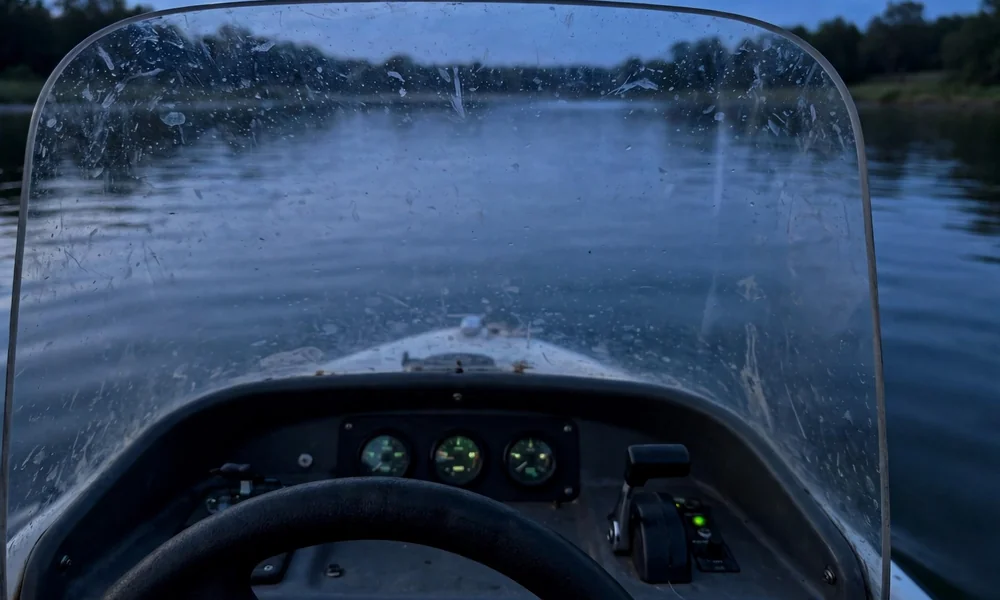
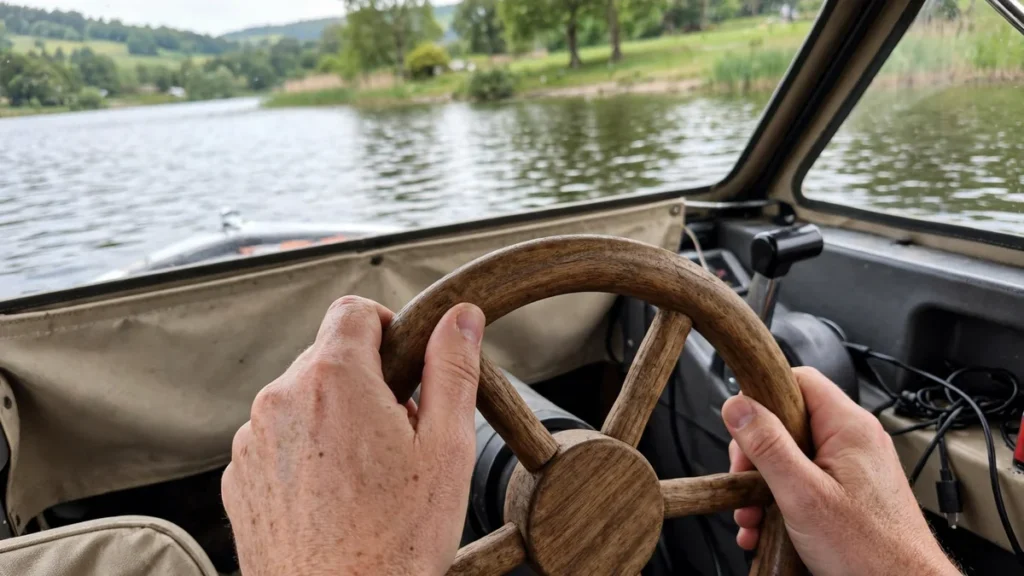
Step aboard a new electric boat and the helm often tells you everything about where the money went. Where there used to be a wheel, a throttle, and a few round gauges you could read at a glance, there is now a single sheet of glass, sometimes wider than the console itself, glowing with charts, battery levels, motor data, and camera feeds. It looks impressive in the showroom. On the water, in an open boat, it is the wrong answer. The case against giant screens on electric boats is that they take a helm designed for the open air and turn it into a living room television that cannot cope with sun, spray, or speed.
An electric boat is not a yacht, and its helm is not a bridge. A yacht has an enclosed wheelhouse, a roof, tinted windows, and room to shade a display. A day boat has an open cockpit, a low windscreen if it has one at all, and a helm station that faces the sky. The screen on a boat like that lives outside, in the weather, in the same way the skipper does. Everything that makes a giant screen fragile in sunlight and rain is worse there, because there is nothing between the glass and the elements except a skipper who is supposed to be watching the water.

An open helm is not a bridge
Sunlight is the first problem, and on an open boat it is unavoidable. A giant screen is a flat, glossy surface, and on a bright day it becomes a mirror. It reflects the sky, the clouds, and the skipper’s own face, and the chart underneath disappears into glare. Polarised sunglasses, which most boaters wear, can make parts of the display go dark or rainbow-coloured. A smaller display can be hooded, tilted, and set low, where the console shades it. A giant one cannot be shaded, because it is too big for the console that holds it, and so it spends the sunniest part of the day unreadable, which is exactly when the boat is most likely to be out.
Spray is the second problem. An open boat takes spray over the bow, and a screen mounted on an open console takes it too. Salt water dries on glass and leaves a film that scatters light and dulls the picture, and a skipper who wipes it with a sleeve risks scratching the coating that is supposed to stop the glare. A small instrument can be wiped in a second and read again. A giant screen needs a proper clean, and nobody wants to stop the boat to polish the dashboard. The screen that looked so crisp at the boat show spends its working life smeared, spotted, and hard to read.
The comparison with yachts is instructive. The case against giant screens on electric yachts rests on the same complaints, and a yacht at least has a roof. On a boat, the problems are the same but the shelter is gone. If a giant screen struggles on an enclosed bridge, it has no chance on an open console, where the sun is higher, the spray is closer, and the skipper is standing in the weather rather than sitting behind glass.
One screen is one point of failure
Giant screens also concentrate risk in a way a boat cannot afford. Put navigation, battery state, motor control, and depth on one display, and that display becomes a single point of failure. When it freezes, when its software crashes, when a voltage dip restarts it as the boat approaches a shallow patch, the skipper loses everything at once: the chart, the depth, the speed, and the battery level. A helm built from several smaller instruments degrades gracefully. One fails and the others keep working. The giant screen fails and the helm goes dark.
That risk matters more on a small boat than on a big one, because there is less redundancy to fall back on. A yacht may carry a second display, a paper chart, and a crew member who can take the wheel. A day boat often has one skipper, one screen, and no backup at all. When the screen dies, the skipper is navigating by memory and by eye, which is fine on a familiar lake and frightening on a tidal estuary with shifting sandbanks. How electric boat steering works in practice depends on the skipper knowing speed and position at all times, and a helm that can go blank without warning is a helm that cannot be trusted.
Cost makes the same point from a different direction. A bespoke giant marine display is expensive to buy and expensive to replace, and it is often tied to a single supplier. When that model is discontinued, the owner faces a refit rather than a repair, cutting a new hole in the console and rewiring the helm. On a boat whose whole appeal is simplicity and low running costs, a fragile, costly, single-source screen is the wrong kind of luxury.
Fingers, spray and speed
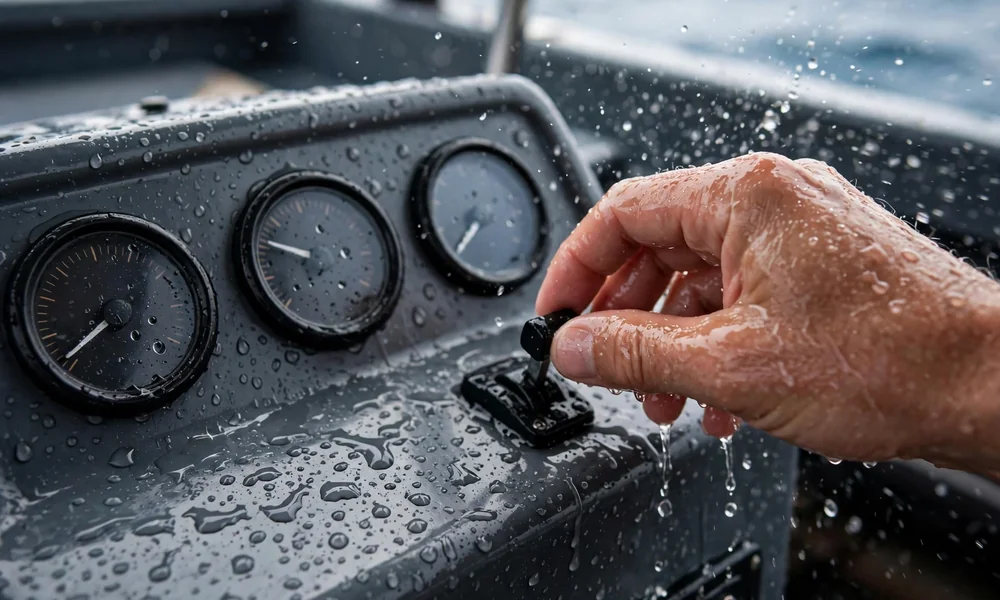
Then there is the interface itself. A touchscreen demands that you look at it, find the right icon, and tap it accurately, while the boat is moving, bouncing, and turning. A physical knob or button can be found by feel, worked with gloves on, and confirmed without looking down. That matters when the skipper’s eyes should be on the water, on the swimmers ahead, on the buoy marking the channel. Every second spent hunting through a touchscreen menu is a second not spent watching where the boat is going, and on a small boat at speed, a second is a long time.
Wet fingers make it worse. Touchscreens do not register reliably when they are wet, and on an open boat everything is wet: the skipper’s hands, the screen, the console. A wave that throws the boat sideways throws the skipper’s hand across the glass, and the screen cannot tell a deliberate tap from an accidental one. A stray touch can silence an alarm, change a route, or switch off a camera feed. Physical controls have guards and resistance that make accidental operation unlikely.
Cars have already learned this lesson, and the case against giant touchscreens in cars rests on the same complaint: burying essential controls in menus makes drivers slower and less safe. On a boat the stakes are higher and the help is further away. A car can pull over. A boat cannot, and there is no hard shoulder on a lake. If a control is hard to reach in a car, it is annoying. If it is hard to reach on a boat, in a squall, with spray on the glass, it is dangerous.
The verdict
Giant screens on electric boats are a showroom feature pretending to be a helm feature. They glare in the sun, smear in the spray, fail all at once, and demand attention when attention belongs on the water. Smaller displays, physical controls, and dedicated instruments do the same job better, more safely, and more cheaply, and they keep working on the days when the weather turns.
The helm of a small electric boat should be built for the worst day on the water, not the best day at a boat show. On that worst day, the skipper needs a chart they can read, a depth they can trust, and a control they can find without looking. A giant screen gives them none of those things reliably. Take the screen down a size, put the buttons back, and let the water, not the glass, be the biggest thing in front of the skipper.