An electric surfboard is a surfboard with a motor, a battery and a remote control. It looks like a surfboard, it is ridden standing up like a surfboard, but it does not need a wave. The rider holds a small waterproof remote, squeezes the trigger, and the board accelerates across flat water, carving turns and picking up speed until it is planing on top of the water like a surfboard riding a wave that never ends.
The idea is simple, and it answers the oldest frustration in surfing: the waiting. A surfer spends most of a session sitting on the board, watching the horizon, paddling for waves that pass underneath. An electric surfboard removes the waiting, with power on demand on any stretch of water, in any weather.

How it works
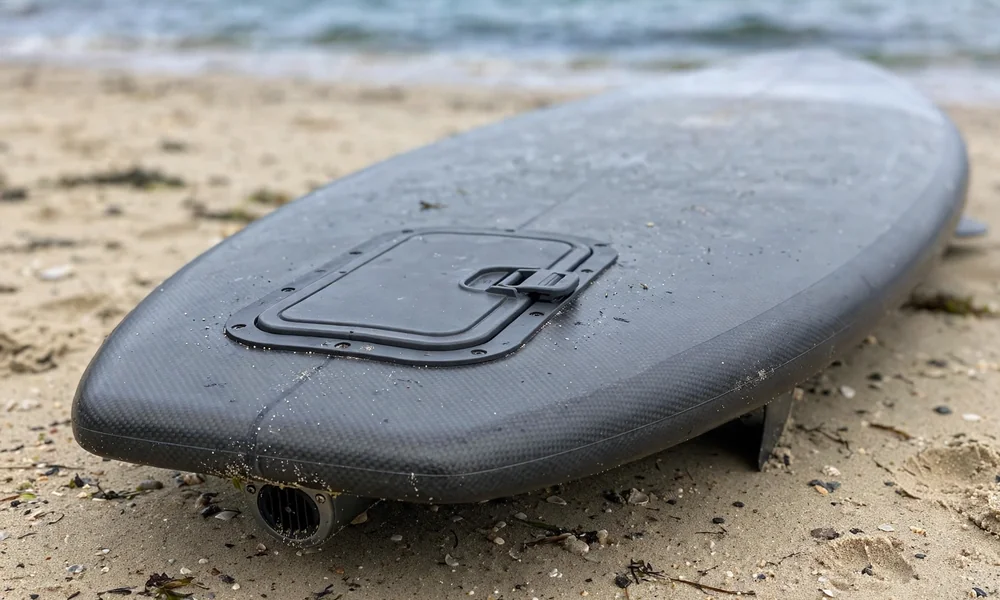
The system has four parts. The board itself is a buoyant hull, usually made of carbon fibre or fibreglass over a foam core, shaped to plane at speed. Inside the board sits the battery, a large lithium pack sealed in a waterproof compartment. Under the board, at the tail, is the motor and the jet or propeller that pushes the water. And in the rider’s hand is the remote, which talks to the board wirelessly and controls the speed.
The motor is the heart of it. Most electric surfboards use a brushless electric motor, sealed against water and cooled by the water flowing past it. The motor drives a jet pump or a propeller. A jet pump takes water in through an intake underneath and fires it out the back, which is safer for swimmers and less likely to snag weed. A propeller is simpler and more efficient, but it sits exposed. The remote signals the board’s controller, which feeds power from the battery to the motor.
Battery, range and speed
The battery decides what the board can do. A typical electric surfboard carries a battery of one to two kilowatt-hours, which sounds small beside an electric car but is a great deal of energy for a board that weighs a few dozen kilos. Ride time is usually thirty to sixty minutes of active riding, depending on the rider’s weight, the speed, and how hard the trigger is squeezed. A heavy rider at full throttle drains the pack fast. A light rider cruising gently can stretch it considerably longer.
Speed is the headline number, and it varies widely. Entry-level boards top out at around twenty miles an hour. Performance boards reach thirty miles an hour or more. How electric boat battery swap works covers the same battery problem on a bigger scale, and the trade-offs are identical: more battery means more range, but also more weight, and on a board every kilo matters.
Learning to ride one
Riding an electric surfboard is easier than surfing and harder than standing on a paddleboard. The board is stable at speed, because the water flowing under it holds it level, but it is tippy at low speed, when it sits deep in the water and rolls with every ripple. Beginners are usually told to start on their knees, get the board moving, and stand up once it is planing. Standing still on a stationary electric surfboard is the hardest part of the whole sport.
Balance is the main skill. The rider stands sideways, like a surfer, with one foot forward and the weight over the middle of the board. Turns come from shifting weight and leaning, and the remote hand stays relaxed on the trigger. Falling off is part of learning, and mostly harmless: the board stops when the rider falls, because the remote has a safety leash that cuts the power the moment it leaves the rider’s hand.
Electric surfboard or electric hydrofoil board?
The closest relative of the electric surfboard is the electric hydrofoil board, and the two are often confused. What an electric hydrofoil board is explains the hydrofoil version, where a wing under the board lifts the whole thing out of the water once it reaches speed, so the rider flies above the surface on a mast. An electric surfboard has no foil. Its hull stays in contact with the water the whole time, planing across the surface like a conventional surfboard.
The difference in feel is large. A hydrofoil board is silent and smooth once it lifts, but it is harder to learn, harder to fall from safely, and far more expensive. An electric surfboard is louder and rougher in chop, because the hull is hitting the water, but it is cheaper, easier to ride, and easier to carry to the beach. Riders who want the sensation of surfing choose the surfboard. Riders who want the sensation of flying choose the foil.
Where you can ride, and what it costs
Electric surfboards work on almost any flat water: lakes, calm bays, wide rivers, and the sea on a flat day. They need a stretch of open water without swimmers, boats or obstacles, and local rules matter: some lakes and beaches ban motorised boards, and some require the rider to stay a set distance from shore or from swimmers. Checking the local rules before launching is part of owning one, and the rules are changing fast as the boards get more popular.
Cost is the main barrier. An electric surfboard costs several thousand pounds or dollars, with performance models running far higher. The battery is the most expensive part, and it wears out, losing capacity over hundreds of charge cycles. Maintenance is mostly simple: rinse the board with fresh water after use in the sea, keep the battery hatch seals clean, and store the battery partly charged in a cool place.
Who it is for
Electric surfboards are for people who love the feeling of surfing but live far from good waves, or who want to ride when the surf is flat. They are popular on lakes and in cities, where the water is calm and the waves never come. They are also popular with surfers as a training tool, because the board lets them practise balance, turning and stance on demand, without waiting for a swell.
They are not for everyone. A purist surfer will tell you that a motor misses the point, that surfing is about reading the ocean and earning the wave. What an electric jet ski is is the closest comparison on the water: a powered craft for riders who want speed and freedom on flat water, without waiting for nature to cooperate.

The board, the battery and the remote
Look at the whole machine and it is remarkably simple. A hull shaped to plane. A battery sealed inside it. A motor and a jet at the tail. A remote in the rider’s hand, with a trigger, a safety leash, and a display showing battery and speed. There is no engine to start, no fuel to mix, no exhaust, and no noise beyond the rush of water and the hum of the motor.
That simplicity is the reason the boards have spread so fast. They are easy to charge from a normal socket, easy to carry to the water, and easy to ride badly and still have fun. An electric surfboard is a surfboard that makes its own wave, and for anyone who has ever sat on a board waiting for the sea to cooperate, that is a hard offer to refuse.


