An electric hydrofoil board, usually called an eFoil, is a surfboard with a motor and a wing underneath that lifts the whole board out of the water. The rider stands on the deck, squeezes a handheld remote, and the board accelerates until the wing below generates enough lift to raise the hull clear of the surface. From then on the board flies a foot or two above the water, silent except for the hum of the motor, with only the wing and a thin mast cutting through the waves.
It looks like magic the first time you see it, but the physics is the same as an aeroplane wing turned upside down. Water flows over the curved wing, the pressure above it drops, and lift pulls the board upward. Because water is roughly eight hundred times denser than air, the wing can be small and the speeds modest: most eFoils lift off at around 10 to 15 kilometres per hour and cruise comfortably at 25 to 30. The result is a ride that feels less like surfing and more like flying low over the sea.
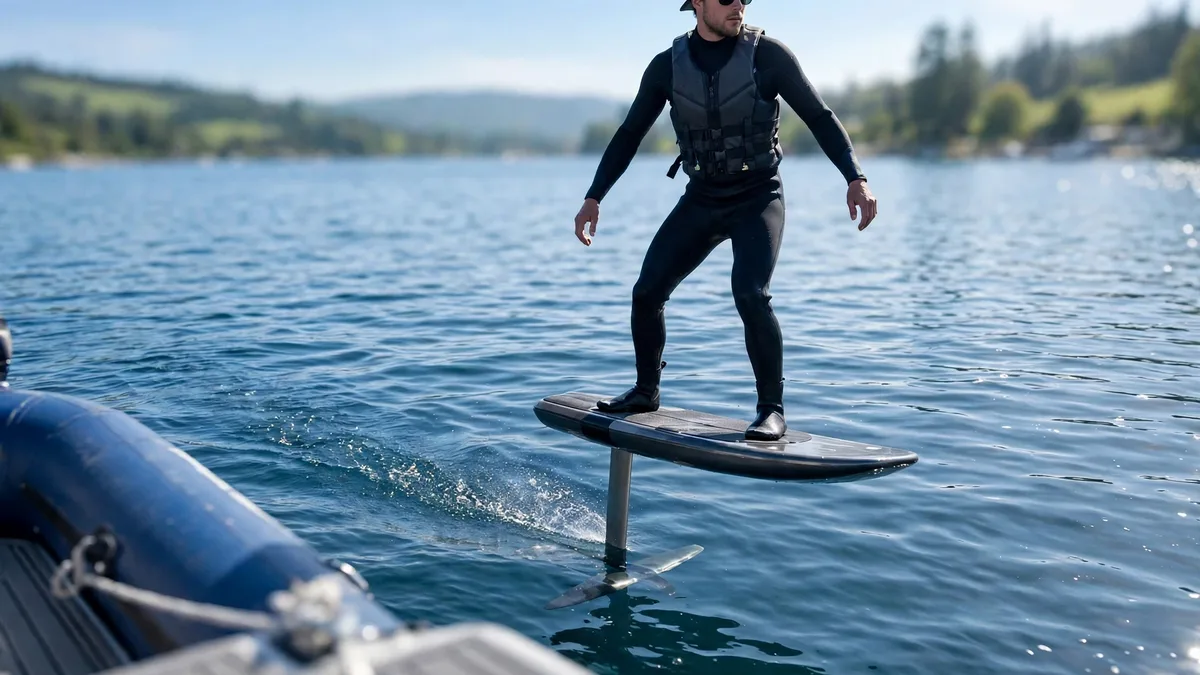
The parts of an eFoil
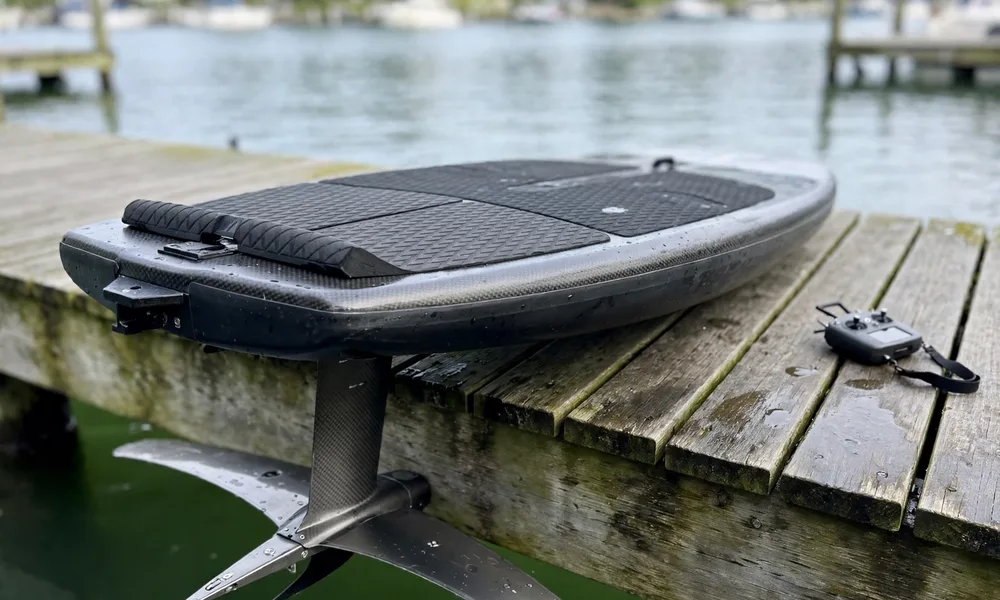
An eFoil has four main parts. The board itself is a thick, buoyant deck, usually around 1.5 metres long, with a battery and control electronics sealed inside. Underneath it sits the mast, a vertical fin about 60 to 85 centimetres long that connects the board to the wing. At the bottom of the mast is the foil: a front wing that makes the lift, a smaller rear wing that keeps the board stable, and a fuselage that joins them. The motor is either built into the mast or mounted on the fuselage behind the front wing, driving a small propeller.
The battery is the heavy part of the package. Most eFoils use a lithium-ion pack of around 2 kilowatt-hours, which gives roughly 60 to 90 minutes of riding depending on the rider’s weight, the speed and how often the board touches down. The battery slots into the board, seals against water with gaskets, and charges from a normal mains socket in a couple of hours. A handheld remote, connected by Bluetooth, controls the throttle in small steps, so the rider can add power gradually instead of being thrown forward by a sudden surge.
How the lift actually works
At low speed the board behaves like any surfboard: it floats on its hull and pushes water aside. As the motor adds speed, water flows faster over the top of the foil wing than underneath it, and the pressure difference creates lift. Once the lift exceeds the weight of rider and board, the hull rises out of the water. Drag falls sharply at that moment, because the only parts still in the water are the mast and the wing, and the board accelerates easily on very little power.
Balance comes from the rider’s feet and from the rear wing. Shifting weight forward pushes the nose down and reduces lift; shifting back raises it. The rear wing acts like the tail of an aeroplane, damping pitch so the board does not porpoise up and down. Beginners learn this the hard way: too much throttle and the board climbs steeply, breaches the surface, and the wing loses grip in the air, dropping the rider back into the water. Small, smooth throttle changes are the whole skill.
Electric power versus wind and waves
The electric version also opens the sport to people who never learned to surf. There is no wave to catch and no kite to control, so the learning curve is mostly balance and throttle control. Most riders get up on the foil within a few sessions, and rental operators use that simplicity to offer lessons on flat water. Electric hydrofoil surfboard specs explained covers the board dimensions, battery sizes and motor ratings in detail, and shows how the different models trade speed against ride time.
The motor, the propeller and the cooling
The motor on an eFoil is a compact electric unit, usually a brushless direct-current design, sealed against salt water and mounted where the water itself cools it. That is a neat piece of engineering: the motor sits in the flow it creates, so it never needs a radiator or a fan. The propeller is small, often with a folding or guarded design, because it spins close to the rider’s feet and to swimmers. A duct or guard ring around the propeller is common on rental boards, where safety matters more than the last bit of efficiency.
Control electronics sit in the board, in a sealed compartment with the battery. They manage the current to the motor, watch the battery temperature, and cut power if the remote signal drops or the board flips. That cut-out is important: a runaway board with a spinning propeller is a hazard, so the system is designed to stop the moment the rider lets go. How an electric hydrofoil ferry works uses the same lift principle at a much larger scale, with the same trade of speed for drag, and it shows why foils make sense wherever efficiency matters more than raw power.
What it feels like to ride
Riders describe the sensation as closer to snowboarding on powder than to surfing. Once the board lifts, the chop disappears, because the hull is no longer touching it. The only feedback is a gentle hum and the wind, and turns happen by leaning, with the board carving smoothly through the water. Speed feels faster than it is, because the rider is standing with nothing between their feet and the sea except a thin mast.
Where eFoils are used, and the rules around them
eFoils are used on lakes, bays, harbours and calm coastal water, and increasingly as yacht toys: a board stows neatly on a superyacht, charges from the yacht’s power, and gives guests a way to explore an anchorage without noise or fuel. Some resorts and surf schools run fleets of them, and a few coastal towns have rental stations on the beach. They are quiet, they leave no wake at foil height, and they need no fuel, which makes them welcome in places where jet skis are not.
Rules vary by location. In many places an eFoil is treated as a powered personal watercraft, which can mean registration, a minimum age and a speed limit near shore. In others it falls into a grey area between a surfboard and a boat. Riders should check the local rules before launching, and stay clear of swimmers, moored boats and shallow water where the mast can strike the bottom. How a jet ski works covers the closest powered relative, and the safety rules overlap more than most riders expect.

Costs, upkeep and who it suits
An electric hydrofoil board suits anyone who wants the feeling of flying over water without waiting for waves or wind. It is a small machine with a simple idea at its heart: put the wing under the water, let the motor do the work, and let the board rise above the drag. Once it lifts, the water stops mattering, and the ride begins.


