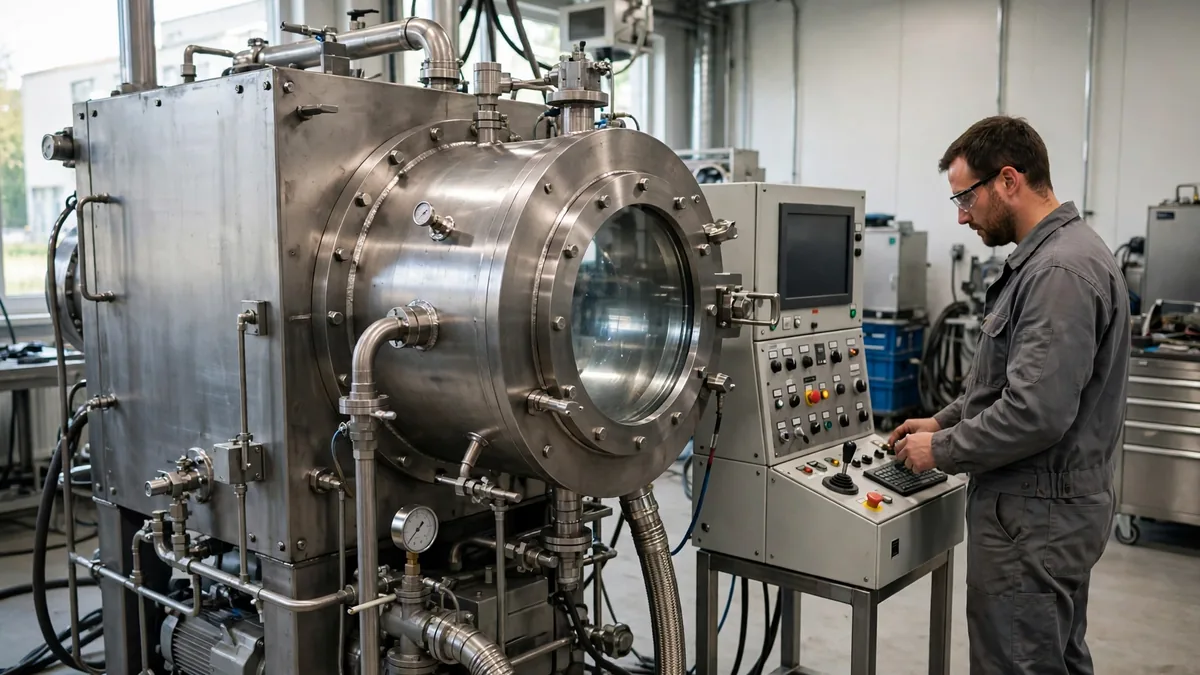
The workshop is quieter than you expect. There is no crackle of an arc, no shower of sparks, no welder in a mask leaning over the joint. Instead there is a steel box the size of a small room, a humming pump, and an operator watching a screen. Inside the box, in a vacuum where no air can interfere, a beam of electrons thinner than a pencil melts two pieces of metal together with a precision no human hand could match. When the door opens, the joint is narrow, clean, and stronger than the metal around it. That box is an electron beam welder, one of the most expensive ways ever devised to join two pieces of metal.
Electron beam welding sounds like science fiction, but it has been joining aircraft parts, rocket components, and medical devices for decades. It works by firing electrons at nearly the speed of light into a joint, where their energy turns to heat in a spot so small and hot that the metal melts and fuses in a single deep pass. The results are superb, and the price of getting them is high at every step, from the machine itself to the room it sits in.
Why It Costs So Much
Reason 1: The machine is a particle accelerator in a workshop
At its heart is an electron gun, which boils electrons off a heated filament, accelerates them with tens of thousands of volts, and focuses them with magnetic lenses into a beam a fraction of a millimetre wide. The gun, the high-voltage power supply, and the focusing system are precision instruments, closer to laboratory equipment than workshop tools, and they must be built, aligned, and maintained by specialists. A complete machine can cost as much as a house, before the vacuum chamber is added. The process is described in how electron beam welding is made, which shows how much hardware sits behind a single weld.
Reason 2: The weld happens in a vacuum
Electrons scatter when they hit air, so the weld must take place inside a vacuum chamber, and the chamber must be big enough to hold the whole workpiece. Pumping a room-sized chamber down to vacuum takes powerful pumps, thick steel walls, heavy doors with precision seals, and time: every load must wait while the air is drawn out, and the chamber must be opened, loaded, and pumped down again. The vacuum system is a second machine in its own right, with its own maintenance, its own spare parts, and its own running costs.
Reason 3: The joint must be perfect before welding starts
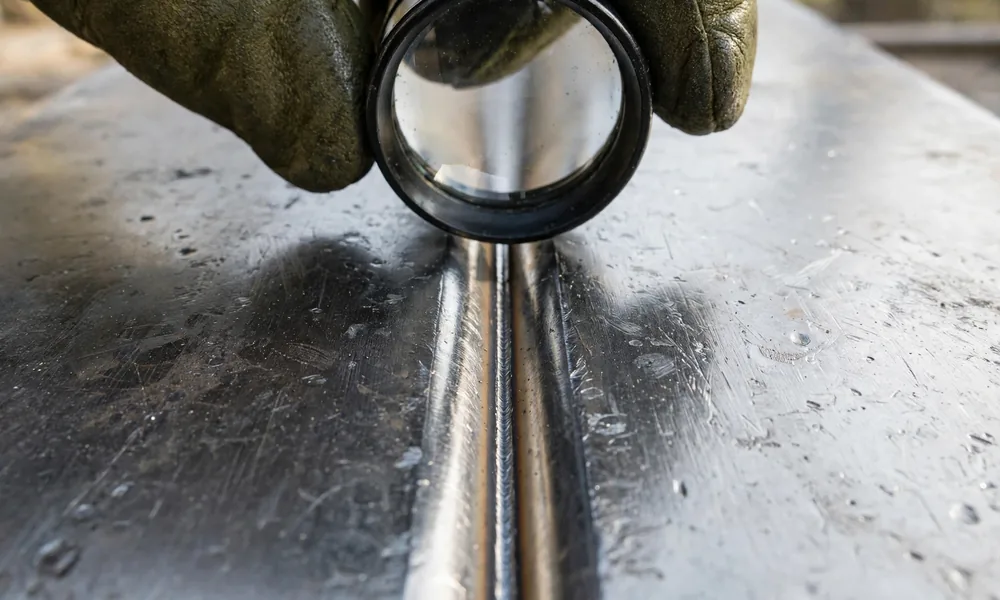
An electron beam weld is so narrow and so deep that there is no room for error in how the parts fit together. The joint faces must be machined flat, cleaned to remove any trace of oil or oxide, and clamped into a fixture that holds them in exactly the right place, because the beam cannot bridge a gap the way a conventional weld can. That preparation is skilled, time-consuming work, and a joint that is not prepared properly can produce a weld that looks fine outside and fails inside. The numbers that define a good weld, from beam power to travel speed, are set out in the electron beam welding specifications.
Reason 4: The operator is a specialist, not a general welder
Running an electron beam welder takes training that goes well beyond ordinary welding. The operator must understand vacuum systems, high-voltage safety, beam focusing, and the metallurgy of the joint, and must read the weld from instruments rather than watching it, since it takes place inside a sealed chamber. Such operators are rare, their training is long, and their time is expensive, which means the labour cost of each weld is far higher than for a conventional process.
Reason 5: Inspection is part of the weld, not an afterthought
Because electron beam welds are used in aircraft engines, spacecraft, and medical implants, where a failure could be catastrophic, every weld must be proved sound. That means X-ray or ultrasonic inspection, and often destructive testing of sample welds made alongside the real part, all by certified inspectors. Inspection can cost as much as the welding itself, and a part that fails may have to be cut apart and started again. The costs of that discipline are explored in why steel welding costs so much, where testing and certification take a similar share of the bill.
Reason 6: The volume is tiny and the parts are precious
Electron beam welding is not used for fences and gates. It is used for turbine discs, gearbox housings, satellite parts, and surgical tools, where one component can be worth thousands of dollars before welding, and only a handful are made each year. The machine, the chamber, and the specialist team must be paid for out of a small number of high-value jobs, so each weld carries a large share of the fixed cost. There is no mass market to spread the expense across.

Electron Beam Welding at a Glance
| Specification | Detail |
|---|---|
| Heat source | Focused beam of high-energy electrons |
| Working environment | Vacuum chamber |
| Typical beam power | Up to 100 kilowatts and beyond |
| Weld depth | Up to 100 millimetres or more in a single pass |
| Weld width | Often less than 2 millimetres |
| Main advantage | Deep, narrow, low-distortion welds |
| Main drawback | Expensive machine, slow loading, needs vacuum |
| Main uses | Aerospace, nuclear, medical, high-value engineering |
| Key requirement | Perfect joint fit and cleanliness |
What Does It Cost?
All figures below are estimates, not quotes, and the real numbers vary with the size of the machine, the part and the country.
| Cost item | Typical estimate |
|---|---|
| Electron beam welding machine | $500,000 to $2,000,000 (estimate) |
| Vacuum chamber and pumps | $150,000 to $600,000 (estimate) |
| Joint machining and fixturing | $500 to $5,000 per job (estimate) |
| Specialist operator time | $150 to $400 per hour (estimate) |
| X-ray and ultrasonic inspection | $500 to $3,000 per part (estimate) |
| Typical single weld job | $2,000 to $15,000 (estimate) |
Those estimates explain why electron beam welding is reserved for parts where the weld must be perfect. A conventional weld might cost a tenth as much, but it cannot match the depth, the narrowness, or the low distortion, and on a turbine disc or a spacecraft part, that difference decides whether the part flies or fails.
A Rare Fact
Electron beam welding can join metals that refuse to be welded any other way, including some combinations of dissimilar metals that would crack under a conventional arc. It has even been used in space: in the 1960s and 1970s, Soviet cosmonauts tested electron beam welding outside a spacecraft, proving a weld could be made in the vacuum of orbit, where the environment does the pumping for free. The experiment worked, and it remains one of the few welding processes ever tried beyond Earth.
Electron beam welding is expensive because the machine is a precision instrument, the weld needs a vacuum, the joint must be perfect before the beam is switched on, the operator is a specialist, every weld must be inspected, and the parts are too precious and too few to spread the cost. Pay for all of that, and two pieces of metal become one with a seam barely wider than a hair.


