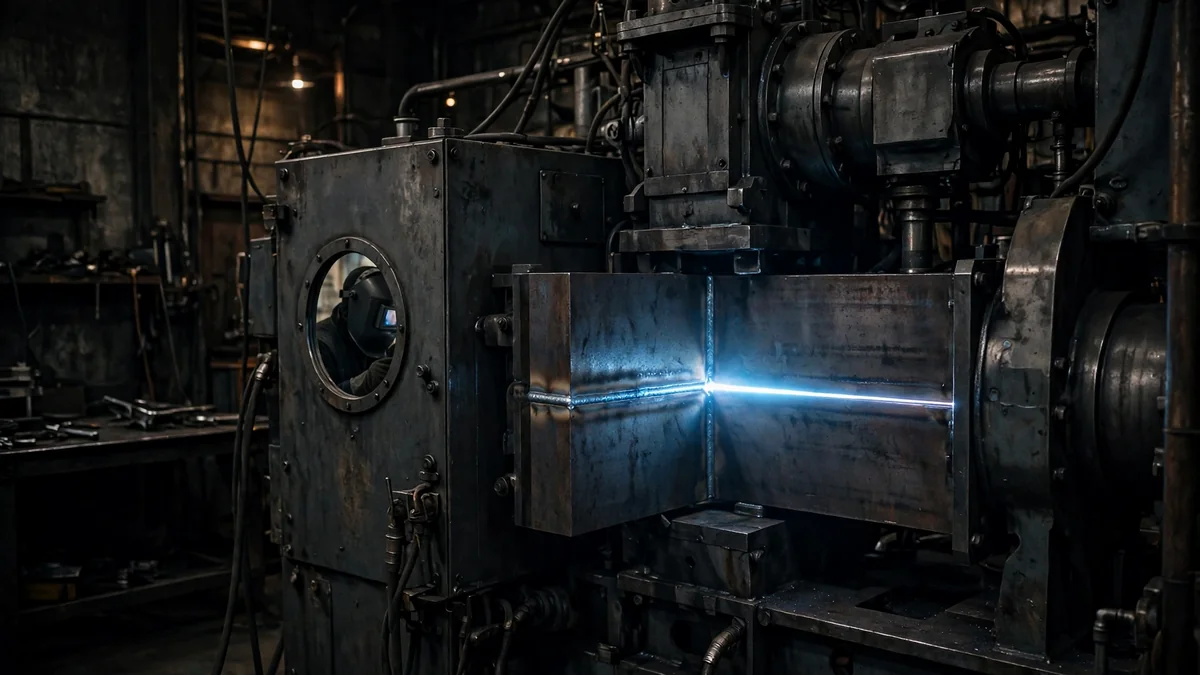
There is a kind of welding where you never see the flame. No shower of sparks, no blinding arc, no welder in a leather apron leaning over the joint with a torch. Instead, the two pieces of metal sit inside a steel chamber the size of a small room, the air is pumped out until the room is emptier than the edge of space, and then a beam of electrons thinner than a pencil lead strikes the seam. In less than a second, the metal melts, flows, and freezes into a joint so clean it looks as though the two pieces grew together.
That is electron beam welding, and it is the quiet giant of high-end manufacturing. Jet engine shafts, rocket fuel tanks, submarine pressure hulls, and the gearboxes of the fastest cars on the planet are joined this way. It is the process engineers reach for when a joint must be perfect — deep, narrow, and almost free of distortion — and when the metal is too exotic, too thick, or too reactive for an ordinary arc.
The numbers behind the process are just as dramatic as the machine itself: a beam of electrons accelerated to a large fraction of the speed of light can melt steel several centimetres deep in a single pass, leaving a weld as narrow as a millimetre. This guide explains those numbers in plain English — what each specification means, and how electron beam welding compares with ordinary welding.
How It Works
Step 1: Loading the parts into the vacuum chamber
Everything starts in a vacuum. The parts are clamped into a fixture inside a sealed steel chamber, and pumps pull the air out until the pressure falls to roughly one hundred-thousandth of normal air pressure. The vacuum matters for two reasons: electrons scatter when they hit air molecules, so the beam would lose focus in open air, and hot reactive metals such as titanium would instantly grab oxygen and nitrogen from the atmosphere and turn brittle. Inside the chamber, the metal stays clean.
Step 2: Generating the electron beam
At the top of the machine sits an electron gun, and its heart is a filament of tungsten heated white-hot until it gives off electrons. Those electrons are pulled away by a high voltage — typically between 60 and 150 kilovolts — and accelerated down a column to a large fraction of the speed of light. Magnetic lenses, which work like the glass lenses of a camera but use magnetic fields instead, squeeze the stream of electrons into a beam only a fraction of a millimetre wide.
Step 3: Aiming the beam at the joint
The operator aims the beam using a low-power setting that paints a faint glowing line along the seam, checking the alignment on a viewing screen. Magnetic fields steer the beam with no moving parts, and modern machines drive it from a computer program that follows the joint’s shape. This is a world away from the hand-held torch of ordinary steel welding, where the welder’s hand decides where the heat goes; here, the beam is placed with the precision of a machine tool, in the same spirit as precision CNC machining.
Step 4: Melting a deep, narrow keyhole
When the beam hits full power, it does something remarkable. The energy is so concentrated that the metal does not just melt — it vaporises a narrow channel, called a keyhole, straight down into the joint. Molten metal flows around the keyhole and solidifies behind it as the beam moves along the seam. Because the heat is delivered in such a tight column, the weld can penetrate 50 millimetres or more in a single pass, while the metal a few millimetres to either side barely warms up.
Step 5: Fusing the joint as the beam travels
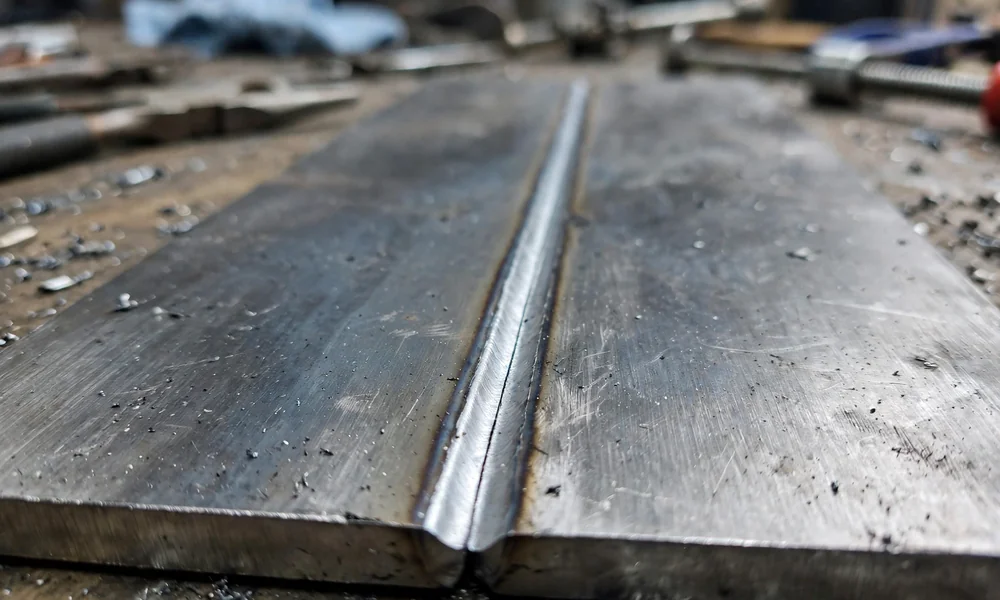
The beam travels along the seam at speeds of several metres per minute, and the molten pool behind it freezes almost instantly. No filler wire is needed in most electron beam welds — the two parent metals simply melt together — which means the joint has the same composition as the parts themselves. The weld face is smooth and slightly rippled, and the root of the weld, deep inside the joint, is as sound as the surface.
Step 6: Cooling in vacuum and inspection
The parts cool slowly inside the sealed chamber, still protected from the air, and then the chamber is brought back to normal pressure. Inspection follows, and electron beam welds are among the easiest to inspect: the narrow, uniform bead shows up clearly on X-ray, and ultrasonic testing can probe the full depth of the joint. This level of certainty is why the process is trusted for parts where failure is not an option, from aircraft engines to the pressure vessels built by metal 3D printing specialists for the most demanding jobs.
Electron Beam Welding Specs
| Specification | Typical range |
|---|---|
| Accelerating voltage | About 60 to 150 kilovolts (low-voltage guns 30 to 60 kV) |
| Beam power | About 1 to 100 kilowatts, depending on machine size |
| Beam diameter at focus | About 0.1 to 1 millimetre |
| Penetration depth, single pass | Up to about 50 to 100 millimetres in steel |
| Depth-to-width ratio | About 10:1 to 25:1, far higher than arc welding |
| Welding speed | About 1 to 10 metres per minute |
| Vacuum level in chamber | About 10^-3 to 10^-5 millibar |
| Heat-affected zone width | About 1 to 3 millimetres either side of the weld |
What Does Electron Beam Welding Cost?
Electron beam welding is not a cheap process, and the machine is the reason why. A small electron beam welder is estimated to cost roughly $250,000 to $500,000, while a large chamber machine for aerospace work is estimated at roughly $1 million to $5 million or more. For that reason, most companies buy electron beam welding as a service from a specialist shop rather than owning a machine. All prices are estimates only and vary widely by machine size, material, and volume.
A Rare Fact
Electron beam welding was born in the nuclear age, not the welding shop. In the 1950s, engineers in France and Germany were trying to weld the fuel elements of nuclear reactors, which were made from metals that refused to be welded in air. They discovered that an electron beam in a vacuum could fuse them cleanly, and the first commercial machines appeared in the late 1950s. Within a decade, the same machines were welding jet engine parts and rocket cases.

The beam is invisible, the chamber is silent, and the weld it leaves is barely wider than a pencil line — yet that narrow seam can hold together the most stressed parts of a jet engine. Learn to read the specifications — voltage, power, penetration, and vacuum — and the machine stops being a mystery and starts being a tool: the most precise way ever invented to melt two pieces of metal into one.


