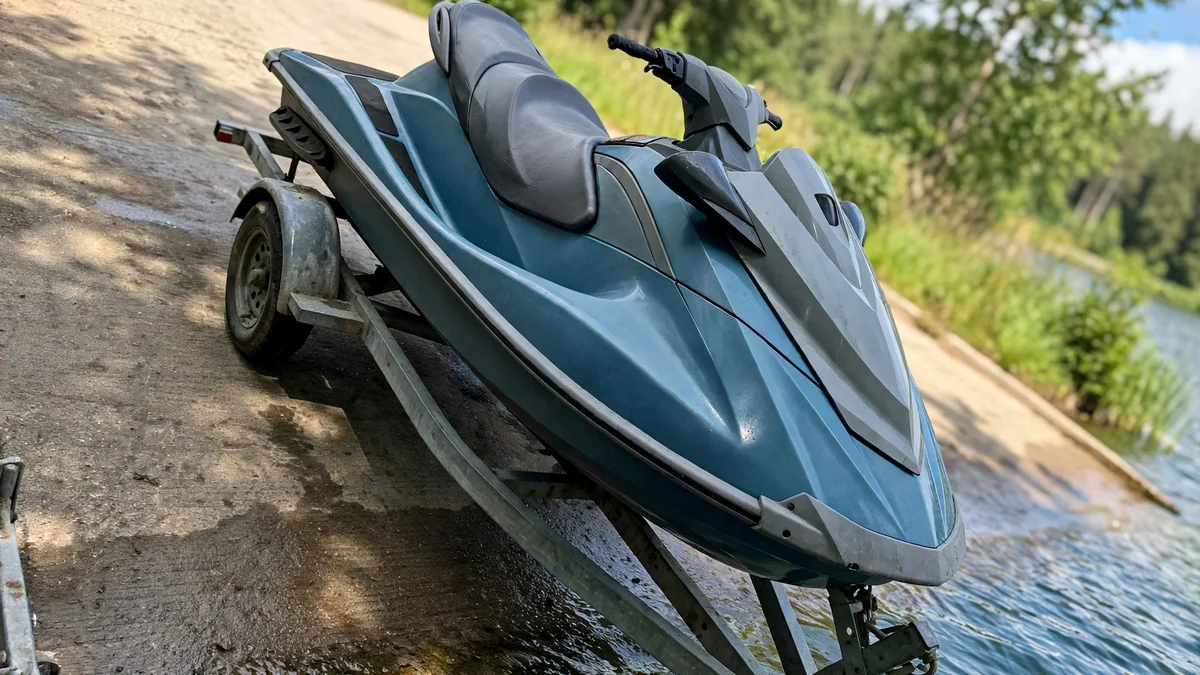
The jet ski waits on its trailer at the boat ramp, small and bright against the grey concrete, looking almost like a toy. A teenager tugs at its handlebars while his father checks the price tag one more time and does the quick, hopeful maths that every buyer does. It is barely longer than a sofa, it has no cabin, no roof, and no seats for more than three people. How, he wonders, can something this small cost as much as a good used car?
The answer is that a jet ski is not a toy with an engine bolted on. It is a small, high-performance boat that must survive salt water, full-throttle acceleration, and jumps off waves, all while carrying a powerful engine in a hull the size of a bathtub. Everything about it is engineered to a standard that a car never faces, and everything about it is built in far smaller numbers, which means every unit carries a larger share of the development cost.
What follows is an honest account of where the money goes. The cost is spread across the engine, the hull, the pump that drives it, the electronics, and the testing that proves it will not sink, catch fire, or throw its rider into the water at speed. None of it is decoration, and very little of it can be removed without making the machine less safe.
Why It Costs What It Costs
The engine is small, powerful, and marinised. A modern jet ski engine produces up to 300 horsepower from a unit smaller than a suitcase, and it must do so while being regularly soaked in salt water. Every part is sealed, coated, or built from corrosion-resistant materials, and the cooling system uses the water it floats in, which means salt, sand, and weed are constant threats. Building an engine that survives that abuse for years is far more expensive than building a similar engine for a motorcycle.
The jet pump is a precision machine. Instead of a propeller, a jet ski uses an impeller inside a tunnel to push water out of the back at high speed. The impeller must be machined to tight tolerances, balanced perfectly, and built from stainless steel that resists cavitation, the tiny collapsing bubbles that can eat through metal. A worn or damaged impeller robs the ski of speed and handling, so makers invest heavily in getting the design right and in making it easy to service.
The hull must be light, strong, and watertight. A jet ski hull is made from fibreglass or a composite material, shaped to cut through waves and to stay stable when the rider stands up or leans into a turn. It must survive being beached on sand, bumped against a dock, and dropped from a wave, all without cracking or taking on water. The moulds for such a hull cost a fortune to make, and the hull is laid up by hand in many factories, which keeps quality high and production numbers low.
Electronics do the work of a whole dashboard. A modern jet ski carries a digital display, a GPS speedometer, ride modes for beginners and experts, a braking system that stops the ski far faster than simply letting off the throttle, and a security system that prevents the engine starting without the right key. The braking system alone, which reverses the jet thrust to slow the ski, is a piece of engineering that took years to perfect. All of it must work while wet, which means sealed connectors and waterproof housings throughout.
Safety testing is relentless. Jet skis are tested in rough water, in salt spray, and in capsize tests that deliberately flip the machine to prove it can be righted and restarted. The fuel system must not leak when the ski is upside down, the engine must shut off when the rider falls, and the hull must float even when flooded. Each test adds cost, and each regulation that follows from a past accident adds another layer of design work.
Small production numbers spread the cost thinly. The world’s jet ski makers build tens of thousands of units a year, not millions like car makers. That means the cost of designing the engine, the hull, and the electronics is divided among far fewer buyers, and each buyer pays a larger share. Tooling, testing, and certification are fixed costs, and on a production run of twenty thousand, they weigh heavily on every single machine.
Dealers, trailers, and accessories add to the bill. The sticker price is rarely the final price. A trailer costs an estimated $1,000 or more, a cover, life jackets, and safety gear add hundreds, and dealer preparation and registration fees add further hundreds still. Many buyers also pay for an extended warranty, because a single engine repair out of warranty can cost an estimated $2,000 or more. The jet ski itself is only the beginning of the spending.

The Numbers at a Glance
| Specification | Typical jet ski |
|---|---|
| Engine | 1.6-litre supercharged three-cylinder |
| Power | 170 to 300 horsepower |
| Top speed | 65 to 70 mph, often limited |
| Length | 3.3 to 3.7 metres |
| Weight | 350 to 450 kilograms |
| Fuel capacity | 60 to 70 litres |
| Seating | One to three riders |
| Price | Estimated $10,000 to $20,000 |
What a Jet Ski Costs
A new jet ski typically costs an estimated $10,000 for the more basic recreational models and rises past an estimated $20,000 for the high-performance versions with supercharged engines and full electronics. The most powerful luxury models can reach an estimated $25,000 before a trailer or accessories are added. That price surprises people who compare it with a motorcycle, but a motorcycle never has to float, never runs in salt water, and never carries its rider across open water at seventy miles an hour.
Running costs are modest by boating standards but real all the same. Fuel consumption is high at full throttle, with a hard day on the water easily burning through a full tank, and servicing once a year typically costs an estimated $300 to $500. Storage, insurance, and winterising add further hundreds each year, and salt-water use demands a fresh-water flush after every outing, or corrosion will shorten the engine’s life sharply. Buyers who maintain their ski carefully can expect many seasons of use, which softens the sting of the purchase price.
To understand how the machine actually moves, read our guide to how a jet ski works, which explains the jet pump in plain language. The reasons an electric boat costs so much show the same small-numbers problem on a larger hull, while the electric boat spec sheet explained simply covers the numbers that matter on the water.

A Rare Fact Worth Remembering
The jet ski began as a personal watercraft that its inventor expected people to ride standing up, like a motorised surfboard. The first models had no seat at all, and riders stood on a small platform while holding the handlebars, which made them thrilling and exhausting in equal measure. It was only when makers added a seat that the machine found a mass audience, because suddenly a family could ride together. The stand-up models still exist for racers and enthusiasts, but the sit-down jet ski is the one that conquered the world’s lakes and coastlines.


