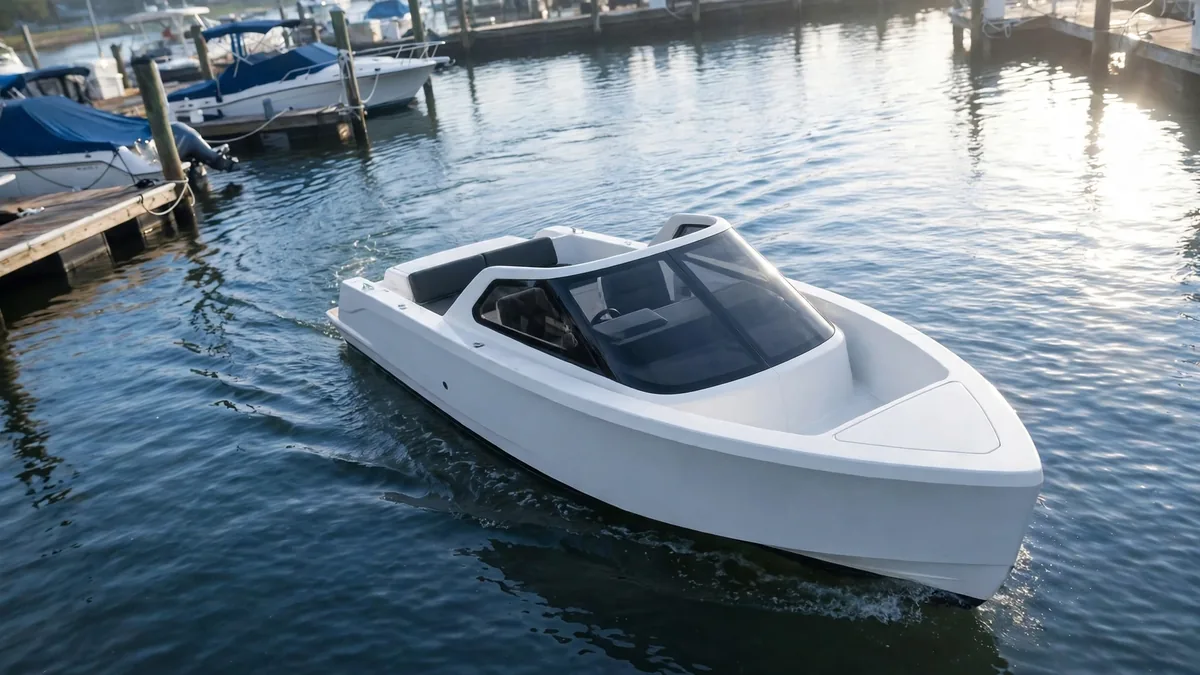
The marina office had a whiteboard with the week’s fuel prices on it, and the owner of the new electric day boat was staring at it with the expression of a man who had just discovered that his boat cost more than his house. He had bought it to save money on fuel. A comparable petrol boat would have cost half as much, and the fuel saving would take decades to close the gap. He asked the question every electric boat buyer asks, sooner or later, and it is the right question: why does an electric boat cost so much?
The answer is not a single expensive part, but a stack of them, each one made harder by the fact that a boat lives in water, and water is the enemy of everything electric. A car keeps its battery dry by staying on a road, and a motorcycle keeps its motor dry by staying out of the rain as much as it can. A boat is surrounded by water, it is splashed by water, and its most important parts sit below the waterline, in the one place where a leak is not an inconvenience but an emergency. Building one means making it waterproof, corrosion-proof, and safe, at a scale of only hundreds a year.
The Battery Is the Boat
The battery is the largest single cost in an electric boat, and it is larger, in every sense, than the battery in an electric car. A day boat needs a pack of 60 to 100 kilowatt-hours, and a larger cruiser needs 200 kilowatt-hours or more, and those packs cost an estimated $400 to $600 per kilowatt-hour at marine scale, compared with an estimated $120 to $150 for a mass-produced car pack. The difference is volume, because a car maker buys cells by the million and a boat maker buys them by the hundred, and specification, because a marine battery must be sealed against water and resistant to salt corrosion.
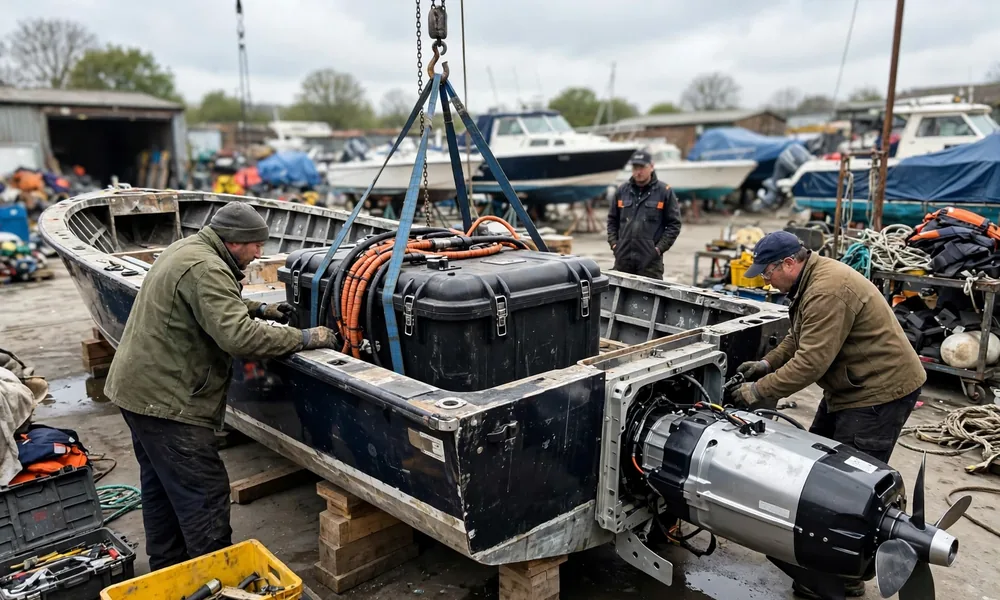
The housing around the battery is a cost that car buyers never see, because a marine battery pack sits in a sealed, waterproof, fire-resistant enclosure, with its own cooling system and its own monitoring, and it must be installed in a way that lets a crew reach it in an emergency without flooding the boat. The enclosure alone can cost an estimated $5,000 to $10,000, and the cooling system, which keeps the cells at a safe temperature while the boat is running hard in warm water, adds more. A battery that overheats on a road pulls over, but a battery that overheats at sea has nowhere to go, so marine makers over-engineer the thermal management and test it to a standard that car makers do not face.
Range is the figure that makes the battery so big, because water is far harder to move through than air. A boat pushing through water at 20 knots uses many times more energy than a car cruising at 60 miles per hour, and the energy required rises with the cube of the speed, so doubling the speed needs eight times the power. The battery must be sized for the worst case, not the best, and the worst case is a big battery. The engineering behind that trade-off is laid out in the electric boat specs explained guide, which shows how speed, range, and battery size connect.
Motors, Propulsion, and the Cost of Water
The electric motor itself is not the most expensive part of the boat, but the propulsion system around it is. A marine electric motor must be sealed against salt water, cooled efficiently, and connected to a propeller through a shaft, a pod, or a jet. A pod drive, where the motor sits underwater in a torpedo-shaped housing, is efficient and manoeuvrable, but it costs an estimated $10,000 to $20,000 on its own, and it must be removed from the water for servicing.
Small Fleets, Big Fixed Costs
The boat industry builds in small numbers, and electric boats build in smaller numbers still. A successful electric boat model may sell 100 to 300 units a year, and the cost of designing it, testing it, and certifying it for sale must be spread across those few boats. Certification is particularly expensive for a marine electric vessel, because it must satisfy maritime safety authorities, classification societies, and insurers, all of whom are cautious about large lithium batteries on the water, and the testing that satisfies them can cost an estimated $1 million to $3 million for a new model. Spread over 200 boats, that is an estimated $5,000 to $15,000 per boat before a single part is bought.
The hull itself is more expensive than a petrol boat’s hull, because an electric boat must be light to make the most of its battery, and light means carbon fibre, vacuum-infused composites, or advanced aluminium rather than cheap, heavy fibreglass. A lightweight hull can cost an estimated 30 to 50 percent more to build, and the weight saving is worth paying for, because every kilogram saved is range gained. The makers who do this best are the ones buyers already trust, and the best electric boat brands ranked shows which yards have earned that trust.
After-sales support is the last cost, because an electric boat needs dealers and technicians who understand high-voltage marine systems, and there are not many of them. A maker must train its network, stock spare batteries and power electronics, and honour a long battery warranty, and that support network is built into the price of every boat. The propulsion choices behind that support are compared in the best electric boat propulsion systems guide, which weighs pods, shafts, and jets against each other.
Electric Boat Costs at a Glance
| Cost Driver | Typical Share or Cost | Why It Is Expensive |
|---|---|---|
| Battery pack | Estimated $25,000–$60,000 | Large pack, marine sealing, cooling, monitoring |
| Propulsion system | Estimated $10,000–$25,000 | Sealed pod or shaft drive, corrosion-proof materials |
| Power electronics | Estimated $5,000–$10,000 | Waterproof inverters, chargers, and cabling |
| Lightweight hull | Estimated 30–50 percent premium | Carbon or advanced composites, skilled labour |
| Certification and testing | Estimated $5,000–$15,000 per boat | Maritime safety approval spread over small volumes |
| Charging and marina costs | Estimated $2,000–$5,000 per boat | High-capacity shore power and waterproof connectors |
| Warranty and support | Estimated $3,000–$6,000 per boat | Specialist technicians, spare parts, long battery warranty |
| Total build cost | Estimated $60,000–$150,000 | Before dealer margin, marketing, and profit |
What an Electric Boat Costs
Retail prices for electric day boats typically start at an estimated $80,000 to $150,000 for a small runabout and climb to an estimated $300,000 to $600,000 for a larger cruiser, with luxury electric yachts exceeding an estimated $1 million. These are estimates based on published list prices and recent sales, not fixed prices. Running costs are lower than a petrol boat’s, because electricity is cheaper than fuel and an electric motor needs less maintenance, but the saving takes many years to repay the higher purchase price.

A Rare Fact
The rarest fact about electric boats is that the first practical electric boat was built in 1839, more than forty years before the first petrol boat, and it crossed the River Neva in Russia carrying fourteen passengers at a walking pace. The technology is not new, it is old, and it spent a century waiting for batteries good enough to make it practical.


