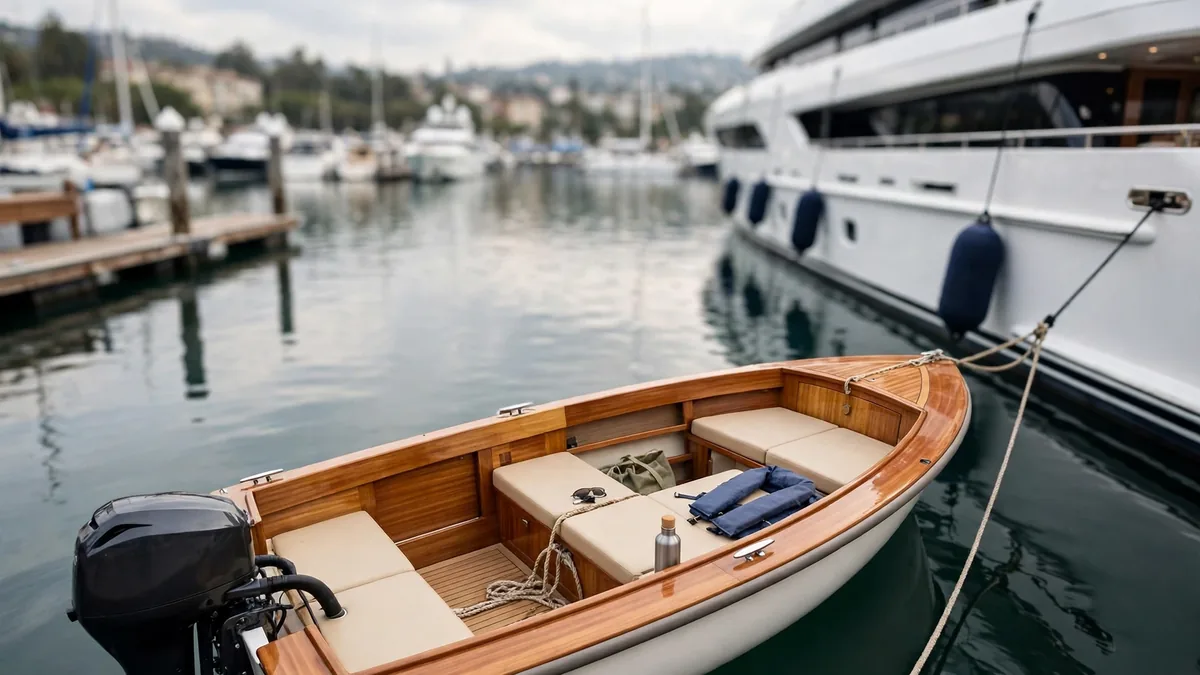
At the stern of a superyacht, a small boat slips into the water without a splash of fuel or a cough of smoke. It is barely four metres long, it carries a handful of guests and their luggage, and it looks, from a distance, like the simplest boat in the marina.
The answer is not the size of the boat, but the standard it is built to, the materials inside it, and the fact that it must match a superyacht in every detail, from its teak deck to the silence of its motor. This guide takes the price apart, cost by cost, to show why a luxury electric dinghy is so expensive, and which of those costs a buyer is really paying for.
1. The hull, and the hand-built shell underneath
The first cost is the hull, because a luxury dinghy is not moulded in a single pour and sent down a line, but built in a small yard by a team that may make only a few dozen boats a year. The hull is laid up from glass fibre or carbon fibre over a foam core, with each layer placed by hand, and then it is faired, sanded, and painted to a yacht finish, with a gloss that has to match the mothership sitting beside it. A scratch or a ripple that a workboat would ignore is a defect here, and the fairing alone can take days of skilled labour.
2. The electric motor, and the silence it must keep
The second cost is the motor, and it is where the electric dinghy earns its price. A luxury dinghy typically carries an electric outboard or inboard motor rated at about 5 to 15 kilowatts, built from marine-grade materials, sealed against salt water, and tuned to be almost silent.
The motor is also built to be used by a guest, not just by a professional crew. The throttle is simple, the steering is light, and the boat will stop at once if the driver lets go, because a tender that runs away from its driver is a danger to everyone in the marina. How the motor, the battery, and the controls work together is described in how a luxury electric dinghy works, where the sealed battery and the quiet thrust are taken apart.
3. The battery, and the range it must give
The third cost is the battery, and it is usually the single most expensive part of the boat. A luxury electric dinghy typically carries a lithium pack of roughly 5 to 15 kilowatt-hours, sealed in a waterproof case under a seat or in the hull, with a management system that watches temperature and voltage cell by cell.
Sealing is what turns a good battery into an expensive one. The pack sits low in a boat that takes spray over the bow, and it must survive being washed, splashed, and occasionally swamped, so every joint and cable entry is tested against immersion.
4. The interior, and the yacht finish inside a small boat
The fourth cost is the interior, because a luxury dinghy is a guest room as much as a boat. The deck is often teak, laid plank by plank and sealed against the sea, the seats are upholstered in marine vinyl or leather that must survive sun and salt, and the fittings are stainless steel or polished chrome, not the plastic of a workboat.
The details are where the labour hides. The stern of the yacht sets the same standard, and how a luxury yacht stern is made shows how the platform the dinghy hangs from is built to the same finish. A dinghy that looks cheap beside a superyacht is worse than no dinghy at all, and the yard knows it.
5. Safety, certification, and the paperwork behind the boat
The fifth cost is safety and certification. A luxury dinghy must meet the safety rules of the country where the yacht is flagged, and often the stricter rules of the yacht’s own classification society as well. That means buoyancy chambers that keep the boat afloat even when it is swamped, a fire extinguisher and a first-aid kit in fixed places, navigation lights that work in the dark, and a load plate that states exactly how many people and how much weight the boat may carry.
The same attention to a single expensive room shows up elsewhere on a yacht, and why a luxury yacht wine cellar is so expensive explains how a small space built to an uncompromising standard can cost more than a house on land.
6. Small numbers, and why there is no cheap version
The sixth cost is rarity. A luxury dinghy yard may build only a few dozen boats a year, compared with the thousands a mass-market builder produces, so there is no production line to spread the fixed costs across.
Customisation is part of the price, and it is also part of the point. That one-off work cannot be automated, and it cannot be made cheaper by building more of them.

The Specifications at a Glance
Here are the numbers that describe a typical luxury electric dinghy, and where its price is concentrated.
| Specification | Typical Luxury Range |
|---|---|
| Length | 3 to 4.5 metres |
| Hull construction | Glass or carbon fibre over a foam core |
| Passenger capacity | 4 to 8 people |
| Motor power | 5 to 15 kilowatts, electric |
| Battery capacity | 5 to 15 kilowatt-hours, lithium |
| Spare battery price | Roughly $3,000 to $6,000 |
| Range at cruising speed | 20 to 40 kilometres |
| Top speed | 20 to 35 kilometres per hour |
| Deck finish | Teak, laid by hand |
| Annual production | A few dozen boats per yard |
What Does a Luxury Electric Dinghy Cost?
A luxury electric dinghy is typically priced at roughly $40,000 to $120,000. A smaller boat with a 5 kilowatt-hour battery and a 5 kilowatt motor is typically priced at roughly $40,000 to $60,000, while a flagship with a 15 kilowatt-hour battery, a 15 kilowatt motor, a full teak deck, and custom trim to match its mothership is typically priced at roughly $90,000 to $120,000.
A Rare Fact
The dinghy is one of the oldest boats in the world, and its name comes from the Bengali word dingi, meaning a small boat, carried into English by sailors in India centuries ago. The first dinghies were rowed by hand and made of wood, and they ferried people and goods between ships and the shore, exactly the job the electric tender does today, only now the rowing is done by a battery.

The hull is faired by hand, the motor is built to be silent, the battery is sealed like a vault, the interior is trimmed to match a superyacht, and the whole boat is built in dozens, not thousands. That is the price, and it is also the reason the little boat looks at home beside the big one. That is the price of a boat built to be silent, safe, and worthy of the yacht beside it.


