The first electric yacht I stepped aboard was silent in a way that felt wrong. This one made no sound at all as we slipped away from the dock. The owner stood at the helm with a coffee in one hand and said the silence was why he had bought it. Then he mentioned the price, and the coffee nearly went over the side. A luxury electric yacht can cost several times more than a similar-sized diesel yacht, and the silence alone does not explain it. The real reasons are hidden in the hull, the battery, and the years of engineering it took to make silence seaworthy.
The battery is the heart of the cost, and it is a very different thing from the battery in an electric car. A yacht needs to push a heavy hull through water for hours, and water is far harder to move through than air. The battery pack in a luxury electric yacht can be ten or twenty times larger than the one in an electric car, measured in hundreds of kilowatt-hours or even megawatt-hours. It must be sealed against salt water, cooled constantly, protected against fire, and built to survive years of vibration, humidity and heat. The cells alone are a fortune. The engineering that keeps them safe at sea is another fortune on top.

Then there is the hull. A diesel yacht can afford to be heavy, because diesel fuel is energy-dense and engines are powerful. An electric yacht cannot. Every kilogram of hull is a kilogram the battery must push, so builders turn to carbon fibre, advanced composites and aluminium, shaped with the same care as a racing yacht. The hull must be efficient enough to make the battery last, which means long waterlines, fine bows and careful attention to every curve. That design time is expensive, and it is spread across a handful of yachts, not hundreds.
Propulsion is the third great cost. An electric yacht does not simply swap a diesel engine for a motor. It needs large electric motors, often podded drives that sit below the hull and steer with the propellers, plus inverters, generators for backup power, and a power management system that balances propulsion, hotel loads, air conditioning and charging. The fastest electric yachts show what this technology can do when it is done well, but doing it well means bespoke components, marine-grade everything, and systems that must work perfectly in salt water, far from a service centre. There is no pulling over at sea.
| Cost driver | Typical share of the price | Why it costs so much |
|---|---|---|
| Battery system | Roughly 25 to 35 percent | Huge marine-grade pack, cooling, fire safety |
| Electric propulsion | Roughly 10 to 15 percent | Pod drives, motors, inverters, backup power |
| Lightweight hull | Roughly 15 to 20 percent | Carbon and composites, tank-tested design |
| Solar and charging | Roughly 5 to 10 percent | Deck solar, shore charging, energy management |
| Luxury interior | Roughly 15 percent | Bespoke cabins, materials, silent systems |
| Hand building and testing | Roughly 10 percent | Skilled shipwrights, sea trials, certification |
| Low volume | The rest | Design spread over a handful of yachts |
Range is the problem that makes everything else harder. A diesel yacht can carry enough fuel to cross an ocean. An electric yacht, even a large one, has a shorter range, and extending that range means a bigger battery, which means a heavier yacht, which needs more power, which needs a bigger battery. Designers break this circle with efficiency: a slippery hull, solar panels across the roof, hydrogeneration from the propellers while sailing, and careful energy management that dims lights and trims air conditioning when it matters. The real cost of a custom superyacht explains how bespoke building drives prices up on any large yacht, and on an electric yacht the bespoke engineering is deeper still, because the propulsion system itself is custom to each hull.
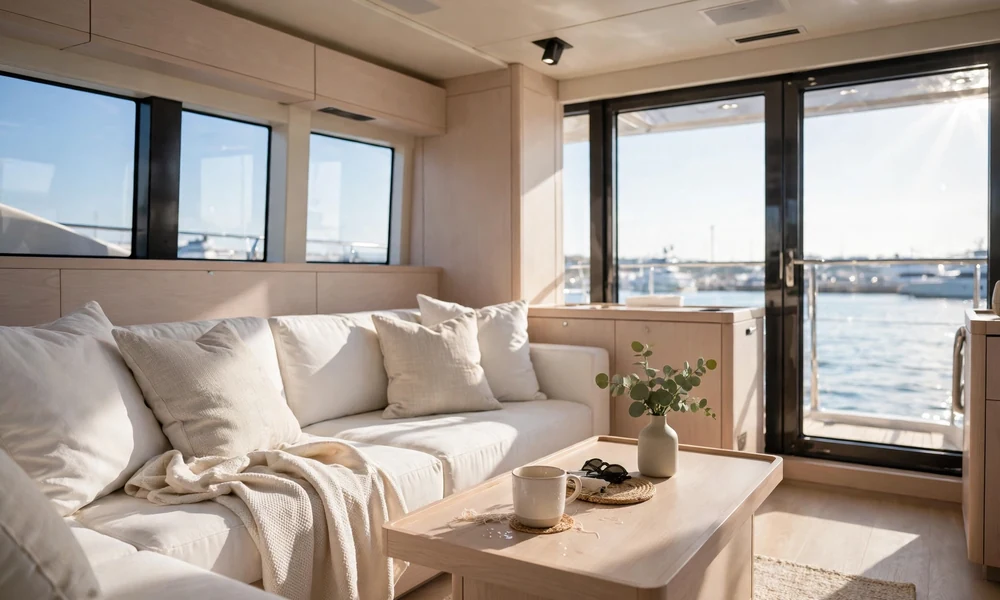
The interior is where the luxury part of the price lives. A luxury electric yacht is expected to be silent, and silence is expensive. Air conditioning, refrigeration, water makers and stabilisers must all run without the throb and vibration that diesel yachts hide behind their engines. Builders mount equipment on isolation pads, line compartments with acoustic insulation, and choose components for quietness over price. The result is a cabin where you can hear the water against the hull and nothing else, and that quiet is the product as much as the marble worktops and the hand-stitched leather.
How a Luxury Electric Yacht Is Made
Building an electric yacht is closer to building a small ship than to building a boat. The work takes years, involves dozens of specialists, and is checked and certified at every stage. Here is how it comes together.
- The hull is designed and tank tested. Naval architects model the hull, test scale models in a towing tank, and refine the shape for efficiency.
- The hull is built. Composite or aluminium panels are formed, joined and faired by hand, then painted to a mirror finish.
- The battery is installed. Battery modules are lowered into a sealed, cooled compartment, wired, and tested under load before the yacht ever touches water.
- Propulsion is fitted. Electric motors and pod drives are mounted, aligned, and connected to inverters and the power management system.
- Solar and charging are added. Solar panels are integrated into the superstructure and shore charging systems are installed and tested.
- The interior is finished. Cabins, galley, helm and deck spaces are fitted out by hand, with acoustic insulation throughout.
- Sea trials prove it. The yacht is tested at sea for range, speed, silence and safety, and certified before delivery.
What does one cost? A luxury electric yacht in the 15 to 20 metre range typically starts at roughly $2 million to $4 million, larger models run $5 million to $10 million, and a custom electric superyacht can pass $20 million. Those are estimates, and the interior, the battery size and the level of customisation move the price sharply. Running costs are lower than a diesel yacht in some ways: electricity is cheaper than marine diesel, electric motors need less servicing, and there is no exhaust system to maintain.
Here is a rare fact that captures the whole idea. Some luxury electric yachts can recharge their batteries while sailing, using the propellers as underwater turbines. As the yacht moves through the water under sail, or while being towed, water flowing past the propellers spins them, and the motors act as generators, feeding electricity back into the battery. It is the marine version of regenerative braking, and it means a sailing electric yacht can arrive at its anchorage with more energy than it left with. The technology is real, it works, and it is one more reason these yachts are so expensive: every system has to do two jobs at once.

A luxury electric yacht is expensive because it asks a battery to do the job of a fuel tank, a hull to be lighter than it has any right to be, and every system on board to work in silence in salt water. The price is the cost of all of that engineering, built by hand, in tiny numbers, for buyers who expect the result to feel effortless. The most expensive yachts ever built put these prices in context, and the lesson is the same: on the water, as on the road, silence and speed are never cheap. But for the owners who buy them, the quiet is the point, and the price is the price of that quiet.


