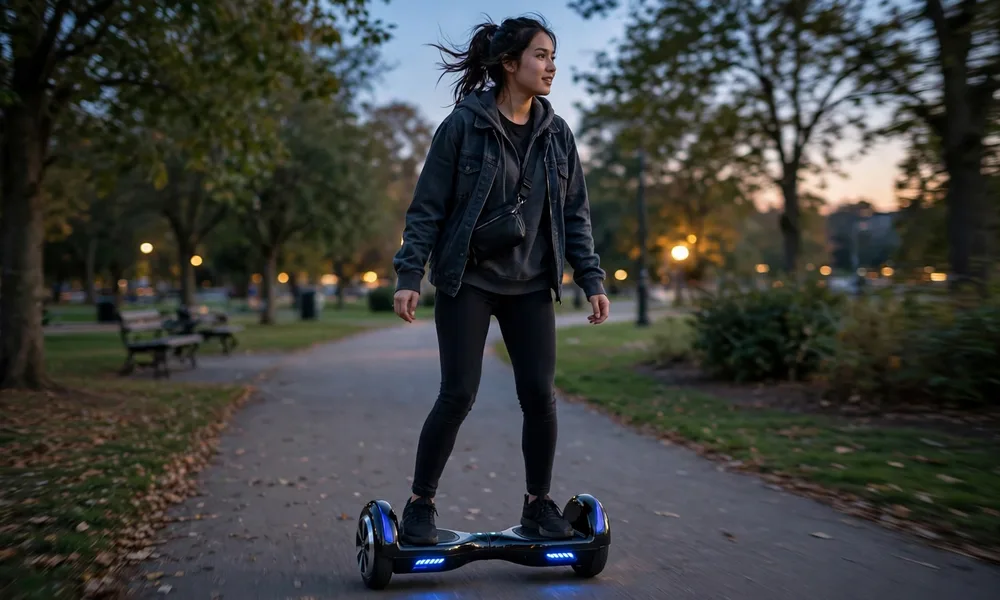
The boy in the park was not showing off. He was standing on a black board with two large wheels, gliding along the path without pushing, steering by leaning, and smiling at the sheer strangeness of it. His father, watching from a bench, asked the obvious question: how can something with no handlebars, no seat and no pedals cost as much as a good bicycle? The board looked simple. Two wheels, a flat platform, a few lights. Almost everything that makes the board work is hidden inside it.
A luxury hoverboard is a self-balancing electric vehicle squeezed into a package smaller than a suitcase, and every part of it has to be small, strong and precisely made. There is no room for cheap, bulky components, and no room for error either, because the board has to keep its rider upright a hundred times a second. Here are seven reasons why the price climbs so far above an ordinary toy, and why the cheapest boards on the market are cheap in ways you cannot see until something goes wrong.
Reason 1: The battery is the most expensive part
The battery is the single most expensive component in a luxury hoverboard, and it is where the cheapest boards cut corners first. A good board uses high-quality lithium cells from a known maker, arranged in a pack with a battery management system that watches every cell for temperature, voltage and charge. That testing and certification costs money, and it is money you cannot see, because a safe battery looks exactly like an unsafe one from the outside. The same care goes into the batteries of bigger electric machines, and the way a single wheel carries its power is set out in how a luxury electric unicycle works, where the battery sits even closer to the rider.
Reason 2: Two motors, not one
A hoverboard has one motor in each wheel, and the two motors must work together perfectly. When the rider leans forward, both motors speed up. When the rider leans to one side, one motor speeds up and the other slows down, and that difference is what turns the board. The motors are brushless hub motors, sealed inside the wheels, and they have to be powerful enough to carry an adult up a slope from a standing start, yet small enough to fit inside a wheel the size of a dinner plate. Building a motor that strong, that small and that quiet is expensive, and matching two of them so they respond identically is harder still.
Reason 3: The gyroscopes never stop working
The part that keeps the rider upright is a set of gyroscopes and accelerometers, tiny sensors that measure the tilt of the board many times a second. A computer reads those sensors and tells the motors how fast to spin to keep the platform level. If the sensors are slow or inaccurate, the board wobbles, overcorrects and throws the rider off. Luxury boards use faster, more accurate sensors and a more powerful processor to read them, and the software that ties them together is tuned over thousands of hours of testing. The board is making a hundred small decisions a second, and you are trusting it with your balance. The quality of those decisions is what you are paying for, and it is the hardest thing in the whole machine to judge from a photograph.

Reason 4: The deck is built like a piece of equipment
The deck of a luxury hoverboard is not a piece of plastic. It is a structural shell, usually aluminium or a reinforced composite, that has to carry the full weight of the rider while protecting the battery, the motors and the electronics inside. It must be stiff enough not to flex, sealed enough to keep out rain and dust, and shaped so the rider’s feet sit naturally on the pressure pads. The footpads themselves are part of the control system: they sense where the rider’s feet are and how much weight is on each side, and they feed that information to the computer. A luxury board uses better pads, better seals and a stronger shell, and it is tested by dropping it, riding it over kerbs and leaving it out in the rain.
Reason 5: Safety testing and certification
After the fires caused by cheap hoverboards, the industry introduced strict safety standards, and meeting them is one of the biggest costs a luxury maker carries. The battery, the charger, the motors and the whole board must be tested by independent laboratories and certified to standards that cover overheating, overcharging, short circuits and impact. Each certification costs money, and each failed test sends the design back to the workshop. The makers who build the best small electric machines are ranked in the best electric scooter brands ranked, where safety testing is one of the things that separates the top names from the rest.
Reason 6: Hand assembly and a long warranty
Luxury hoverboards are not made in the same way as toy boards. They are assembled in smaller batches, by workers who fit each motor, test each battery and check each board before it is boxed. Every board is ridden, or at least run on a test rig, before it leaves the factory, and any board that wobbles, judders or makes an unusual noise is pulled from the line. That testing takes time, and time is money, but it is also why a luxury board rarely arrives faulty. The warranty is part of the price too. A luxury maker typically offers a two-year warranty with real support, spare parts and a repair service, while a cheap board offers a few months and a customer service address that never answers.
Reason 7: Small numbers and a small market
The final reason is the simplest: luxury hoverboards are made in small numbers. A factory that makes a million cheap boards can spread the cost of its tooling, its testing and its design across a million sales. A maker that builds a few thousand premium boards a year has to recover the same kinds of costs from far fewer buyers, so each board carries a bigger share. The same economics shape other small electric rides, and the way a rider controls a board with a remote instead of their feet is set out in how a luxury electric skateboard works, where the engineering is just as dense and the market just as small.
What a luxury hoverboard costs, and a rare fact
A luxury hoverboard typically costs an estimated $1,200 to $3,500, depending on the battery, the motors and the build quality. The money is in the battery, the motors, the sensors, the shell and the testing, and none of it is visible until you ride the board and feel how steady it is. The rare fact is that the hoverboard was never meant to hover. The name was borrowed from a film prop, and the real machine does not float at all. It rolls, on two wheels, balanced by the same technology that keeps a rocket upright in flight. Buy the board with the certified battery, the strong motors and the long warranty, because those are the things that keep you upright, and they are the things the price is really paying for.


