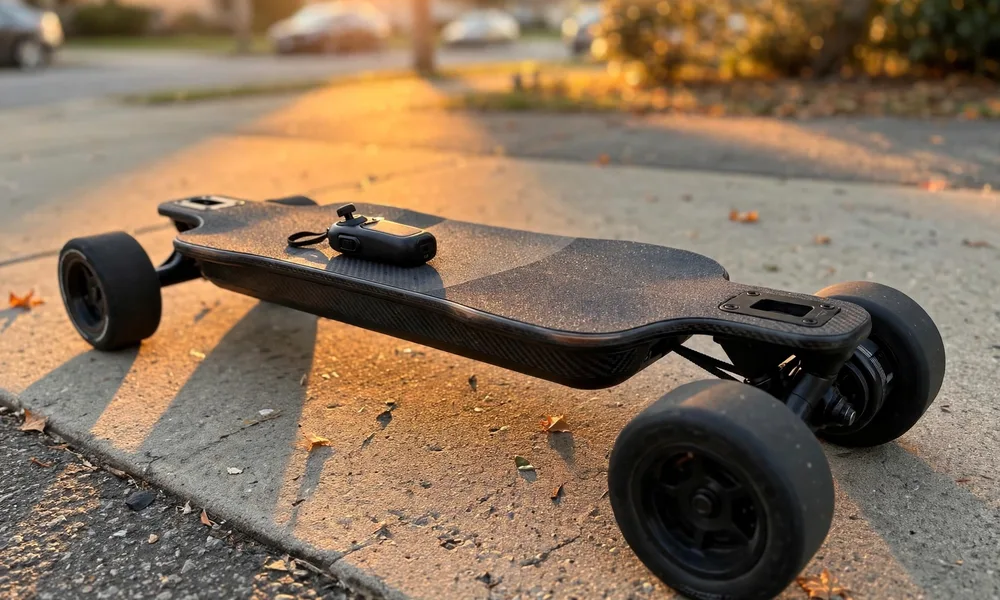
The board is lying on the pavement, slim and quiet, and it does not look like it is switched on. Then the rider steps onto it, gives it a small push, and squeezes the trigger on the remote in his hand. The board moves off without a sound, gathers speed without any effort from the rider, and by the end of the street it is travelling faster than most people can run, with the rider standing still and the wind in his face. Nothing on the board seems to be working hard, and that is the trick. A luxury electric skateboard hides all of its engineering inside a deck thinner than a book.

Step 1: The remote talks to the board
Everything starts with the remote, a small machined unit that fits in the rider’s palm. Inside it is a thumb wheel or a trigger, a small display showing speed and battery, and a radio that talks to the board many times a second. When the rider rolls the thumb wheel forward, the remote sends a number, not a command, and that number tells the board how much power the rider wants, from a gentle crawl to full speed.
The link is built to be unbreakable in practice. If the radio drops for a fraction of a second, the board holds its last speed rather than stopping dead, and the remote reconnects instantly. If the rider drops the remote, the board slows to a stop on its own, because a runaway board with nobody on it is the one failure the designers refuse to allow. The remote is the rider’s only control, and it is built to the same standard as the board itself, as the story of how a luxury electric skateboard is made shows, where the remote is machined and tested like a piece of jewellery.
Step 2: The controller decides how much power to give
The radio signal reaches the motor controller, a small circuit board sealed beside the battery inside the deck. The controller is the brain of the board, and its job is to turn the rider’s request into exactly the right amount of power. It does not simply switch the motors on. It ramps the power up smoothly, so the board accelerates like a lift rather than a catapult, and it splits the power between the two motors so the board tracks straight.
Step 3: The battery feeds the motors
When the rider asks for speed, the battery delivers direct current to the controller, which shapes it into the alternating current the motors need. The pack is sized for range rather than raw power, and on a luxury board it will carry the rider thirty to fifty kilometres on a charge. A three-wheeled cousin of the board uses the same idea on a bigger scale, as the guide to how a luxury electric trike is made explains, with a larger pack and a motor built for the same quiet, instant torque.
Step 4: Hub motors turn electricity into motion
Most luxury electric skateboards drive their wheels with hub motors, motors built directly into the rear wheels, so there are no belts, no gears and nothing to wear out. Inside each wheel is a ring of magnets and a set of copper coils, and when the controller sends current through the coils, the magnets turn, and the wheel turns with them. The motor is silent, sealed and almost maintenance-free, and it delivers its full torque from a standstill, which is why the board pulls away so smoothly from a stop.
Step 5: Leaning steers the board
There is no steering wheel on an electric skateboard. The rider steers by leaning, and the trucks do the rest. The trucks are the metal axles under the deck, and they pivot when the rider shifts his weight, turning the wheels in the direction of the lean. On a luxury board the trucks are machined from a single piece of aluminium rather than cast, so they hold their shape under load and the steering stays precise at speed.
The bushings, the small rubber pieces that let the trucks turn, are chosen for the rider’s weight and riding style, and they are tuned until the board carves smoothly without feeling twitchy. At low speed the board turns easily, and at high speed it feels stable, because the geometry of the trucks naturally firms up as the speed rises. An electric bike asks its rider to do the same job with handlebars, and the price of that different kind of control is explained in the guide to why a luxury electric bike is so expensive, but the skateboard’s answer is simpler: the rider’s body is the steering.
Step 6: Braking turns the motors into generators
Slowing down is where the engineering shows. When the rider eases off the thumb wheel, the controller does not just cut the power. It reverses the motors, turning them into generators that resist the spin of the wheels and feed a little charge back into the battery. The braking is smooth and progressive, so the rider slows gently rather than being thrown forward, and on a long downhill stretch the recovered energy can add a noticeable amount of range.
Step 7: Riding it well is a skill of small movements
The last part of how the board works is the rider. A good rider stands with his feet across the deck, knees slightly bent, and makes small movements rather than big ones. He leans to turn, shifts his weight forward to climb a hill, and back to slow down. He watches the road ahead, because the board’s soft wheels forgive small cracks but not large ones, and he keeps his thumb steady, because a smooth hand makes a smooth ride.

Specifications
| Detail | Specification |
|---|---|
| Deck | Carbon fibre, around 90 centimetres long |
| Weight | Around 7 to 9 kilograms |
| Battery | Around 400 to 600 watt-hours |
| Motors | Two hub or belt-drive motors |
| Top speed | Around 45 to 60 kilometres per hour |
| Range | Around 30 to 50 kilometres per charge |
| Wheels | Around 100 to 120 millimetres, soft urethane |
| Control | Wireless remote with thumb wheel and display |
What it costs
The estimated price of a luxury electric skateboard is around 2,500 dollars, and that figure is an estimate only, because the cost depends on the deck material, the battery size and the motor setup. The carbon deck and the custom battery pack account for a large share, followed by the machined trucks and the motors. A buyer is paying for a board that is light to carry, quiet to ride and smooth at speeds where a cheaper board would shake and wobble.
A rare fact
Few people know that a luxury electric skateboard can charge itself a little every time the rider slows down. The motors act as generators under braking, feeding power back into the battery, and on a long downhill stretch that recovered energy can add a noticeable amount of range. It is the same idea used in electric cars, shrunk down to fit inside a board you can carry under one arm, and it is the reason a careful rider often arrives home with more battery left than a careless one.