The first thing you notice about a luxury roadster is not the price tag. It is the sound. A low, unhurried growl as it pulls away from the kerb, nothing like the strained whine of an ordinary car, and then the way the whole machine seems to settle onto the road, low and wide, as if it were carved from a single block rather than assembled from ten thousand parts. People turn their heads. They always do. A roadster is not transport. It is a statement, made in steel, leather, and noise.
The second thing you notice is how little of it there is. No roof, or a roof that folds away like a conjuring trick. No back seats. Barely a boot. A roadster gives up almost everything a sensible car offers, and charges more for the privilege. That contradiction is the whole point, and it is where the price starts to make sense. You are not paying for more car. You are paying for less car, built to a standard that ordinary cars never attempt, by people who spend their working lives on a single model.
This is the story of where that money goes. A top-tier luxury roadster can cost several times the price of a fast family saloon, and the reasons are not one big thing but a hundred small ones: hand-finished panels, an engine built by one person, leather cut and stitched by hand, and a production line that moves at the pace of a craft workshop rather than a factory. Nothing about it is mass-produced, and that is the product.
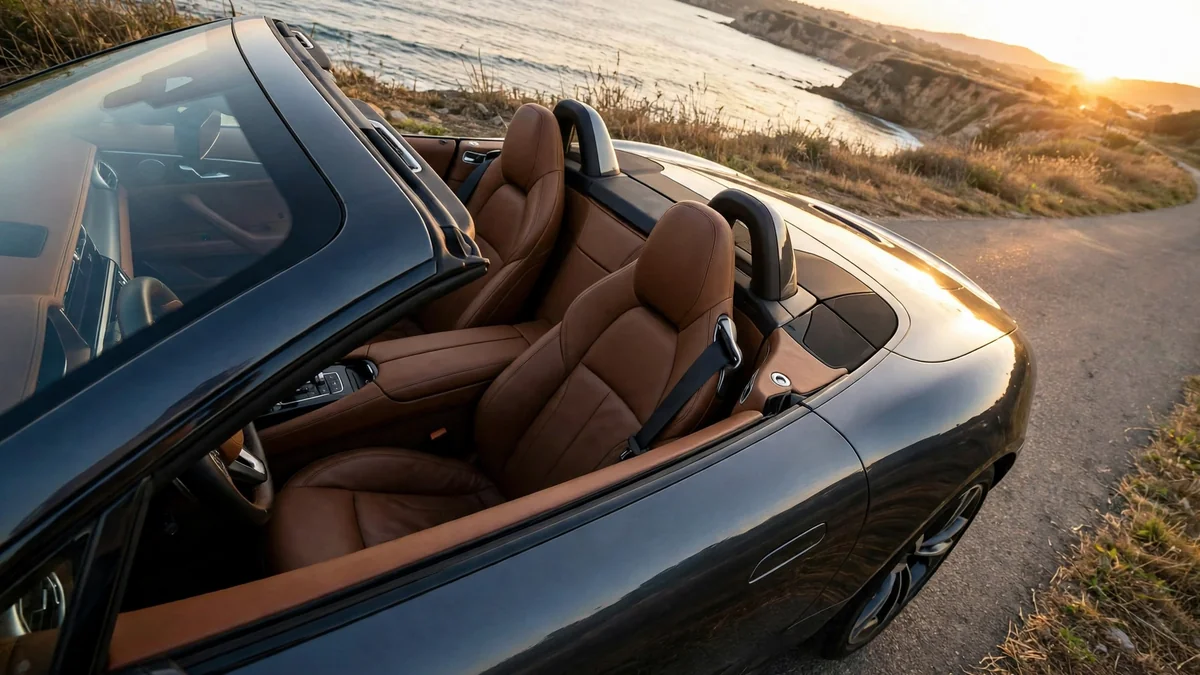
How a luxury roadster is built
The build is slow on purpose. Where a normal car takes hours on a moving line, a luxury roadster takes days or weeks, and each stage is a craft in its own right.
- A body with no roof to hide behind. A roadster has no fixed roof, so the body must be stiff on its own. Engineers add bracing through the sills, the bulkheads, and the floor, using aluminium and high-strength steel in a structure that is modelled, tested, and tuned until the body barely flexes. The result feels solid at speed, but the extra engineering costs a fortune before a single panel is fitted.
- Panels shaped and finished by hand. The bonnet, wings, and doors are pressed, then checked, filed, and polished by hand until the panel gaps are even to fractions of a millimetre. A machine can stamp a panel in seconds; a craftsperson spends hours making it look as though it grew there. That labour is invisible when it is done well, and that invisibility is exactly what the buyer is paying for.
- One engine, one builder. In the most exclusive roadsters, a single technician assembles each engine from start to finish and signs it with a small plaque. The engine is bench-tested, run in, stripped, checked, and rebuilt if a single measurement is out. The power figures are impressive, but the real cost is the time: an engine that one person builds over days, rather than a line that builds hundreds a day.
- A folding roof that must never leak. The roof of a roadster is an engineering puzzle. It must fold into a space barely bigger than a suitcase, open and close in seconds, seal against rain at motorway speed, and survive thousands of cycles without a rattle. The mechanism alone can contain hundreds of parts, each one tested until it works silently, every time.
- An interior stitched by hand. The leather is cut from the centre of the hide, where it is smoothest, and the offcuts are discarded. A single interior can take a craftsperson days of cutting, stitching, and fitting, with every seam aligned by eye. The smell of a new luxury roadster is not an accident. It is the smell of that work, and it is one of the first things a buyer notices.
- Testing on the road, not just the bench. Every roadster is driven, hard, by a test driver who listens for rattles, checks the steering, and pushes the car through corners a customer will never attempt. Faults found here are fixed by hand and the car is tested again. A roadster is not released because it passed a checklist; it is released because a driver who knows the model decided it felt right.

The specifications behind the price
These figures are typical of a flagship modern luxury roadster. They explain the performance, but they also explain the cost: everything here is at the far end of what is possible in a car this size.
| Specification | Figure |
|---|---|
| Engine | About 4.0-litre twin-turbo V8 |
| Power output | About 600 horsepower |
| 0 to 100 km/h | About 3.5 seconds |
| Top speed | About 320 km/h |
| Weight | About 1,600 kilograms |
| Gearbox | 8-speed dual-clutch automatic |
| Body material | Aluminium and carbon fibre |
| Roof operation | About 15 seconds, folding fabric |
| Production volume | A few thousand per year |
| Warranty | About 3 years, unlimited mileage |
The telling figure is the production volume. A mainstream carmaker builds more cars in a morning than a luxury roadster maker builds in a year, and that changes everything. Tooling and development costs are spread across a few thousand cars instead of a few hundred thousand, so every car carries a far bigger share. Low volume is not a failure of the business. It is the business: scarcity is part of what the buyer is purchasing, and the factory is sized to protect it.
What a luxury roadster actually costs
A flagship luxury roadster costs an estimated $200,000 to $350,000 before options, and that figure is an estimate that varies widely by brand, engine, and market. Options can add tens of thousands more: special paint, carbon-ceramic brakes, a bespoke interior, and a sound system tuned to the cabin. Then there is the running cost. Insurance is steep, tyres are wide and short-lived, and servicing must be done by specialists. The price is the point: it guarantees that the car will be rare on the road, that the engineering is uncompromised, and that the person who built the engine signed it. To see the build in detail, how a luxury roadster is made follows the car from bare chassis to finished machine, and how a luxury roadster works explains the engine, the roof, and the chassis in plain terms.

A rare fact worth knowing
Here is a detail that surprises even car enthusiasts: the earliest roadsters were not luxury cars at all. A century ago, a roadster was simply the cheapest open car a maker could build, a light two-seater with no weather protection and no pretensions. The luxury came later, when makers realised that stripping a car back to its essentials and then perfecting every remaining part created something more desirable than any limousine. The modern luxury roadster is, in a sense, a very expensive return to simplicity: two seats, an engine, and the sky. And that simplicity is why the price is so high.
So the roadster is expensive for the oldest reason in the book: it is made slowly, by skilled people, in small numbers, from the best materials available, and it refuses to compromise on anything the driver can see, hear, or feel. The roof folds, the engine sings, and the car turns heads for a reason that has nothing to do with the badge. For the numbers behind the drama, the luxury roadster specs explained lays out the power, the weight, and the performance that the price buys.


