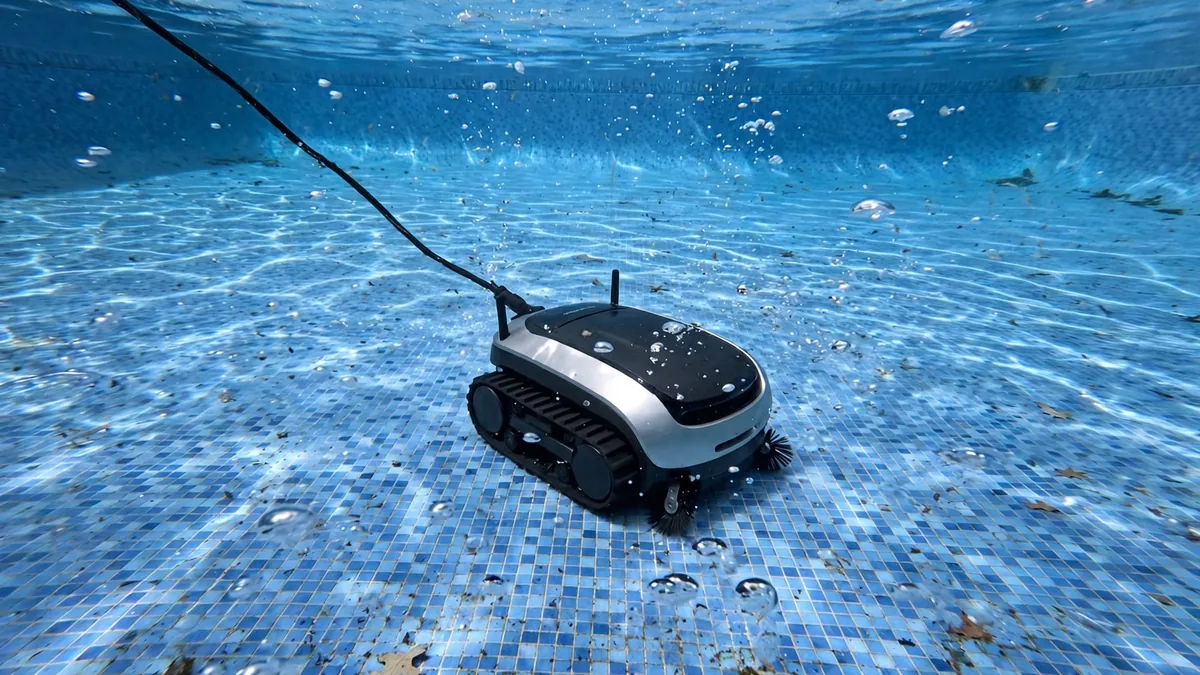
Look at a luxury robot pool cleaner sitting on the deck and it seems absurd that it could cost as much as a good bicycle. It is a small box on tracks, no bigger than a shoebox, with a cable trailing behind it like a tail. Then you drop it in the pool, it sinks to the bottom, climbs the walls, scrubs the waterline and comes back up with a filter full of leaves, sand and grit, and the price starts to make a different kind of sense.
A luxury robot pool cleaner can cost thousands. The cost lives underwater: motors that must work while completely submerged, a navigation system that maps a pool it cannot see, and a filter that catches dirt too fine to see. This is the story of where that money goes, and why the engineering, not the box, sets the price.
Motors That Work Underwater
A pool cleaner’s motors live in the hardest place a motor can live: completely underwater, for hours at a time, in water full of chlorine. Ordinary motors would rust, short and die within a week, so a luxury cleaner’s motors are sealed inside waterproof housings, with shafts that pass through seals rated to keep water out under pressure, and windings coated against the chemicals that eat ordinary metal. Building a motor that strong, that small and that waterproof is expensive.
The tracks are the cleaner’s feet, and they matter more than they look. Rubber tracks grip the pool floor and climb the walls, holding the cleaner against the surface while its brushes scrub, and they must grip on tiles, plaster and vinyl alike, without scratching any of them. A cheap cleaner’s tracks slip on a tiled wall and fall back to the floor, while a luxury cleaner’s tracks hold firm all the way to the waterline. The how a luxury robot vacuum works story shows the same drive thinking on dry land, where a machine that cannot reach the dirt cannot clean it, and a pool cleaner that cannot climb cannot clean the waterline at all.
Power reaches the cleaner through a cable, and the cable is a piece of engineering on its own. It must carry power and data while the cleaner turns, climbs and spins, so it is built to twist without tangling, with a swivel at the cleaner end that lets the cable rotate freely. A swivel that never tangles is a small part that costs a surprising amount to make well.
Navigation, Mapping and the Dirt It Must Find
Navigation is the pool cleaner’s brain, and it works in the dark. The cleaner cannot see the pool, because its cameras would be blind underwater and its GPS signal dies at the surface, so it navigates by feel: gyroscopes that measure every turn, pressure sensors that measure depth, and software that builds a map of the pool from the cleaner’s own movements. The map tells it where it has been and where it has not, so it covers the whole pool.
Luxury cleaners remember the pool’s shape from one clean to the next, and they adjust their route to the pool they are in. The luxury yacht jacuzzi specs show the same water-handling thinking on a much grander scale, where pumps, jets and filters must work together in a small space, and a pool cleaner that maps its pool wastes no battery revisiting water it has already cleaned.
Obstacle sensing is the quiet part of the navigation. The cleaner must find the steps, the ladder and the drain cover, and avoid getting stuck on any of them, because a stuck cleaner is a cleaner that cleans nothing. Luxury models sense a blocked track and reverse themselves out.
Filtration and the Water It Leaves Behind
Filtration is the cleaner’s real job, and it is measured in microns. A luxury cleaner carries two filters, a coarse one for leaves and twigs and a fine one for sand, algae and grit too small to see, and the water passes through both on every circuit. The fine filter catches particles down to a few microns across, which is smaller than a grain of sand.
The filter is designed to be emptied in seconds, without tools and without touching the dirt, because a filter that is hard to clean is a filter that never gets cleaned. A top-loading basket lifts out, rinses under a hose and drops back in, and an indicator tells the owner when it is full. The why a luxury yacht spa is so expensive story shows the same obsession with clean water on a yacht, where filtration is the difference between a spa and a soup.
Water flow is the hidden half of the filtration story. The cleaner’s pump must move enough water to pull dirt into the filter without stirring up the fine silt on the floor, and the intake is shaped to lift debris gently rather than blast it away. A luxury cleaner swallows the dirt instead of pushing it around the pool.

Tiny Runs, Hand Assembly and Pool-Grade Materials
Luxury robot pool cleaners are made in small numbers, and small numbers mean high prices. A factory that makes a hundred thousand ordinary pool toys can spread the cost of its moulds, its testing tanks and its engineers across every unit, but a luxury maker building a few thousand cleaners a year must charge each buyer a share of all of it. The cleaner is assembled by hand, with each motor, seal and sensor fitted and tested by a person.
The materials are where the luxury shows. A luxury cleaner uses a shell that resists chlorine and sun, stainless steel parts where a cheap cleaner uses plated steel that rusts, and seals rated for years underwater rather than months. The shell must be tough, because it bangs against pool walls and steps, and light, because the owner must lift it out of the water.
As an estimate, a luxury robot pool cleaner costs about $2,000 to $6,000, the motors and waterproofing about $600 to $1,800 of that, the navigation and electronics about $500 to $1,500 more, and the filtration, materials and hand assembly about $600 to $1,800 on top. These are estimated ranges, not quotes. What never changes is that the cleaner is built in small numbers by hand, and a machine built that way can never be cheap.
A Rare Fact From the World of Robot Pool Cleaners
Here is a detail few pool owners ever learn: a luxury robot pool cleaner can cut a pool’s chlorine use. By catching the fine organic dirt that chlorine would otherwise have to burn away, the cleaner leaves less work for the chemicals, and pools cleaned by robots often need noticeably less chlorine to stay clear.
What the Price Means for You
If you are wondering why a luxury robot pool cleaner costs so much, look at four things: the motors, the navigation, the filtration and the build. Sealed underwater motors, mapping that covers the whole pool, fine filtration down to a few microns and a chlorine-proof hand-assembled body are the marks of a cleaner worth its price. The cable matters more than anyone admits, because a cleaner that tangles is a cleaner that stops. The best luxury robot pool cleaner is the one you never have to think about, dropping in, climbing out, and leaving the water clear while you simply swim.