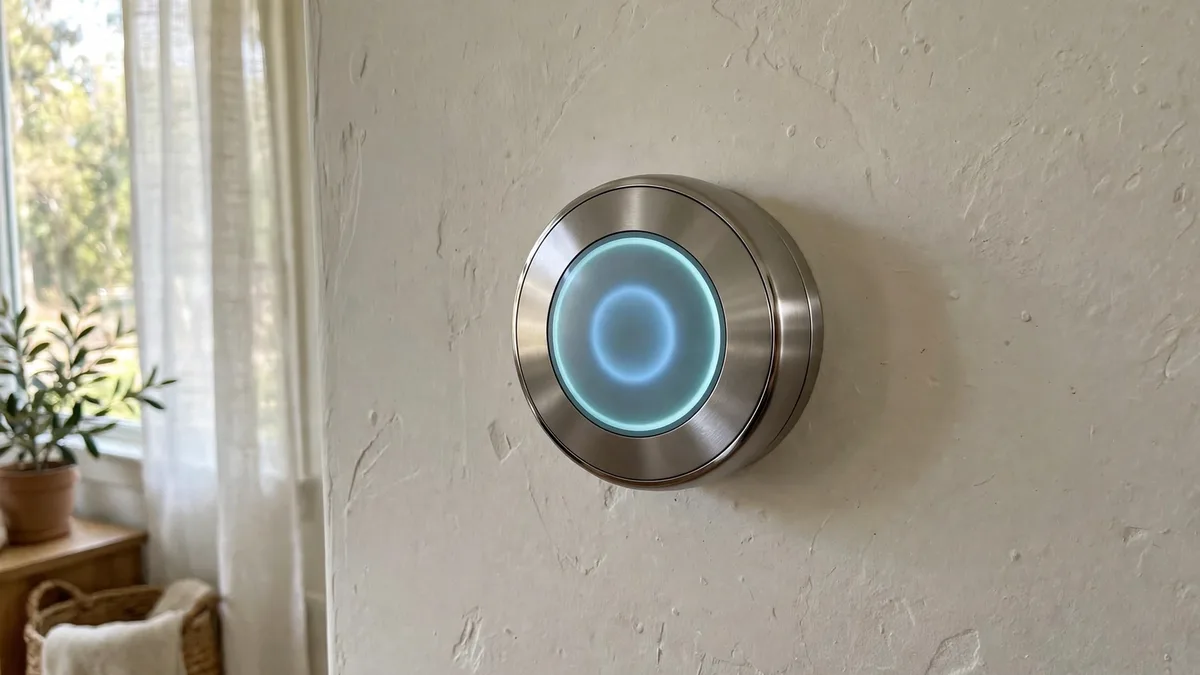
A luxury smart thermostat is a small dial on a wall, and it can cost ten times what a basic thermostat costs. It does not heat the house itself, it does not cool it, and it holds no water and no fuel. All it does is decide when the heating and cooling should run, and yet that small decision is one of the most expensive in the house. The price is not in the dial. It is in the sensors, the learning, the materials and the years of engineering behind a disc that saves energy without making a room uncomfortable.
A thermostat is the only device in the house that talks to the heating system, the people in the rooms, the weather outside and the electricity grid, all at once.
The Sensors: Knowing the House Room by Room
A basic thermostat measures the temperature in one hallway and assumes the rest of the house is the same. A luxury smart thermostat measures far more: temperature, humidity, occupancy and sometimes light, in several rooms at once, using small wireless sensors placed where people actually live. The hallway may be warm while the bedroom is cold, and the thermostat has to know that before it decides whether to fire the boiler.
Those sensors are the first cost. Each one is a small device with its own battery, radio and calibration, and it has to report accurately for years without drifting. A sensor that reads two degrees high will heat a house that is already warm, and a sensor that misses an occupied room will leave someone cold. The thermostat also watches humidity, because damp air feels colder than dry air at the same temperature, and a good system adjusts for that. The specifications behind the sensors are laid out in luxury smart thermostat specs explained, where the sensing and control hardware are described in detail.
The Learning: A Thermostat That Studies the House
The most expensive part of a luxury thermostat is not hardware at all. It is the software that learns how a house behaves. Every house heats and cools at its own speed: a stone cottage warms slowly and holds its heat, a modern timber house warms fast and cools fast, and a flat with large windows overheats in the afternoon sun. The thermostat learns those patterns over weeks, watching how long the boiler takes to raise each room by a degree and how quickly the rooms cool when the heating stops.
That learning is what lets the thermostat start the heating at the right moment so the house is warm when the owner wakes, without running the boiler all night. It also lets it notice that nobody is home and turn the heating down, or that the weather is about to turn cold and the house needs a head start. The algorithms are trained on data from millions of homes, and they keep improving with updates. The result feels simple, a house that is warm when it should be, but the simplicity is the product of an enormous amount of computation. The same kind of always-on intelligence sits in the other smart devices in the home, and how a luxury smart speaker works describes a similar blend of microphones, processors and cloud software.
Materials and the Dial Itself
The dial is where the luxury positioning is most visible. A premium thermostat is a machined metal ring around a glass display, with a weight and a smoothness that a plastic thermostat cannot match. The ring turns with a precise, damped click, and the display lights up only when it is needed, fading back to a dark mirror when the room is empty. That restraint is deliberate: the device is designed to be looked at a hundred times a day and to never look cheap.
Inside, the engineering is just as careful. The thermostat runs on the thin wires of an old heating system, wires that were never designed to power a computer, and it has to steal tiny amounts of power without switching the boiler on by accident. Some models need a common wire, and installing one can mean an electrician’s visit. The display, the touch sensor and the radio all have to work for a decade on a wall that is sometimes cold and sometimes sunlit.

Energy, the Grid and the Long Payback
A luxury thermostat justifies its price partly by saving energy. By heating only the rooms that are used, by learning when the house is empty, and by avoiding overshoot, a good system is estimated to cut heating and cooling bills by roughly ten to fifteen percent. In a large house with high energy costs, that saving can repay the thermostat in a few years, and after that it is money back every winter.
The newest models go further, talking to the electricity grid and to solar panels on the roof. They can pre-heat the house when electricity is cheap and let it coast when prices spike, or run the heat pump when the sun is shining and the panels are producing. That coordination needs a secure connection, regular updates and a manufacturer that stays in business to provide them, which is why the brand behind the thermostat matters as much as the device itself. The same long-horizon thinking applies to the other expensive objects in the home, and why a luxury smart bed is so expensive follows a similar logic of sensors, software and a long payback.
What the Price Looks Like
A luxury smart thermostat is estimated to cost between $200 and $350 for the thermostat itself, with additional room sensors estimated at $30 to $50 each, and professional installation estimated at $100 to $200 where a common wire is needed. The sensors and the learning software together are estimated to account for about half of the price, the materials and the display for roughly a quarter, and the warranty, updates and support for the rest. Those figures are estimated, because makers do not publish their costs, but the shape of the price is consistent: the intelligence and the sensing cost more than the dial.
A Rare Fact About Smart Thermostats
One detail few owners know is that the first programmable thermostats were sold as a luxury for the wealthy in the early twentieth century, and they were mechanical clocks attached to a bimetallic strip. The modern luxury thermostat is their direct descendant, a clock that learned to watch the weather, the house and the people inside it. A century of engineering separates the two, but the idea is the same: comfort that arrives before you ask for it, and a house that never wastes heat while you are away.

What the Price Means for You
The price makes sense when the thermostat is judged by the heating bill rather than by the dial. In a large house, or one with rooms that are used at different times, the room sensors and the learning can save real money every month, and the thermostat can pay for itself in a few winters. In a small, well-insulated flat with one room that matters, a simpler thermostat may do the same job for far less.
Before buying, count the rooms that need sensors, check whether the house has a common wire, and add the cost of the sensors and the installation to the price on the box. Then check the warranty and the update policy, because a thermostat that stops receiving updates in three years will feel old long before it fails. Buy the sensing, the learning and the support, not the metal ring, and the price will make sense.