High on the side of a cruise ship, painted a bright orange that can be seen for miles, hangs a boat that nobody hopes to use. It sits quietly in its davits through calm seas and sunny days, and the passengers walk past it without a second thought. Yet that small orange boat can cost more than a comfortable yacht, and the reason is not the paint. It is everything inside the shell, and everything the shell must survive, on the one day it is ever needed.
A luxury ship lifeboat is not a dinghy with an engine. It is a self-righting, fireproof, enclosed survival craft, built to rules written in the lessons of real disasters, and every part of it is tested until it proves it will work when nothing else does. This is the bill, piece by piece.

Where the Money Goes
A hull that rights itself
The biggest single cost in a lifeboat is the hull, and the reason is the shape. A lifeboat must right itself if a wave turns it over, which means the hull is designed around a low centre of gravity, sealed buoyancy chambers and a rounded top that sheds water instead of trapping it. The mould alone is a major piece of engineering, because the shape must be right to within millimetres, and a hull that rights itself slowly is a hull that fails its test.
Fireproofing and the sprinkler skin
A lifeboat must be able to motor through burning oil on the water, and that requirement shapes the whole boat. The shell is coated with fire-resistant resin, the windows are made from heat-proof glass, and a sprinkler system covers the outside of the hull with a curtain of water, pumped from the sea by the boat’s own engine. The system must run for as long as it takes to clear the fire, and its pump, pipes and nozzles are all marine-grade parts that cost far more than their ordinary equivalents.
The engine that must always start
Every lifeboat carries its own diesel engine, and it is one of the most expensive parts of the boat for a simple reason: it must start first time, every time, after months of sitting unused in salt air. The engine is a marine unit with a hand-start backup, a sealed fuel system and an air intake that can breathe even when the boat is upside down, and it is tested far more often than any other engine on the ship.
Davits, falls and the launch system
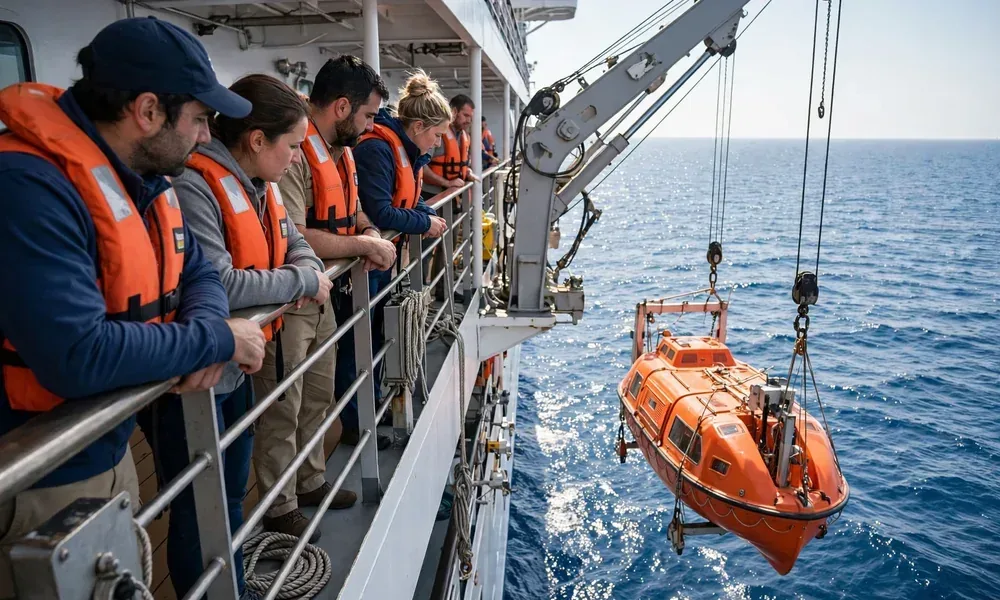
A lifeboat is only as good as its launch, and the davits that lower it are a large part of the bill. The steel arms must swing a fully loaded boat, weighing many tonnes, out over the water and lower it smoothly even if the ship is listing heavily to one side. The winches, the brakes and the wire falls are all sized with a wide safety margin, and the release gear must free the boat from both falls at the same moment, or the boat will tip as it drops.
Certification and the cost of proving it
No lifeboat goes to sea without a certificate, and earning that certificate is expensive. The boat is tested for stability, self-righting, speed, manoeuvring and fire resistance, and the tests are witnessed by inspectors from a classification society who charge for every visit. Prototypes are deliberately overloaded, capsized, dropped and driven through fire, and the testing of one design can take months.
The cost does not stop once the certificate is issued. Every boat on every ship is inspected and tested on a fixed schedule for its whole life, with load tests, engine trials and release checks, and the records are kept for years. A lifeboat that fails an inspection is taken out of service until it is fixed, which means the ship cannot sail with a full passenger list. The price of the boat includes the price of proving, again and again, that it still works.
Supplies, seats and a hundred people
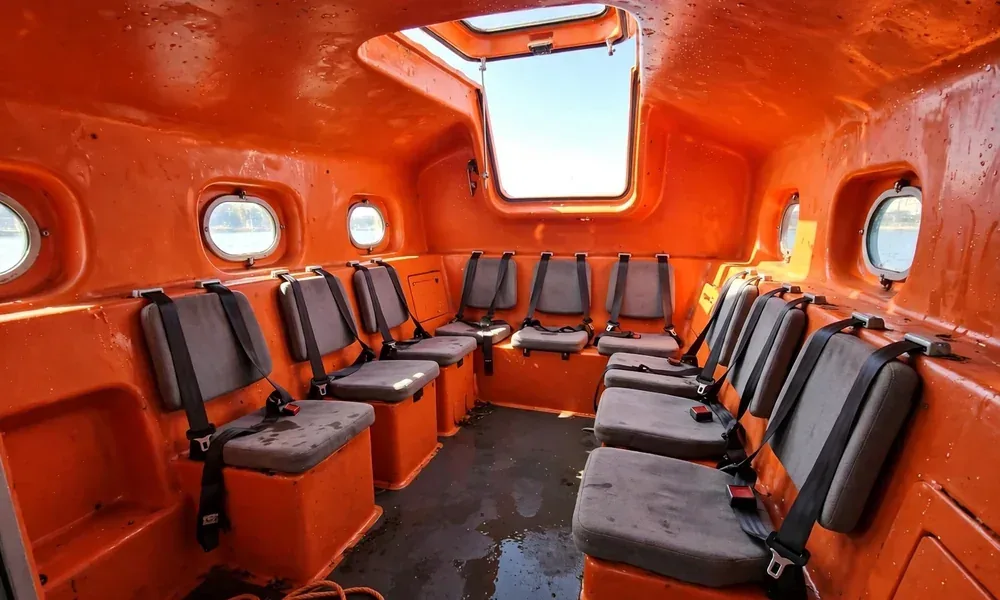
The last part of the bill is what goes inside. A large lifeboat carries seats and harnesses for more than a hundred people, and each seat must hold a person securely in rough seas. The boat also carries water, food rations, first aid kits, flares, a radio, a compass, a searchlight and a sea anchor, and every item is marine-grade, sealed against salt and damp, and replaced on a schedule whether it has been used or not.
The supplies are the cheapest part of the boat in money terms, but they are the most demanding in discipline. Water goes stale, batteries run flat, and flares expire, so the ship’s crew checks and replaces them constantly. The cost of keeping a lifeboat ready is a steady, quiet expense that never stops for the whole life of the ship, and it is part of why the price of a lifeboat is never just the price of the boat.
| Cost driver | Share of the price |
|---|---|
| Self-righting hull | The largest single share, hand-built and tested |
| Fireproofing and sprinklers | A large share, every material chosen for heat |
| Engine and drive | A large share, built to start first time, always |
| Davits and release gear | Often as much as the boat itself |
| Certification and testing | Months of witnessed tests before approval |
| Seats and supplies | The smallest share, but a constant running cost |
The figure most people misunderstand is the price of the boat itself, because the boat is only half the purchase. The davits, the testing, the certification and the lifetime of inspections cost as much again, and a shipowner who buys the cheapest boat and the cheapest davits has bought the most expensive mistake on the ship. The lifeboat is the one piece of equipment on board that is priced for the worst day, not the best one.
The Bill, Added Up
A luxury ship lifeboat typically costs an estimated 250,000 to 500,000 dollars for the boat alone, and the davits, testing and certification can double that figure, with a full set of boats on a large ship running into many millions. The money is spent before the boat is ever used, and the owners hope it never is. The same careful building goes into every lifeboat on the water, and the way a luxury ship lifeboat is made covers the moulds and the hand-laid shell, while the way a luxury lifeboat is so expensive looks at the same question from the smaller boat’s point of view.
A Rare Fact
The first lifeboats were open wooden rowing boats, and they were often the last thing to be thought about when a ship was built. The modern enclosed, self-righting, fireproof lifeboat is the result of a century of disasters, and every feature in it, from the sprinkler skin to the release gear, can be traced to a ship where that feature was missing.
A luxury ship lifeboat costs more than a small yacht because it is not really a boat. It is a survival system, built to launch in the dark, in a storm, with a full load of frightened people, and to keep them alive until rescue comes. The same logic prices every rescue craft on the water, and the way a luxury rescue boat is so expensive shows how the same rules apply to the smaller, faster boats that go out to meet trouble head on.


