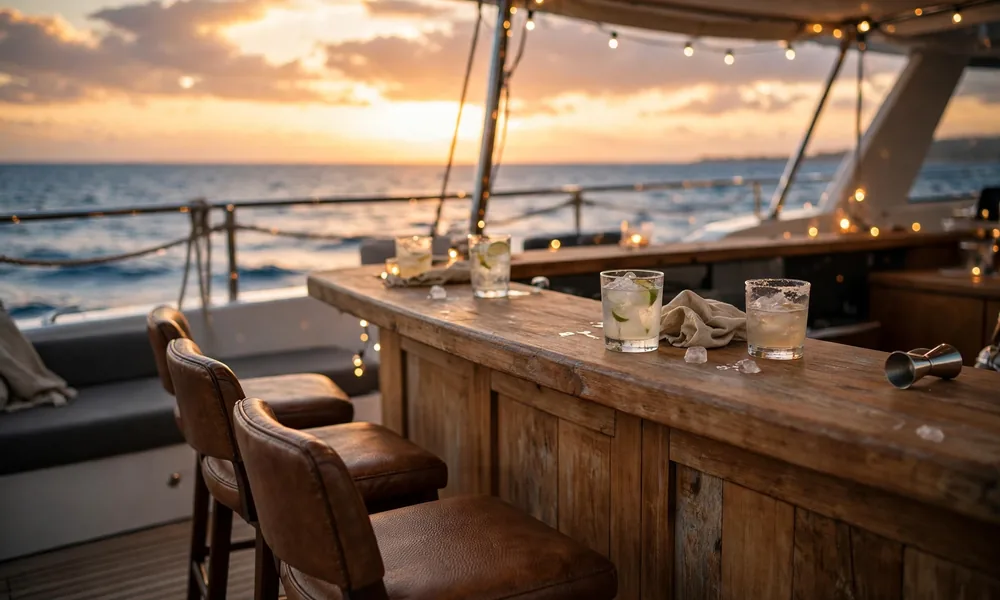
Walk into the bar of a luxury yacht and the first thing you notice is how quiet it is. The glasses do not rattle, the bottles do not clink, and the counter stays perfectly still even as the sea moves underneath you. The wood is dark and polished to a mirror shine, the brass gleams, and the whole room feels like a private club that happens to float. Then you learn the price of fitting it out, and it is enough to buy a house, for a room that holds eight people.
The reason is not the drinks. It is the room itself, a bar that must survive storms, salt air and constant motion, keep hundreds of bottles safe, chill drinks to the degree, and look flawless while doing it, all in a space smaller than a hotel bedroom. Every surface, every fitting and every glass in it has been designed twice, once for beauty and once for the sea.
The Counter Is a Piece of Engineering
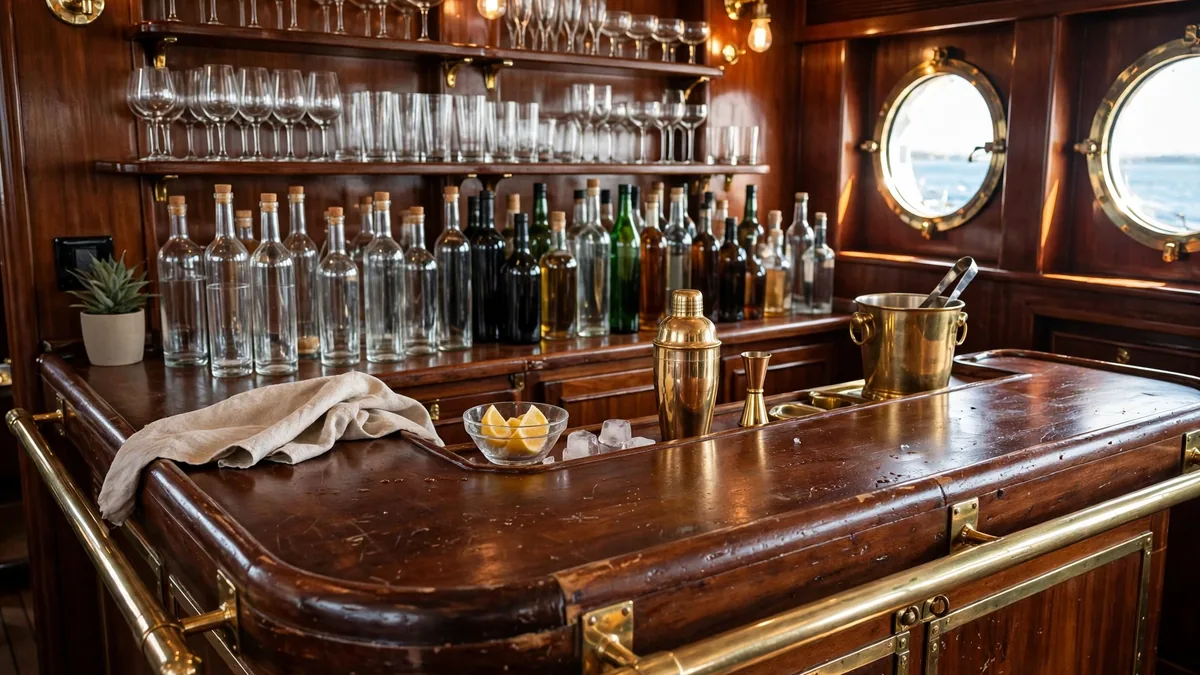
The bar counter is the most expensive single object in the room. It is usually made from a single slab of rare timber or stone, chosen for its grain and its weight, and then sealed against salt, sun and spilled drinks with layers of marine lacquer. The slab must be heavy enough not to slide in a swell, yet light enough not to upset the yacht’s balance, and it is bolted to the deck through the floor, so it becomes part of the ship itself. A counter that looks like furniture is really a structural fitting.
The fittings around it are just as considered. Brass rails, leather panels and backlit shelves are all fixed with hidden brackets, so nothing rattles when the yacht rolls, and every bottle sits in a rack shaped to its own size. The why the luxury yacht galley is so expensive story shows the same obsession in the kitchen, where every cupboard and drawer is locked against the sea, and the bar is that idea dressed up for guests, where the engineering must be invisible.
The stools are a lesson in the same thinking. They are bolted to the deck or weighted so they cannot tip, upholstered in marine leather that resists salt and sun, and stitched by hand because machine stitching fails in the damp. A stool that looks simple can cost as much as a good armchair, and there are usually six or eight of them, lined up along a counter that took a master joiner weeks to build.
Glass, Bottles and the Art of Staying Still
Glassware on a yacht is a problem no land bar has to solve. Ordinary glasses slide, chip and shatter when the yacht rolls, so the bar uses heavy crystal with thick bases, or specially weighted stems, and every glass has a place in a rack lined with felt. The crew counts the glasses before and after every evening, because a broken glass in a carpeted bar is a hazard for bare feet, and the replacement cost of a single hand-blown crystal glass can run into hundreds of dollars.
The bottles are the bar’s real treasure. A luxury yacht bar stocks hundreds of bottles, from rare vintage champagne to single malt whiskies that are no longer made, and the collection itself can be worth more than the room that holds it. The bottles are kept in a climate-controlled cabinet, held at a steady temperature and humidity, and the rarest ones are locked away, poured only for the owner. The why the luxury yacht master cabin is so expensive story shows the same care for precious things in the owner’s suite, where the finishes are chosen to protect what is inside them, and the bar cabinet is that idea applied to drink.
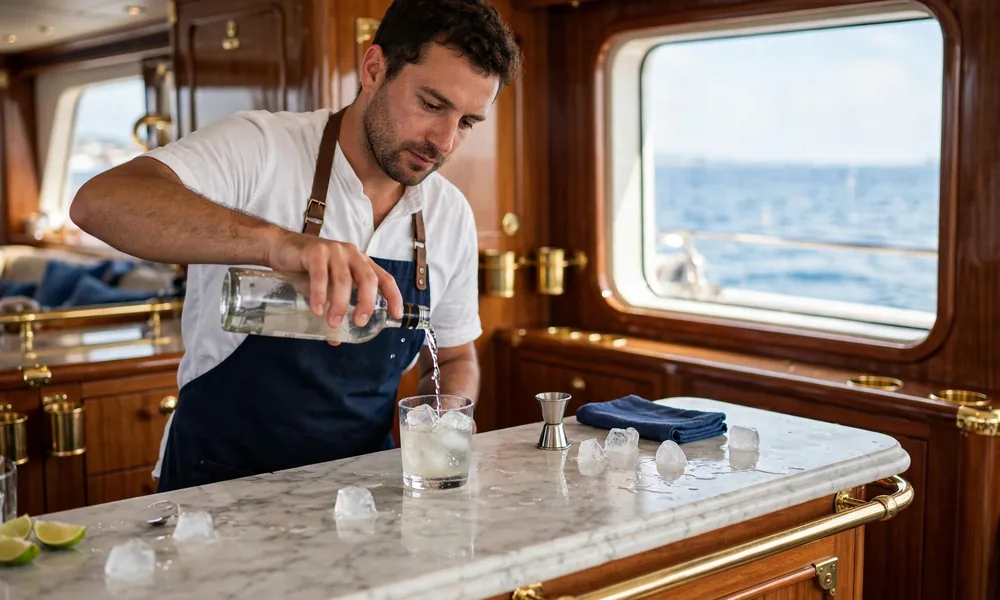
Chilling is a machine in its own right. The bar has its own refrigeration, separate from the galley, with wine kept at one temperature, champagne at another, and spirits chilled just enough to take the edge off. The compressors are silenced and vibration-proofed, because a humming fridge would ruin the quiet of the room, and the ice maker produces clear, slow-melting cubes, the kind that do not water a drink down, at a cost that would shock a land bar owner.
Hand-Built, Tested and Rare
Almost no yacht bar is built on a production line. Each one is designed for its yacht, built by a small team of joiners, metalworkers and upholsterers, and fitted by hand in a shipyard, where the room is measured again and again as the hull flexes. The wood is matched grain for grain, the brass is polished by hand, and the lighting is tuned so that the room glows warm at dusk and bright enough to read by at noon. A bar that takes months to build can never be cheap, and the buyer pays for the hands that made it.
Testing is quieter than on deck, but it is just as strict. The bar is used, cleaned, restocked and used again before the yacht is delivered, and every rattle, every sticky drawer and every glass that slides is found and fixed. The makers know that a guest will notice a wobbling stool or a rattling shelf within minutes, and that the owner will hear about it. The why the luxury yacht beach club is so expensive story shows the same hand-built care in the yacht’s outdoor living space, where the finish must survive the sea and still look perfect, and the bar is that standard indoors.
As an estimate, a luxury yacht bar costs about $200,000 to $800,000 to fit out, the counter and joinery about $80,000 to $300,000 of that, the refrigeration and bar equipment about $40,000 to $120,000 more, and the glassware, bottles and finishing about $50,000 to $200,000 on top. These are estimated ranges, not quotes, and the final figure depends on the size of the yacht, the materials chosen and the drinks collection. What never changes is that the bar is the room where the owner entertains, and it is built to be remembered.
A Rare Fact From the World of Yacht Bars
Here is a detail few guests ever learn: the ice on a luxury yacht is made from water purified on board, and it is often the purest water on the vessel. The yacht’s watermaker turns seawater into fresh water, and the bar’s ice machine then filters it again and freezes it slowly, so the cubes are crystal clear and melt slowly. Some bars keep a separate freezer for a single block of ice, cut by hand into cubes for the owner’s favourite drink, and the block is replaced every few days, a small ceremony the crew performs without ever mentioning it to the guests.
What the Price Means for You
If you are wondering why a luxury yacht bar costs so much, look at four things: the counter, the glassware, the refrigeration and the rarity. A counter built like part of the ship, glasses made to survive a swell, cooling that keeps every bottle at its own temperature, and a room built by hand for a single yacht are the marks of a bar worth its price. The drinks matter less than the brochures suggest, and the silence matters more than anyone admits, because a bar where nothing rattles is the one where guests relax. The best yacht bar is the one that feels like a private club, quiet, warm, and always ready.