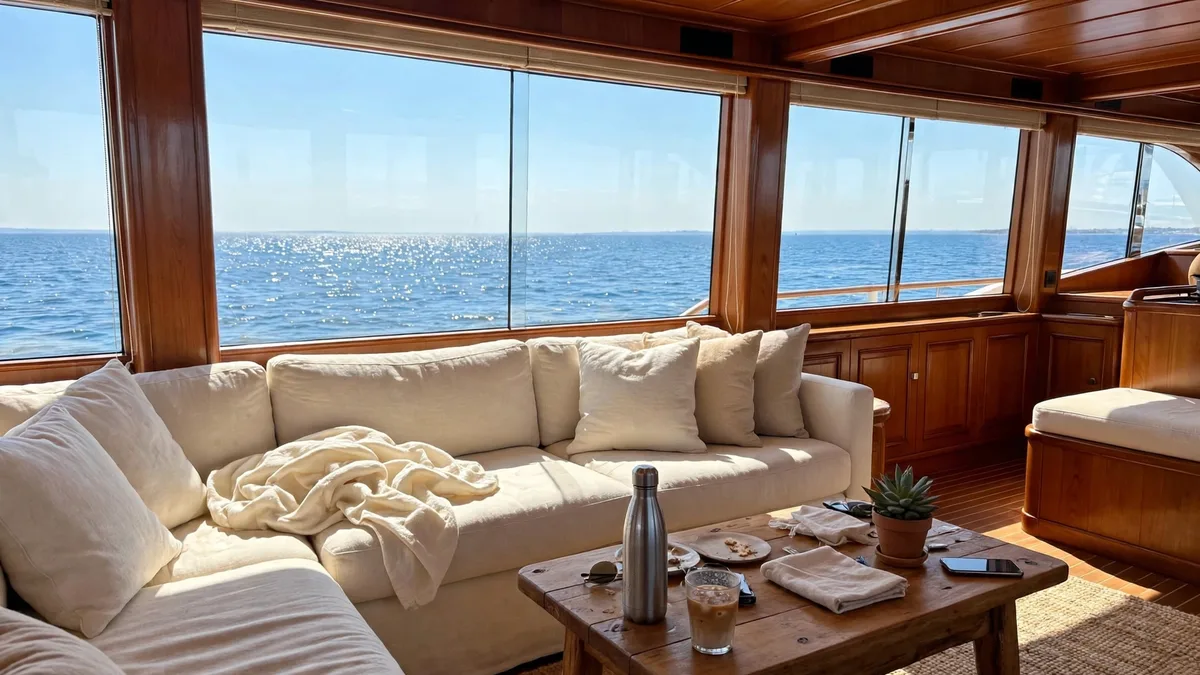
The salon is the room where a yacht stops feeling like a boat. It is wide, bright and calm, with sofas deep enough to sink into, a table that never wobbles, and windows so large the sea feels like a painting hung on the wall. Guests spend most of their waking hours here, and the owner judges the whole yacht by it.
Building it is a joiner’s job on a grand scale. The room is the widest space in the hull, it has to stay level and silent while the yacht rolls, and every piece of furniture must be fixed down without looking fixed down. This is how a luxury yacht salon is made, from an empty white shell to the living room of a floating home.
How It’s Made
Step 1: The shell is levelled and lined
Every salon starts as the widest empty space in the hull, a white steel or aluminium box with ribs, pipes and cable runs crossing it. The builders first level the floor, because a salon floor that slopes by even a few millimetres will make every table look crooked and every guest feel seasick. A self-levelling compound is poured and left to set dead flat.
Then the walls and ceiling are lined. Insulation goes in first, to hush the engines and keep the room cool, followed by a layer of plywood that gives the joiners something solid to fix to. The ceiling is dropped slightly to hide the air conditioning ducts and the wiring, and the whole shell is painted white so the joiners can see every mark they make.
Step 2: The floor is laid
The salon floor is usually pale wood, often bleached oak or pale teak, laid in long planks that run the length of the room. Each plank is glued and pinned to the subfloor, and the joints are kept tight so no dirt can work its way in. On some yachts the centre of the room gets a large rug instead, laid over a wooden border that frames it like a picture.
Once laid, the floor is sanded flat and given a hard-wearing matt finish that will not shine under the lights or show every footprint. The edges are finished with a brass or wood threshold where the salon meets the deck outside, and a shallow step is built in if the deck sits higher than the floor.

Step 3: The furniture is built in
The sofas are the biggest job. They are not bought off the shelf but built into the room, with hardwood frames bolted through the floor so they cannot move in a swell. The cushions are cut from high-density foam and wrapped in leather or outdoor-grade fabric that shrugs off salt air and spilled drinks, and the seams are double stitched.
Tables, sideboards and the bar are built the same way, each one shaped to the curve of the wall behind it. The coffee table gets a fiddle rail around its edge so glasses stay put, and every drawer and cupboard is fitted with soft-close runners and latches that hold in rough water. Nothing in the salon is allowed to slide, rattle or fall.
Step 4: The windows go in
The panoramic windows are the salon’s best feature and its hardest fitting. Each pane is a single sheet of laminated glass, sometimes two metres wide, cut to the exact curve of the superstructure. The glass arrives crated and is lifted into place by suction cups, then set into a rubber seal and bolted frame that must stay watertight in a storm.
Blinds or sheer curtains are fitted inside, running on hidden tracks in the ceiling so they can be drawn without a visible rail. Tinted glass is often used to cut the glare, and on the largest yachts the windows are heated, so condensation never fogs the view on a cold morning at anchor.
Step 5: Lighting, sound and screens are wired
Next come the systems that make the salon work after dark. Dimmable downlights are set into the ceiling in rows, reading lamps are fitted beside the sofas, and a strip of warm light is hidden behind the cornice so the ceiling glows softly. Every circuit runs back to a panel the crew can control from the bridge.
Speakers are set flush into the ceiling and walls, and a large television is hidden behind a panel or inside a cabinet that rises from a sideboard at the touch of a button. The wiring runs through the lining in fireproof conduit, and the whole system is tested for hum and buzz, because a salon with a buzzing speaker is a failed salon.
Step 6: The salon is dressed and sea-trialled
The last step is dressing the room. Cushions are arranged on the sofas, books and a vase of flowers are set on the coffee table, and the bar is stocked with glasses. The crew walk through the room as guests would, sitting on every seat and opening every drawer, to catch anything that catches or creaks.
Then the yacht goes to sea. The builders run the salon through a chop, listening for rattles, watching the glasses on the table and checking that no door swings open. If a sofa creaks or a blind rattles, it comes apart and is refitted. Only when the room stays silent in a swell is it handed over.
| Spec | Detail |
|---|---|
| Shell | Steel or aluminium hull, floor levelled flat, walls and ceiling lined and insulated |
| Floor | Bleached oak or pale teak planks, glued and pinned, matt hard-wearing finish |
| Furniture | Sofas and tables built in and bolted down, leather or outdoor-grade fabric |
| Windows | Laminated panoramic glass, rubber sealed, tinted, sometimes heated |
| Systems | Dimmable lighting, flush speakers, hidden television, bridge-controlled circuits |
| Testing | Sea trial in a chop, checking for rattles, swinging doors and buzzing speakers |
The hardest part of building a luxury yacht salon is keeping it silent. The room is large, the floor is hard and the windows are huge, so every rattle echoes, and the joiners chase noises the owner would never notice on land but cannot ignore at sea.
What One Costs
Fitting out a luxury yacht salon typically costs an estimated $300,000 to $1,500,000, set mostly by the size of the room, the glass and the furniture. A modest salon sits near the bottom, while a full-beam salon with panoramic glass and a bar costs far more. The bar itself is a small fortune, and why a yacht bar costs a fortune breaks down the price, while how a luxury yacht cinema is made shows the darkened room built for film nights at anchor.
A Rare Fact
On many superyachts the salon floor is laid over a layer of cork, not just for warmth underfoot but because cork deadens sound so well that footsteps on the deck above barely reach the cabins below.
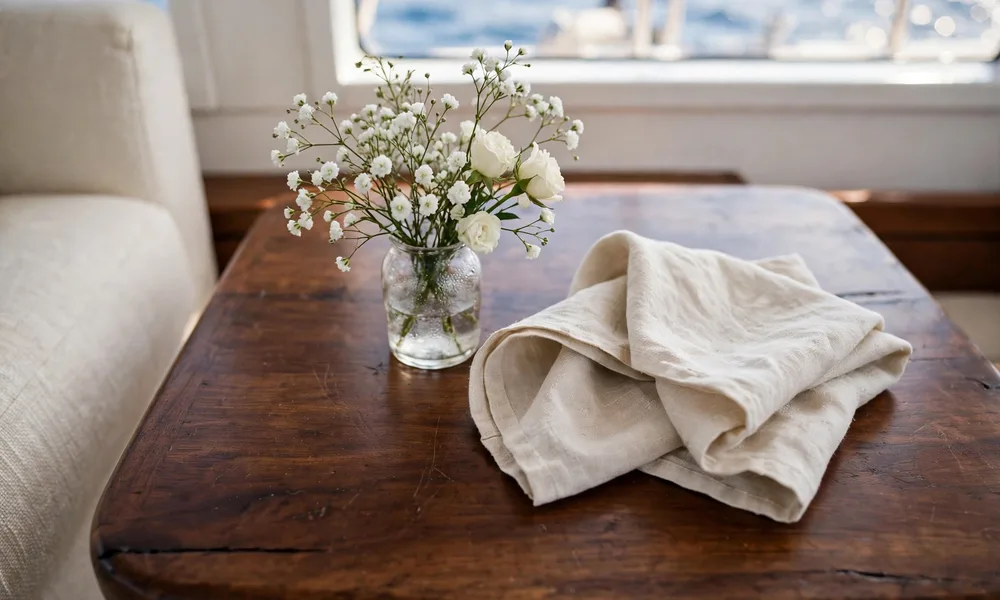
A luxury yacht salon is a levelled shell, a pale wood floor, sofas bolted to the deck, windows as wide as the room and lighting that makes the ceiling glow, all tested in a chop until nothing rattles. It is the room where the yacht earns its keep. For the quietest corner on board, how a yacht library is built shows a room made for reading while the sea goes by.


