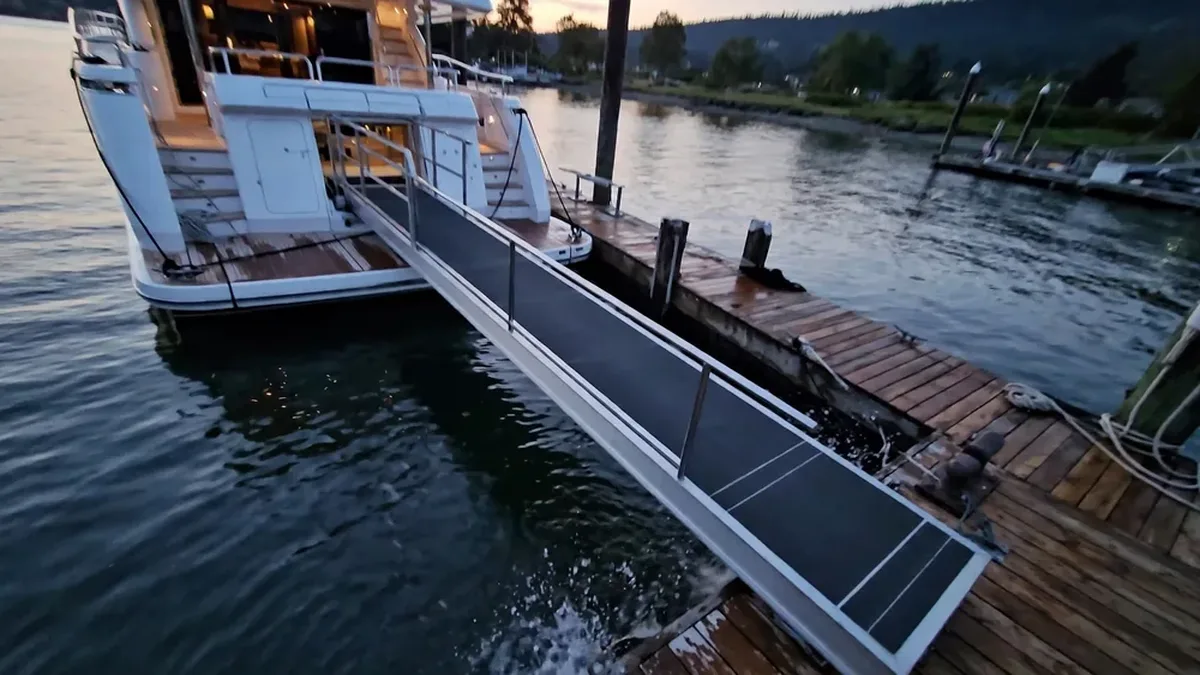
Every guest who boards a luxury yacht walks the same path: down the dock, up a slender bridge of metal and teak, and onto the deck. That bridge is the passerelle, the yacht’s gangway, and it is one of the most expensive pieces of equipment on the boat. A long, hydraulic passerelle on a large yacht can cost more than a house in many towns. Guests see a walkway. The yard sees a crane, a lift, a diving board, and a piece of furniture, all folded into one machine that must work perfectly over open water, every single time, with people standing on it. This article explains where that money goes, and why a simple-looking gangway carries a house-sized price tag.
First, What a Passerelle Has to Do
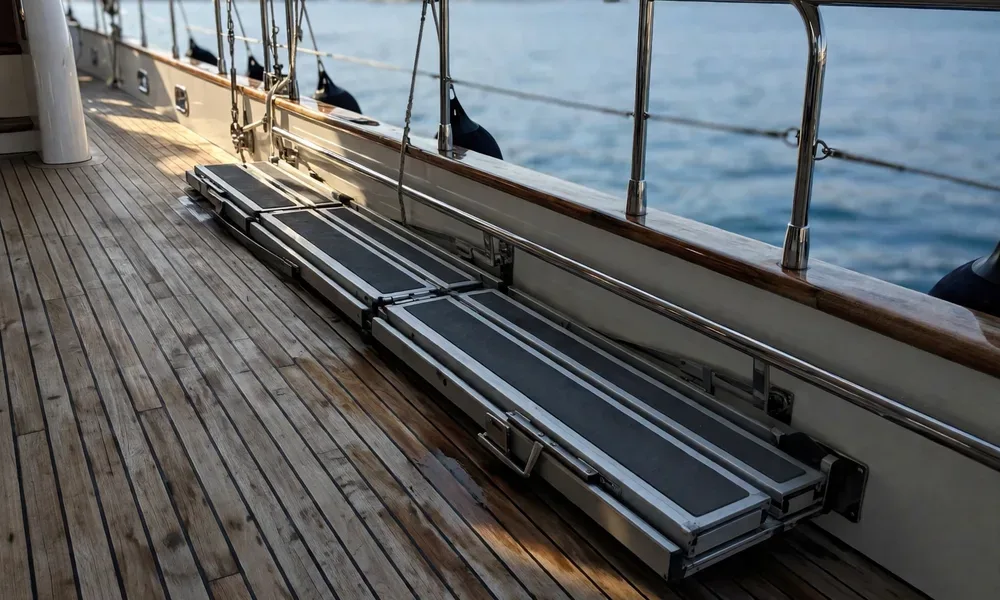
A passerelle is a retractable gangway, usually 4 to 8 metres long, that extends from the yacht’s stern or side to the dock. It must span a gap over water, carry guests and their luggage, rise and fall with the tide, and then fold away neatly when the yacht sails. That is already more than a gangway. On many yachts the passerelle also works as a crane, lifting a tender or a jet ski, and as a swim platform, lowering guests to the water. Some designs rotate, so the same unit can serve the stern or the side. Every one of those jobs adds machinery, and every job must be safe while people are standing on the walkway. A passerelle that fails does not just break. It drops people into the water between a yacht and a dock, which is why the safety margins are so large, and why the price follows them.
The Structure: Light, Stiff, and Beautiful
The walkway itself is a structural beam, usually built from marine-grade aluminium or carbon fibre, with a teak or synthetic deck surface. It must be light enough for one hydraulic cylinder to lift, stiff enough not to bounce underfoot, and strong enough to carry several people plus luggage with a large safety factor. Carbon fibre is the expensive choice, and the light one, but it needs specialist lay-up and curing, and a damaged section cannot be patched by any local yard. Aluminium is cheaper and repairable, but heavier, which means bigger hydraulics and a bigger power draw. Either way, the structure is engineered like a small bridge, with deflection limits measured in millimetres. Guests notice bounce instantly, and a walkway that flexes underfoot feels unsafe even when it is not. The teak surface adds its own cost, because it is laid by hand, caulked seam by seam, and finished to match the deck it folds into.
Hydraulics: The Muscle Under the Teak
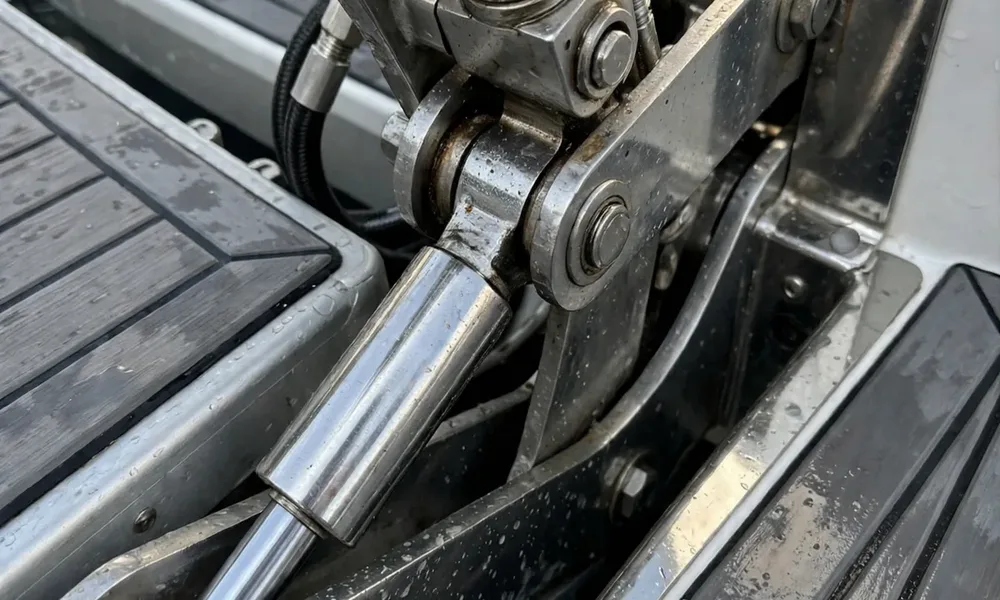
The passerelle moves on hydraulics, and the hydraulic system is the most expensive part of the whole unit. A typical installation uses a power pack, a pair of lift cylinders, and a slew or extension cylinder, all built from stainless steel and sealed against salt water. The cylinders must lift the walkway smoothly, hold it perfectly still while guests cross, and lower it gently onto the dock, all while the yacht moves on its moorings. That means proportional valves, pressure holding, and a control system that compensates for the yacht rolling. If the hydraulics fail, the walkway must not fall. So there are counterbalance valves and mechanical locks that freeze the passerelle in place the moment pressure is lost. The power pack lives in a dry compartment below deck, with hoses routed through the hull, and every fitting is marine grade. A hydraulic leak on a guest walkway is not an option, so the system is built and tested to a standard far above ordinary deck machinery.
Controls That a Guest Can Use Safely
The controls are deliberately simple, usually a small panel or a remote, because the person operating the passerelle may be a crew member in a hurry or a guest with no training. Behind that simplicity sits a control system with position sensors, load sensors, and interlocks that stop the walkway from moving into the dock, the water, or another part of the yacht. The system knows where the walkway is at all times, and it refuses commands that would cause a collision. It also limits speed near the ends of travel, so the walkway never slams into its stops. Building that behaviour takes sensors, wiring, and software, all of it marine-rated and tested in salt air.
Where the Money Goes
As with most yacht equipment, the part guests see is only a fraction of the price. The hydraulics and the structure take more than half, and the controls and the finish take most of the rest. Installation is the final share, and it is not small. Fitting a passerelle means cutting an opening in the transom, reinforcing the structure around it, routing hydraulics through the hull, and testing the whole unit with loads before the yacht is handed over. Certification adds paperwork, because a guest walkway is classed as lifting and access equipment, and the yard must prove it meets the rules.
| Cost driver | Share of the price | Why it costs so much |
|---|---|---|
| Hydraulic system | About 30 percent | Marine cylinders, power pack, safety locks |
| Structure | About 25 percent | Carbon or aluminium beam, hand-laid teak |
| Controls and sensors | About 15 percent | Position sensing, interlocks, remote control |
| Finish and rails | About 15 percent | Polished metal, folding rails, matching teak |
| Installation | About 15 percent | Hull reinforcement, testing, certification |
Why Not Use a Simple Gangway Instead
A plain aluminium gangway costs a tiny fraction of a hydraulic passerelle, and many smaller boats use one happily. The crew carries it out, rests one end on the dock, and guests walk across. It works, but it has limits that luxury yachts cannot accept. A plain gangway cannot adjust to the tide, so at low water it becomes a steep slope and at high water it may not reach at all. It cannot lift a tender, it cannot rotate to the side, and it must be manhandled by the crew in all weather. It also looks like what it is, a ladder with pretensions, which matters on a yacht where every visible fitting is part of the impression. The passerelle earns its price by removing the crew from the job, by adjusting itself to the tide, and by disappearing into the yacht when it is not needed. It is a gangway that behaves like part of the yacht, because it is.
The Price of Never Failing
The real cost driver is the failure rule. A passerelle must never drop a guest, never trap a hand in a hinge, and never fail in a way that strands people on the dock. So every critical part has a backup or a safe state, and the whole unit is tested far beyond its rated load. That testing, and the engineering behind it, is what turns a walkway into a house-priced machine. Owners pay it because the passerelle is the first thing a guest touches and the last thing they remember, and because a yacht that cannot board its guests safely cannot be used at all. It is a gangway, a crane, and a lift in one, built to yacht standards, and priced like it. To see its simpler cousin, read how a luxury ship gangway is made, our guide to how a luxury ship deck works, and why a luxury yacht tender garage is so expensive.


