Every swim from a yacht ends the same way: a tired swimmer, wet hands, and a short climb back to the deck. The ladder that makes that climb possible looks simple, just a few steel tubes and rungs, but on a luxury yacht it is one of the most carefully built pieces of hardware on board. It must hold a grown adult in a swell, fold away without rattling, and still look like it belongs on a beautiful boat.
A cheap ladder bends, wobbles, and rusts. A yacht ladder does none of those things, because it is made from marine-grade steel, welded by hand, polished to a mirror shine, and tested far harder than any swimmer will ever test it. This is how a luxury yacht swim ladder is made, from a length of raw tube to the last polished rung.
How It Is Made
Step 1: Choosing steel that can live in salt water
Everything starts with the choice of steel. A yacht swim ladder spends its life half in salt water and half in sea air, the two things that eat ordinary metal fastest. So builders use marine-grade stainless steel, usually the 316 grade, which contains molybdenum, an element that helps the metal resist the pitting and staining that salt water causes.
Each length is checked for straightness, a clean surface, and the mill certificate that proves the grade, because the wrong steel will look perfect on delivery day and show rust spots within a single season.
Step 2: Cutting and bending the frame
Once the steel is approved, the ladder is measured out and cut. The two side rails are cut first, then the rungs, then the short arms that connect the ladder to the transom. Each cut is made with a saw or a laser cutter, and the ends are cleaned so that no rough edge or burr is left behind, because a burr is a place where corrosion starts and where a bare foot can be cut.
Then the rails are bent. A swim ladder needs gentle curves, not sharp corners: the top of each rail curves over to form a handhold, and the bottom curves slightly so the ladder stands away from the hull. The bending is done on a mandrel bender, a machine that supports the tube from the inside while it bends, so the tube keeps its round shape instead of flattening or wrinkling at the curve.
Step 3: Welding the rungs in place
With the rails shaped, the rungs are welded in. Each rung is set into its place with a jig, a steel frame that holds every part at exactly the right angle and spacing, so that all the rungs are level and evenly spaced. A rung that is even slightly crooked is obvious to anyone climbing the ladder, and it makes the ladder feel unsafe.
The welding is done with TIG welding, a precise method that uses a tungsten electrode and an inert gas shield. The welder works slowly, fusing each joint with a small, neat bead, keeping the heat low so the steel keeps its corrosion resistance. When the welds cool, they are ground smooth and blended into the tube, so the joints feel like part of the ladder rather than lumps stuck onto it.
Step 4: Building the hinges and the folding frame
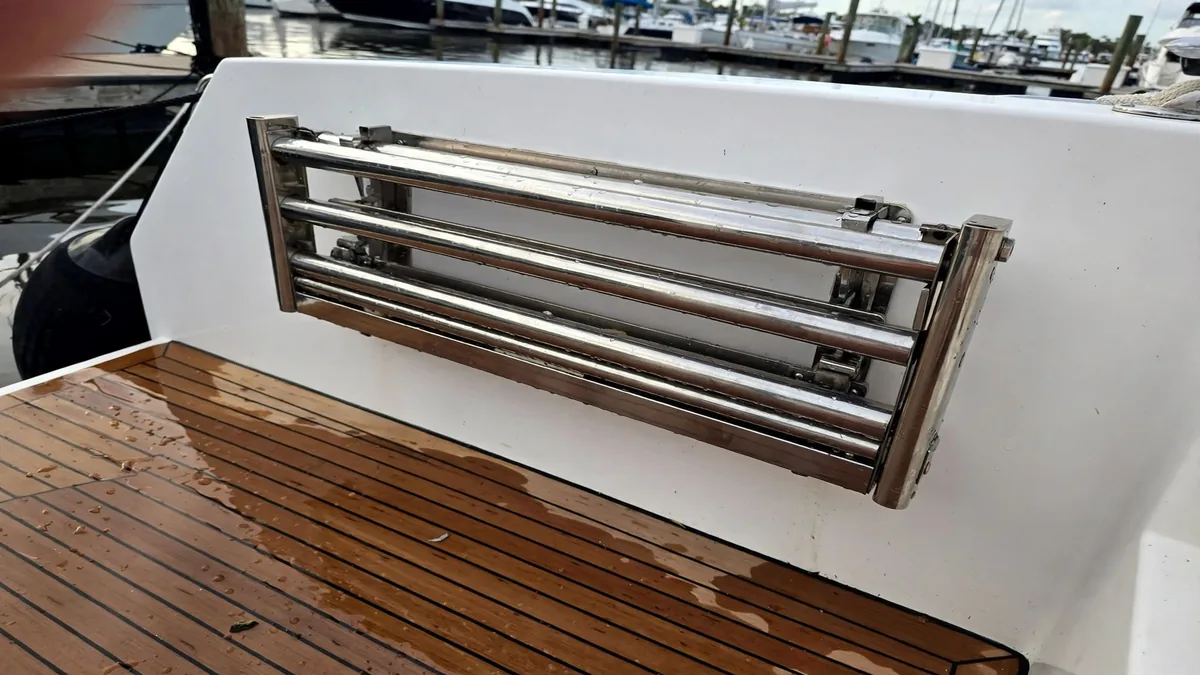
A yacht swim ladder must fold away. When the boat is under way, the ladder is folded flat against the transom or tucked under the swim platform, out of the water and out of the way. That means the ladder needs hinges, and the hinges are the hardest part of the whole build, because they must move freely for years without loosening or seizing up.
The hinge plates are cut from thicker stainless steel and drilled for pins, and the pins themselves are made from a harder grade of steel so they do not wear. Each hinge is fitted by hand, tested through its full range of movement, and adjusted until the ladder swings smoothly and locks firmly in both its open and folded positions. A ladder that rattles at sea is a ladder that was built badly, and owners notice the rattle long before they notice anything else.

Step 5: Adding grip so wet feet do not slip
Steel is slippery when wet, and a swim ladder is always wet, so grip is designed into the rungs rather than added as an afterthought. Some ladders use rungs with a flattened top, others use a rubberised tread, and the best ones use a teak or synthetic teak insert, which stays grippy when soaked and matches the teak of the swim platform.
The treads are fitted one by one and fastened with stainless screws that sit flush with the surface, so nothing catches a toe. Then the whole ladder is tested with wet feet, again and again, because a ladder that is beautiful but slippery is a ladder that will hurt someone. The test is simple and it is honest: climb it wet, climb it tired, and see how it feels.
Step 6: Polishing, passivating and testing the load
The last stage is the finish. The whole ladder is polished, first with coarse abrasives and then with finer and finer compounds, until the steel shines like a mirror. Polishing is not only about looks: a smooth surface gives salt and dirt nowhere to grip, so a polished ladder resists corrosion far better than a rough one.
After polishing, the ladder is passivated, a chemical treatment that restores the invisible chromium oxide layer on the surface of the stainless steel, the layer that actually protects it from rust. Then comes the load test. The ladder is mounted on a test frame and loaded with far more weight than any swimmer will ever put on it, and it must hold that weight without bending, creaking, or loosening a single hinge.
Only when it passes the load test is the ladder packed for the yacht. It travels wrapped in soft cloth, and a specialist fits it on board, bolting it through solid backing plates and checking the fold and the lock one final time. From the deck it looks like a simple set of rungs, but every tube, weld, and hinge has been made to survive years of salt, sun, and wet feet.

Why It Matters
The swim ladder is the part of the yacht that guests touch most, and it is the part that decides whether a swim feels easy or feels like a struggle. A well-made ladder invites people into the water and brings them back safely, and it does that job for years without asking for attention. That is the quiet test of luxury: not how something looks on the day it is delivered, but how it still works, and still shines, after a thousand swims. A ladder like the one on a luxury yacht swim platform shows the same thinking, where the platform and the ladder are designed together so the step from the water to the deck feels natural. The same care goes into why a luxury yacht swim platform costs so much, and into the passerelle that carries guests ashore, because every way on and off a yacht is built to the same standard.


