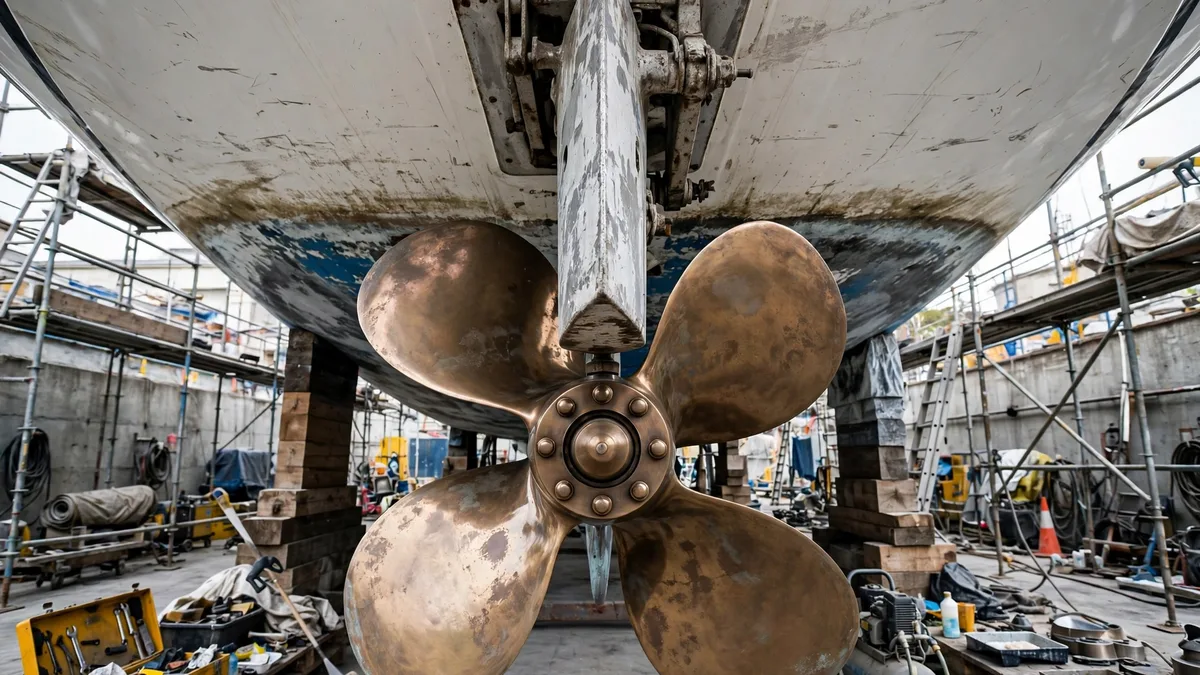
It is first light in the boatyard, and the yacht stands on blocks like a beached whale, her white hull towering over the concrete. All eyes are on the stern, where a four-bladed bronze propeller hangs in the open air, big as a cartwheel, catching the low sun. For eleven months a year this piece of metal lives underwater, ignored. Today, out of the water and dripping, it is the most interesting thing in the yard.
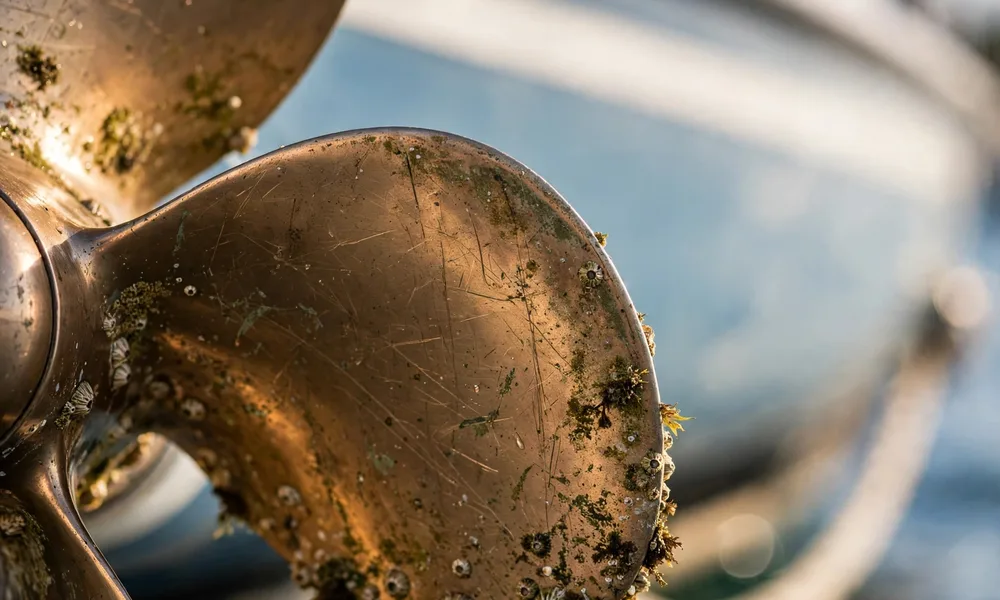
Stand close and you can see the propeller is not flat like a fan. Each blade is twisted, like the blade of a screw, and polished to a dull gold by the water itself. Barnacles cling to the hub, and a faint green stain marks where the bronze has met the sea. It looks simple — a lump of metal bolted to a shaft — yet this is the entire engine of the yacht, in the sense that matters most. Everything else on board exists to turn this one thing.
A modern yacht’s hull may be assembled from sections built in different yards, as modular ship construction has made large vessels faster to build, but the propeller is always fitted last, by hand, in a dry dock like this one. It is measured and balanced with the care of a watchmaker, because a propeller wrong by a few millimetres will shake the whole yacht and wear out its own shaft. Here is what the numbers stamped on it actually mean.
How It Works
Step 1: Blade pitch — the screw in the water
A propeller works like a screw going into wood. Each blade is twisted at an angle, and that angle is called the pitch — the distance the propeller would travel forward in one full turn if it were screwing through a solid. In water it slips, so it advances less: a high-pitch propeller is like a high gear, fast at speed but slow to get going, while a low-pitch propeller is like a low gear, quick off the mark but limited at the top end.
Step 2: Rotation and thrust
When the engine turns the shaft, each blade bites into the water at its twisted angle, pushing water backwards — and the water pushes the blade, and the yacht, forwards. That is thrust, the same action-reaction that drives an aeroplane propeller through air, only water is about 800 times denser, so the forces are far larger and the blades spin far slower. A yacht propeller turns at a few hundred revolutions per minute, and every turn must be smooth: vibration travels straight up the shaft into the cabins, which is why a well-matched propeller works hand in hand with systems like yacht gyroscopic stabilizers to keep the ride calm.
Step 3: Cavitation — when water boils cold
Spin a blade fast enough and the pressure on its back face drops so low that the water itself boils — not from heat, but from lack of pressure. Tiny bubbles of vapour form, then collapse violently as they reach higher-pressure water. That collapse is cavitation, and it is brutally destructive: the collapsing bubbles hit the blade like microscopic hammers, pitting the bronze and, over time, eating holes clean through it. A cavitating propeller also loses grip and rattles. The cure is a bigger, slower-turning propeller with more blade area, which spreads the load and keeps the pressure up.
Step 4: Blade count and diameter
Most yacht propellers have three or four blades. Three blades are slightly more efficient because each blade works in cleaner water, but four blades run smoother, spread the load, and absorb high power without cavitating. Five blades appear on larger yachts, where smoothness matters most. Diameter matters too: a bigger propeller moves more water more slowly, but it needs clearance under the hull — usually at least 15 percent of the diameter between blade tip and hull — or the pressure pulses will thump against the plating.
Step 5: Folding and feathering props
Sailing yachts face a special problem: with the engine off and the yacht under sail, a fixed propeller drags through the water like an open parachute, slowing the boat by as much as a knot. The answer is a propeller that gets out of its own way. A folding propeller has blades hinged at the hub that fold flat against the shaft when the engine stops, like a closing umbrella. A feathering propeller goes further: its blades rotate edge-on to the flow, presenting almost no resistance, then twist back into position when the engine engages. Both cost more than a fixed propeller, but they can be worth a full knot of speed.
Step 6: Matching the prop to the hull and engine
No propeller works on its own — it is one part of a chain running from the engine, through the gearbox and shaft, to the hull moving through the water. Engineers match them by working backwards from the yacht’s target speed: the hull sets how much power is needed, the engine and gearbox set how fast the shaft can turn, and the propeller is sized to absorb exactly that power at exactly that speed. Get it wrong and the engine either over-revs without reaching speed or labours under load. The same discipline shapes the hull itself, as explained in superyacht hull construction. A well-matched propeller lets the engine reach its full rated revs at full throttle.
Yacht Propeller Specs
| Specification | Typical range |
|---|---|
| Diameter | About 12 to 40 inches (30 to 100 cm) |
| Pitch | About 10 to 30 inches (25 to 76 cm) |
| Number of blades | 3 to 5 blades, most commonly 3 or 4 |
| Material | Nickel-aluminium bronze, manganese bronze, or stainless steel |
| Weight | About 10 to 150 kg depending on size |
| Maximum RPM | About 800 to 2,000 RPM at the shaft |
| Efficiency | About 50 to 70 percent at cruising speed |
| Shaft size | About 25 to 75 mm diameter |
What Does a Yacht Propeller Cost?
A fixed three-blade bronze propeller for a small sailing yacht is estimated to cost roughly $500 to $2,000, while a larger four- or five-blade propeller for a motor yacht is estimated to cost roughly $3,000 to $15,000, and a folding or feathering propeller roughly $4,000 to $12,000. Custom propellers for superyachts are estimated to cost $50,000 or more. Prices are estimates only and vary by size, material, and blade count. Fitting and balancing are usually charged on top.
A Rare Fact
The screw propeller is barely older than the railway. In 1836, the English inventor Francis Pettit Smith fitted a wooden screw to a small boat and demonstrated it on a pond in Hendon, north London — the screw had broken in a test, leaving only a stub, and Smith noticed the boat went faster with the shorter screw. Three years later, in 1839, the steamship Archimedes was launched with a screw propeller and proved the idea at sea, even winning a tug-of-war against a paddle steamer. Within a decade the screw had replaced the paddle wheel at sea, and the yacht propeller in the boatyard today descends directly from that broken wooden screw.

Next time a yacht glides past, silent and effortless, remember what is doing the work below the waterline: a twisted piece of bronze, turning a few hundred times a minute, screwing its way through the sea.