Press the power button on a luxury gaming PC and nothing happens for half a second. Then the fans spin up with a soft rush, strips of light bloom along the case, and the screen fills with a game world so detailed you can see rain on a window and dust in a sunbeam.
A luxury gaming PC is not just a fast computer with a bigger price tag. It is a machine built around a single job, rendering interactive worlds at high speed, and every part is chosen for that job. The processor and the graphics card are the stars, but the power supply, the cooling and the case matter just as much, because a fast chip that overheats will slow itself down to survive, and a beautiful machine that crashes mid-game is worth nothing.
Here is what happens inside that glowing box, from the press of the button to the frame on your screen.
How It Works
Step 1: Power arrives clean and steady
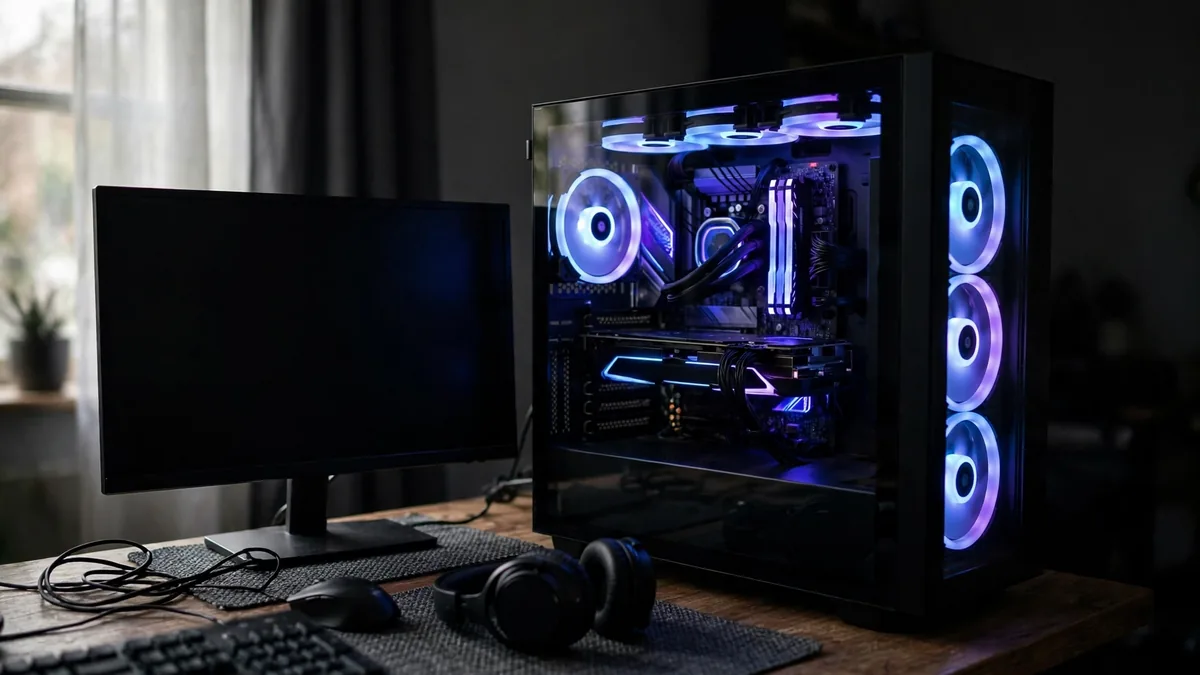
Everything begins at the power supply, a heavy metal box at the bottom of the case that turns mains electricity into the low, stable voltages the components need. A luxury build uses a high-wattage supply, often 850 watts or more, with an efficiency rating that keeps waste heat low and a modular design that lets the builder use only the cables the machine needs. Inside, capacitors smooth out ripples in the current, because a spike or a dip can crash a game or corrupt a file. When you press the power button, the supply wakes the motherboard first, which checks that every part is present and healthy before it lets the processor start.
Step 2: The processor thinks in billions of steps
The central processor is the machine’s brain, a chip the size of a postage stamp holding billions of transistors. It runs the game itself: the rules, the physics, the artificial intelligence of the enemies, and the instructions that tell the graphics card what to draw. It works by fetching an instruction from memory, executing it, and storing the result, billions of times a second. A luxury gaming processor has many cores, so it can run the game, the operating system, a voice chat and a recording program at the same time without stumbling.
Step 3: The graphics card paints the world
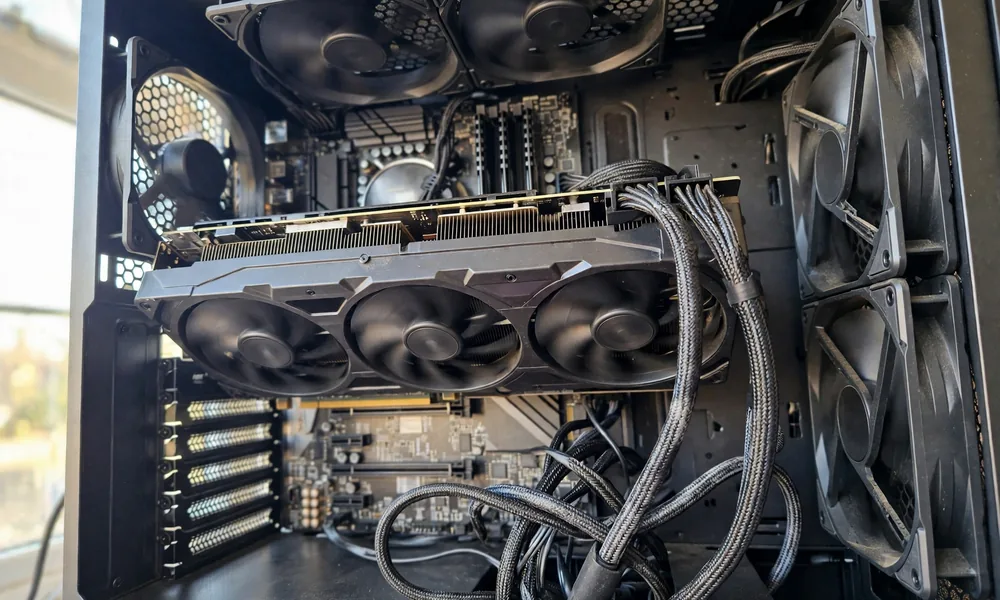
The graphics card is the largest and most expensive part of the machine, and it does the work you actually see. It takes the three-dimensional world the processor describes and turns it into a flat image, sixty or a hundred and forty-four times a second. Its thousands of small cores work in parallel, calculating light, shadow, reflection and texture for millions of pixels at once. Modern cards also trace rays of light the way they behave in the real world, which is why reflections in puddles and glass look so convincing.
Step 4: Memory and storage feed the machine
A fast processor and graphics card are useless if they spend their time waiting, so memory and storage are built for speed. The main memory holds the parts of the game the machine is using right now, and it is fast enough to deliver data in billionths of a second. The storage, usually a solid-state drive that slots directly onto the motherboard, holds the game itself, and a luxury build uses a drive fast enough to load a whole level in seconds rather than minutes.
Step 5: Cooling keeps the speed alive
Heat is the enemy of speed. As chips get hotter they slow themselves down to avoid damage, a process called throttling, and a luxury PC is designed to stop that happening. Air-cooled builds use large heatsinks and several fans that pull cool air in at the front and push hot air out at the back. Liquid-cooled builds go further, pumping coolant through a block on the processor and out to a radiator where fans blow the heat away. The case is designed as a wind tunnel, with vents, dust filters and cable channels that keep the airflow smooth. Temperature sensors report to the motherboard, which speeds the fans up only when it needs to, so the machine stays quiet when you are browsing and loud only when you are gaming hard.
Step 6: The motherboard and software conduct the whole machine
The motherboard is the nervous system that ties everything together, carrying power and data between the processor, graphics card, memory and storage on traces finer than a hair. It also carries the network chip that connects you to other players, the audio chip that drives your headphones, and the ports for your keyboard, mouse and monitor. When the machine is running, the operating system and the graphics driver act as conductors, scheduling work, managing memory and translating the game’s instructions into something the hardware understands. A frame is only finished when every part has done its job in order, and then the graphics card sends it to the monitor, where it appears for a fraction of a second before the next one takes its place.
| Specification | Typical figure |
|---|---|
| Processor | High-end multi-core CPU, billions of transistors |
| Graphics card | Flagship GPU with thousands of cores and its own memory |
| Memory | 32 GB or more of fast RAM |
| Storage | 1 to 2 TB solid-state drive |
| Power supply | 850 W or more, high efficiency, modular cables |
| Cooling | Air or liquid cooling with temperature-controlled fans |
What One Costs
A luxury gaming PC typically costs an estimated $3,000 to $8,000, with extreme builds reaching $10,000 or more once custom cooling, a premium case and top-end parts are included. The graphics card alone can account for half the price, and the rest goes to the processor, memory, storage and the cooling that keeps them running at full speed. The machine is also upgradeable in a way a console is not: a new graphics card in two years can give it a second life, which is part of why people spend so much on the case and power supply in the first place. The graphics card is the heart of the whole thing, and how a gaming GPU works explains the painting engine in detail, while how a laptop vapour chamber works shows how the same heat problem is solved in a machine a fraction of the size.
A Rare Fact
The most powerful gaming graphics cards draw so much electricity that, under full load, a single card can use more power than a microwave oven. That is why the power supply, the cooling and the case matter as much as the chip itself: the machine is not just computing, it is managing a small furnace. Some luxury builders even run two separate power supplies in one case, one for the graphics card and one for everything else, just to keep the power delivery clean when the card suddenly demands a surge of current in the middle of a game.
A luxury gaming PC is easy to judge by its lights and its price, but the real luxury is invisible: it is the absence of waiting, stuttering and crashing. Every frame arrives on time, every texture loads before you see it, and the machine stays cool and quiet while doing work that would have needed a room full of computers a generation ago. If you want to know why a luxury gaming PC is so expensive, the answer is not one part but the whole system, tuned so that nothing ever has to wait for anything else.