It starts with a spark and a hiss, and a light so bright that a welder has to hide behind a darkened visor to look at it. Two pieces of steel lie on a bench, separate and cold. A few seconds later they are one piece, joined by a seam of metal that was liquid a moment ago and is now stronger than the steel around it. That is welding: melt the edges, let them flow together, and let them freeze as one piece.
Welding holds the modern world together — bridges, ships, submarines and skyscrapers. Yet the weld itself is a line of metal a few millimetres wide. If it is wrong — too cold, too fast, or full of tiny bubbles — the joint can fail without warning, years later. This is how welding steel works, and why the welds that matter most are watched more closely than almost anything else in engineering.
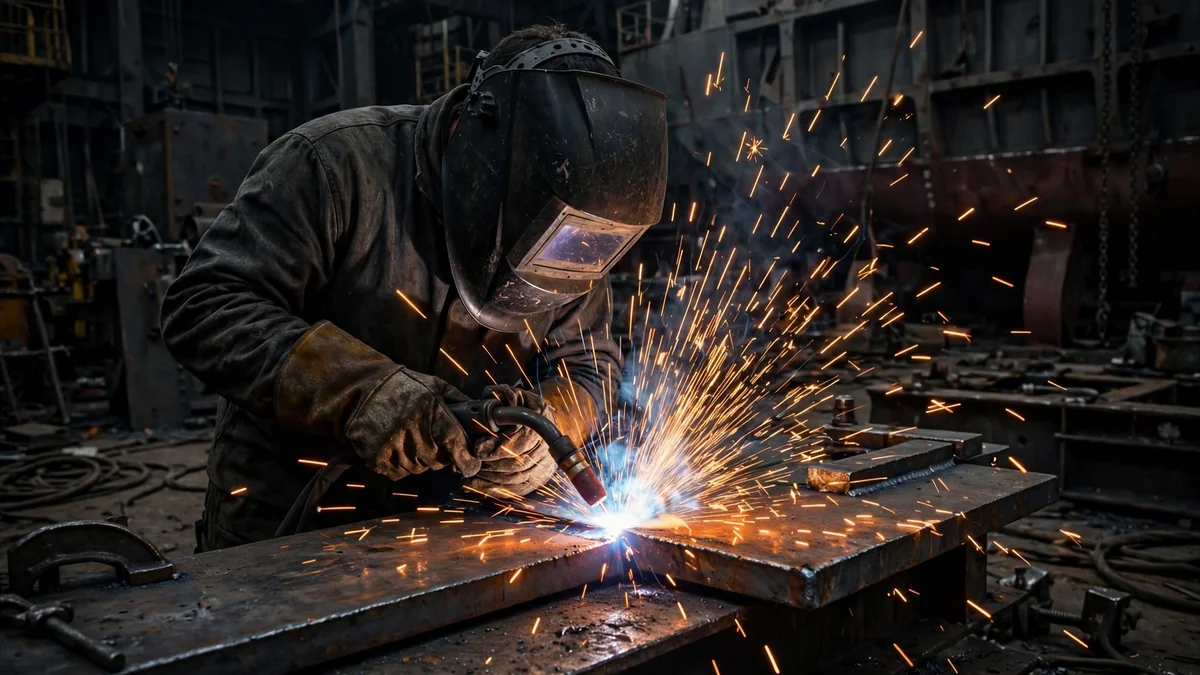
How It Works
Step 1: Preparing the joint
Every good weld begins before the torch is lit. The two pieces of steel are cut to shape, and their edges are ground into a V, so the molten metal can reach all the way through the joint. The steel is cleaned until it shines, because rust, paint, oil and even a fingerprint can end up trapped inside the weld as a flaw. The pieces are clamped in place, with a gap of a few millimetres between them. The fitters check the alignment, because a weld freezes the pieces exactly where they are.
Step 2: Striking the arc
Most steel welding today uses an electric arc, a spark held between the tip of the torch and the steel. The welder strikes it like a match, and the arc burns at around 3,500 degrees Celsius, far hotter than the melting point of steel. The edges melt into a small pool, and filler wire is fed in to fill the gap. The pool is only a few millimetres across, and the welder moves it slowly along the joint while the metal behind it cools and freezes into the weld.
Step 3: Shielding the molten metal
Molten steel is hungry for oxygen. Left in open air, it would grab oxygen and nitrogen from the atmosphere and turn brittle, full of pores like a sponge. So the weld is shielded while it is liquid. In one method, flux on the filler wire burns into a shielding gas cloud; in another, argon or carbon dioxide is blown over the weld from the torch. The shield lasts only while the metal is hot. If the wind blows it away, or the gas runs out, the weld is ruined, and the only fix is to grind it out and start again. The same care with heat and atmosphere matters in carbon fibre curing, where conditions must be controlled just as carefully.

Step 4: Building the weld in passes
A thick piece of steel cannot be welded in a single pass. The joint is filled layer by layer, like building a wall, with each pass melting into the one below it. Between passes, the welder chips away the slag and brushes the surface clean. On a submarine hull or a pressure vessel, a single joint can take dozens of passes, and a whole structure can hold kilometres of weld. The welder follows a written procedure, tested first on sample joints that are cut apart and examined.
Step 5: Controlling the heat
Heat is the welder’s tool and its enemy. Too little heat and the weld does not fuse with the steel; too much and the steel around the joint changes its structure and becomes brittle. Thick steel is often preheated so the weld cools slowly, and heated again afterwards to relieve locked-in stresses. Getting the heat right is a skill learned over years, and it is why the best welders are paid like specialists. It demands the precision of titanium machining, where a tiny error can ruin an expensive part.
Step 6: Inspecting every inch
When the weld is finished, it is inspected as if lives depend on it, because they often do. First a visual check, then deeper tests. Ultrasound is sent through the weld, and any flaw inside it bounces the sound back like an echo. X-rays are taken, the same way a doctor X-rays a broken bone, and a dark line on the film shows a crack. On the most critical work, every weld is tested, and any that fails is cut out and welded again from scratch.

Step 7: Proving the joint and protecting it
The last step is to prove the weld and protect it for its working life. Sample welds are pulled apart to prove they are stronger than the steel around them, and the finished structure is load- or pressure-tested before use. Then the weld is cleaned, primed and painted, because a bare weld rusts first. On a ship, the welds are checked again at every dry docking, for the whole life of the vessel. The same rhythm runs through modern shipbuilding, where whole sections are welded separately and joined, as in modular ship construction.
Specs
| Specification | Typical figure |
|---|---|
| Arc temperature | Around 3,500°C at the tip of the arc |
| Melting point of steel | Around 1,370 to 1,540°C, depending on the alloy |
| Common methods | Stick (SMAW), MIG (GMAW), TIG (GTAW), submerged arc |
| Shielding gas | Argon, carbon dioxide, or a mix of the two |
| Joint types | Butt, fillet, lap, corner and edge joints |
| Weld passes on thick steel | Dozens of passes for a single thick joint |
| Inspection | Visual, ultrasound, X-ray and magnetic particle testing |
| Acceptance standard | Zero cracks; flaws above a set size are cut out and re-welded |
Price
Welding itself is priced by the job, not by the weld, and the range is wide. As an estimate, a qualified welder in a shipyard or fabrication shop typically earns roughly $25 to $45 an hour, and a single day of specialist welding on a large structure can cost a few thousand dollars in labour, materials and inspection — these are estimates, and rates vary widely by country, skill and setting. The expensive part is rarely the welding itself: it is the inspection, testing and rework. On a submarine or a pressure vessel, the inspection alone can cost as much as the welding, because every weld is X-rayed and checked.
A Rare Fact
The first underwater welding was done in the nineteenth century, but the welders had a problem: the electric arc kept going out, and the water kept getting in the way. The solution was to weld inside a bubble. Early underwater welders worked in a diving bell, with the water pumped out, and only later did welders learn to weld in the open water itself, shielded by a cloud of gas from the arc. Even today, deep-water welders work cold, dark and under pressure, with the arc burning underwater in front of their face.
From a spark in a dark workshop to a seam that holds back the ocean, steel welding is a craft where a few seconds of heat decide whether a structure lasts for decades or fails without warning. The weld is small, the skill is large, and the inspection is relentless. That is why the welds that matter most are made as if a life depends on them — because one usually does.


