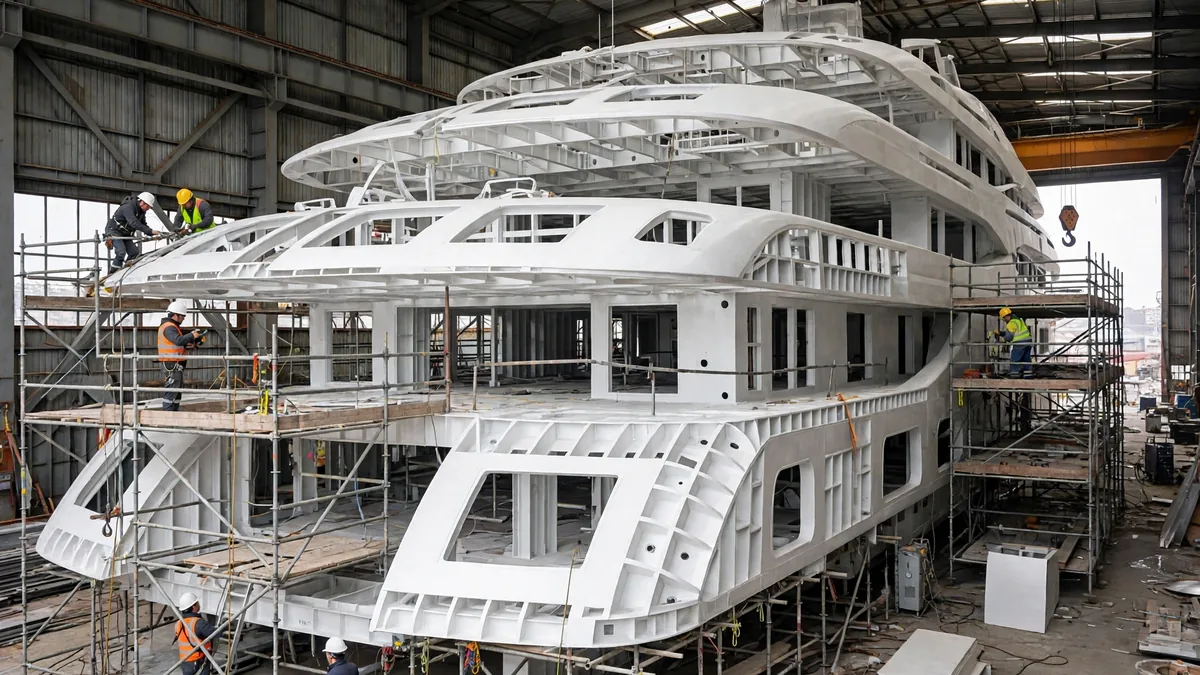
Walk through a superyacht shed at dusk and the first thing you notice is how quiet the biggest object in the room is. The aluminium superstructure rises above you in smooth white curves, window openings cut like dark slots, decks stacked one over the other like the floors of a small hotel. It looks light enough to float on a breeze, and that is exactly the point. Everything above the steel hull of a superyacht is built from aluminium so the vessel can carry more glass, more cabins and more toys without sitting too low in the water.
What you are looking at is not a shell bolted onto a hull. The superstructure is the yacht’s upper world: the bridge, the owner’s deck, the guest cabins, the saloon and the sun deck, all joined into one rigid structure that has to survive storms, flex with the hull beneath it, and stay silent while guests sleep. A superyacht aluminium superstructure is one of the most expensive structures afloat for its weight, and the reasons are hidden inside the metal.
Why It Costs So Much
The price of an aluminium superstructure is not the price of aluminium. Raw marine-grade plate is only a small part of the bill. The real money goes into turning soft, heat-sensitive metal into a fair, watertight, fire-safe structure that will last for decades at sea, and into doing it once, because there is no cheap way to fix a superstructure that was built wrong. A yard that rushes this work ends up with cracked welds, wavy paint and a yacht that creaks in a seaway.
1. Marine-grade aluminium, certified plate by plate
A superyacht superstructure is built from marine-grade aluminium alloys, usually 5083 plate and 6082 extrusions, chosen because they resist seawater corrosion and weld without cracking. Every plate arrives with mill certificates tracing it back to the furnace it was cast in, and classification surveyors can ask to see them at any time. The materials behind a superyacht aluminium superstructure explain why the alloy grade matters more than the thickness, and why the yard pays a premium for plate it can trust.
2. Shaping curves that refuse to stay flat
Aluminium plate arrives flat, and a superstructure is anything but flat. Each panel is cut, rolled and pressed into compound curves, some of them gentle across a deckhead, some of them tight around the bridge front and the funnel casing. The work is done on rolling machines and with careful heat treatment, because aluminium remembers every bend and springs back if it is forced.
3. Welding that fights heat at every step
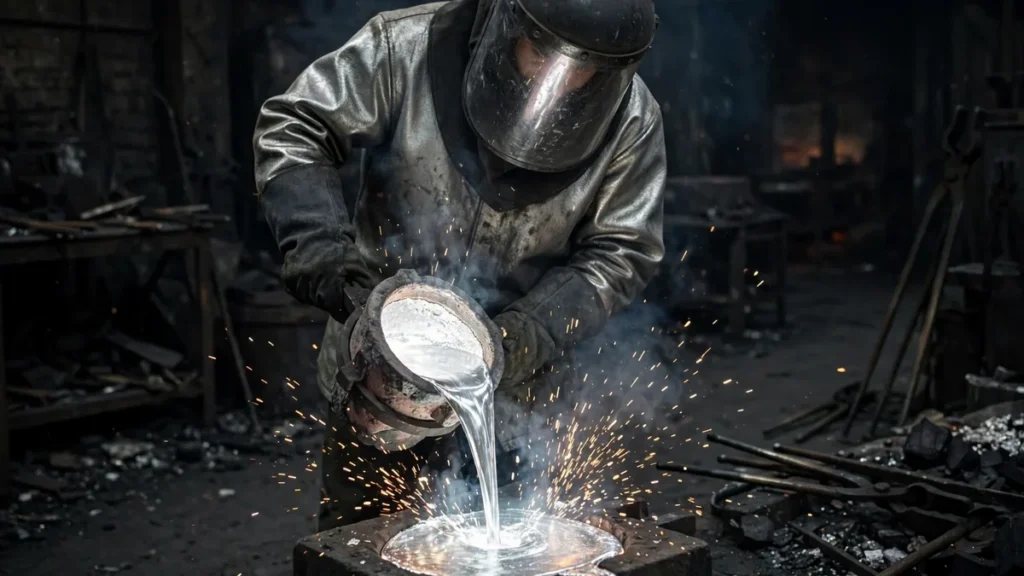
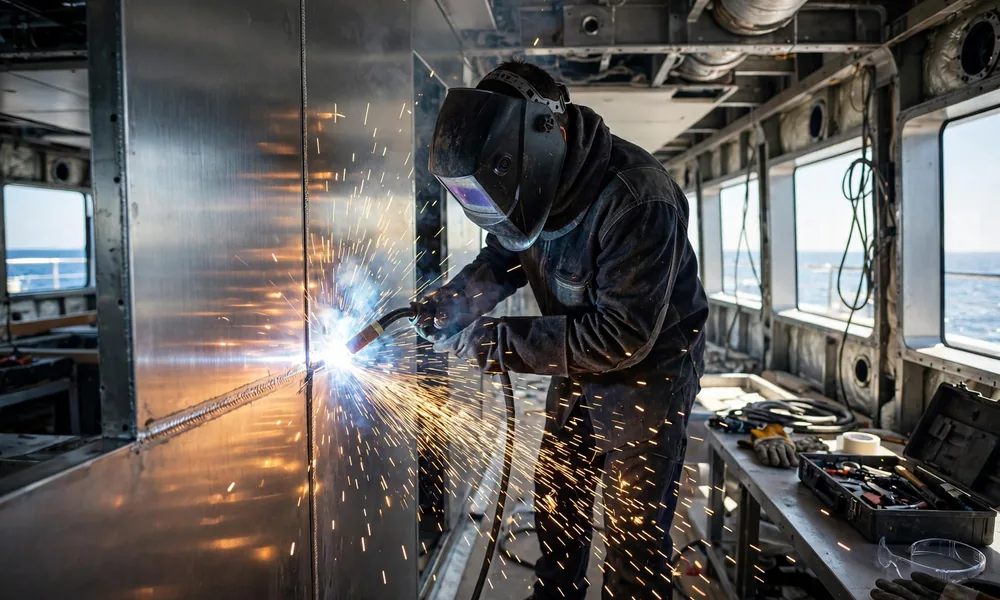
Aluminium welding is far harder than steel welding, and it is where much of the cost hides. The metal conducts heat away from the weld so fast that the welder must pour in energy to keep the puddle molten, yet too much heat softens the alloy around the joint and weakens it. Welders on a yacht project are certified to strict standards, and their work is checked by dye-penetrant testing, ultrasonic testing and X-ray, not just by eye. How a superyacht aluminium superstructure is made walks through the build step by step, and the welding and its inspection thread through every one of those steps.
4. Fairing a superstructure to mirror smoothness
This is where a yacht superstructure stops being a ship and starts being a luxury object. Once the aluminium shell is welded, the surface is far from smooth, because every weld shrinks as it cools and pulls the plate into shallow dips. The yard applies fairing compound, sands it, checks it with long straightedges and raking light, and repeats the process again and again until the surface is fair to within a millimetre or two over its whole length.
5. Joining aluminium to a steel hull without corrosion
The superstructure sits on a steel hull, and steel and aluminium are natural enemies in seawater. Where the two metals meet, the yard must fit an insulating barrier and a bimetallic transition joint, usually an explosively bonded strip of steel and aluminium, so the joint cannot become a battery that eats the aluminium away. The joint has to carry the full bending load of the superstructure while keeping the metals electrically apart.
6. Fire, noise and insulation that guests never see
Inside the white shell is a second structure that nobody photographs. Fire insulation blankets the decks and bulkheads so a fire in one cabin cannot reach the next, and floating floors and resilient mounts keep engine vibration and wave noise out of the guest cabins. How a superyacht aluminium superstructure works shows how the shell, the insulation and the structure work together, and why a superstructure that looks simple from the quay is really three structures in one.
What the Numbers Say
| Specification | Aluminium superyacht superstructure |
|---|---|
| Main material | Marine-grade 5083 aluminium plate |
| Typical plate thickness | 6 to 12 mm, heavier at deck and bridge |
| Typical length | 40 to 100 metres of superstructure |
| Structure weight | One-third the weight of the same steel structure |
| Build time | One to two years for the superstructure alone |
| Fairing tolerance | Within a few millimetres over the full length |
| Design life | Thirty years or more with proper maintenance |
What It Costs, and Why
An aluminium superstructure for a large superyacht typically costs an estimated $8 million to $25 million to build, depending on size and complexity, and the superstructure alone can be a fifth or more of the finished yacht’s price. The figure is an estimate because no two yachts are alike: a longer superstructure needs more plate, more welding and more fairing, and a superstructure with a helicopter deck, a swimming pool or a glass observatory costs more still. The labour, the inspection, the fairing and the insulation are where the money goes.
That cost is spread over very few superstructures. A leading yard might deliver a handful of large yachts a year, so the cost of the shed, the dry dock, the rolling machines and the specialist workforce is divided among a tiny number of projects.

Why the Price Stays High
The price stays high because the work cannot be automated away. Robots can weld a car body a thousand times a day, but every superyacht superstructure is a one-off, with curves that change from one project to the next. The fairing is done by hand, the welding is done by certified people, and the inspection is done by surveyors who answer to a classification society, not to the yard.
There is also the matter of what the superstructure has to survive. It carries the whole upper world of the yacht, it takes the full force of green water over the bow in a storm, and it has to keep its shape for decades without the maintenance budget of a cargo fleet. A superstructure built cheaply would cost less on delivery day and far more over the life of the yacht, and nobody who can afford a superyacht wants to discover that at sea.
A Rare Fact
Some aluminium superstructures are so fair that the paint above the waterline can act as a mirror, and yards check the fairness by shining a raking light along the surface in a darkened shed.