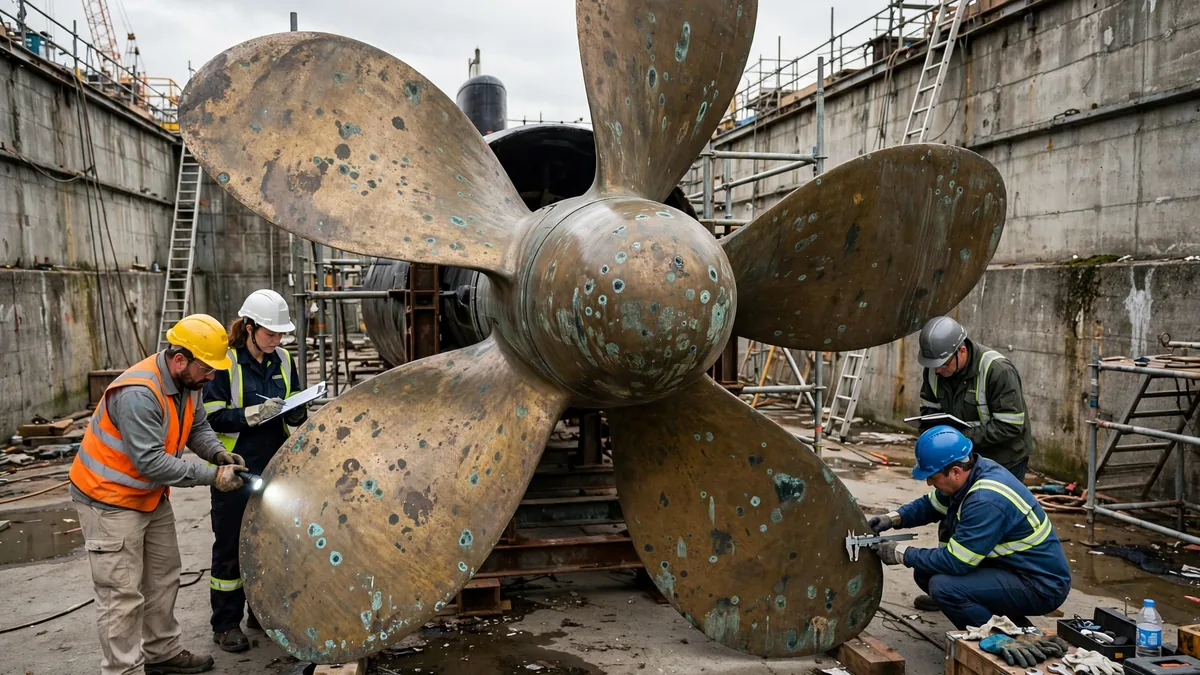
Stand in a dry dock at dawn and the first thing you see is not the submarine. It is the propeller. A great bronze disc, taller than a man, with blades curved like the petals of a steel flower, hanging in the still air where the stern used to be. It looks almost too beautiful to be a machine, and that is the point. A submarine propeller is not just a fan that pushes water. It is the submarine’s voice, and if it speaks too loudly, the boat is found.
Every turn of that propeller has to be silent, smooth and perfectly balanced, because a submarine survives by not being heard. The blades must push thousands of tonnes of steel through the water at speed, yet leave almost no wake, no cavitation and no vibration for an enemy hydrophone to catch. A submarine propeller is one of the most expensive single parts on any vessel, and the reasons are machined into the bronze itself.
Why It Costs So Much
The price of a submarine propeller is not the price of bronze. Raw metal is only a small part of the bill. The real money goes into turning a casting into a shape so precise that water flows over it without tearing into bubbles, and into doing it once, because there is no cheap way to fix a propeller that was machined wrong. A yard that rushes this work ends up with a noisy boat, and a noisy submarine is a dead submarine.
1. Nickel-aluminium bronze, cast in a single pour
A submarine propeller is cast from nickel-aluminium bronze, an alloy chosen because it resists seawater corrosion, survives cavitation erosion, and keeps its strength under shock. The casting is enormous, often a single pour weighing many tonnes, and it must cool slowly and evenly or hidden flaws will grow inside the metal. The materials behind a submarine propeller explain why the alloy matters more than the size, and why the foundry charges a premium for a casting it can guarantee.
2. Blades shaped by mathematics, not by eye
Each blade is a three-dimensional sculpture designed on a computer to spread the load evenly across its surface, so no part of the blade works harder than the rest. The shape is different at the root, the middle and the tip, with a skew that sweeps the blade backwards to cut cavitation. The design is secret, because the blade shape is what makes one navy’s submarines quieter than another’s.
3. Machining that takes months on a single machine
After casting, the propeller is machined on a five-axis milling machine the size of a house, and the work can take months. The cutter removes metal a fraction of a millimetre at a time, following the designed surface to tolerances measured in hundredths of a millimetre. Inside submarine propeller production walks through the machining step by step, and the slow, careful cutting is the reason a single propeller ties up a machine that could otherwise build parts for a whole fleet.
4. Balancing to a silence no ear can hear
A propeller that is out of balance by even a few grams will vibrate, and vibration travels through the hull and into the water, where a listening ship can hear it from miles away. The finished propeller is balanced on a special rig, spun slowly, and trimmed by hand until it runs true. A propeller that fails the balance test goes back to the machine, and the cycle repeats.
5. A surface finished by hand, blade by blade
After machining, each blade is finished by hand. Polishers work over the bronze with finer and finer abrasives until the surface is smooth enough that water slides over it without tripping into turbulence. The hand finishing is slow, skilled and impossible to rush, and it is done in clean conditions so no grit is left embedded in the metal.
6. Testing that must prove silence before the boat sails
A submarine propeller is not finished when it is bolted on. It has to satisfy the navy, the yard and the boat’s own crew, each with their own rules about noise, vibration and performance. The boat is taken to a measured range, where hydrophones on the seabed listen as it runs past at different speeds, and the acoustic signature is compared against the design. How a submarine propeller works shows how the blades, the hub and the shaft work together, and why the noise trials are the moment of truth for the whole design.

What the Numbers Say
| Specification | Submarine propeller |
|---|---|
| Main material | Nickel-aluminium bronze alloy |
| Typical diameter | 5 to 8 metres for a large submarine |
| Typical blade count | Five to seven skewed blades |
| Propeller weight | Several tonnes for a single propeller |
| Machining time | Months on a five-axis milling machine |
| Surface tolerance | Within hundredths of a millimetre |
| Design life | Twenty years or more between overhauls |
What It Costs, and Why
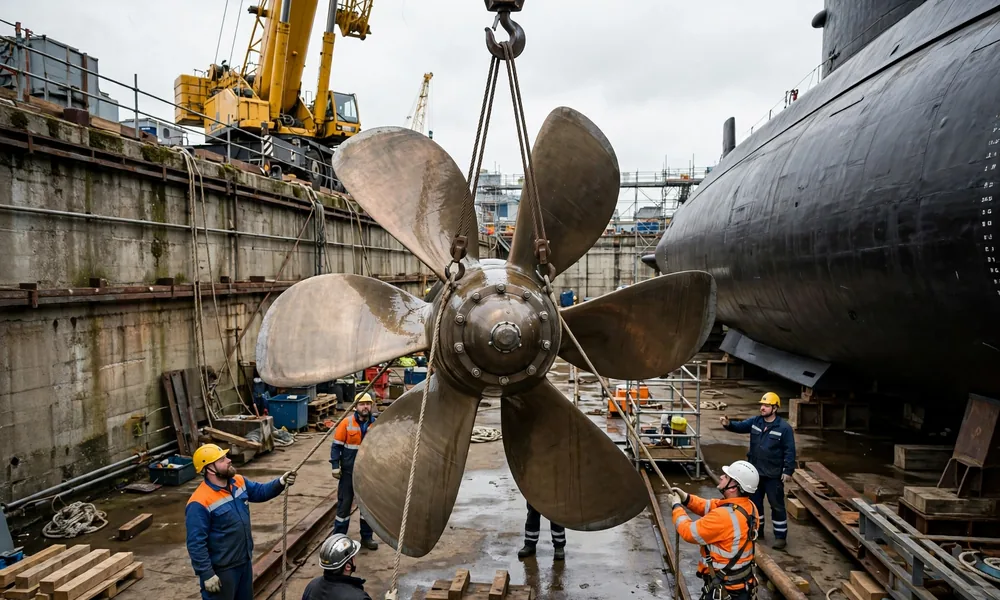
A single submarine propeller typically costs an estimated $5 million to $15 million to build, depending on size and complexity, and a replacement can cost more still once the boat is opened up in dry dock. The figure is an estimate because no two propeller designs are alike: a larger boat needs a larger propeller, a quieter design needs more machining and more hand finishing, and a propeller with a pump-jet shroud costs more still. The casting, the machining, the balancing and the acoustic trials are where the money goes.
That cost is spread over very few propellers. A navy might order a handful of submarines in a decade, so the cost of the foundry, the giant milling machine and the specialist workforce is divided among a tiny number of parts.
Why the Price Stays High
The price stays high because the work cannot be automated away. A machine can mill the blade, but the design, the hand finishing and the acoustic testing all depend on people with years of experience, and those people are few. The propeller is also classified, which means the work can only be done in secure yards by cleared workers, and the design cannot be shared with a cheaper supplier overseas.
There is also the matter of what the propeller has to survive. It carries the whole submarine, it takes the full power of the boat’s engines through a single shaft, and it has to keep its shape for decades without the maintenance budget of a merchant fleet. A propeller built cheaply would cost less on delivery day and far more over the life of the boat, and nobody who commands a submarine wants to discover that at depth.
A Rare Fact
Some submarine propellers are so carefully shaped that their blades are skewed backwards by more than thirty degrees, and the skew is tuned so that each part of the blade enters the wake of the hull at a different moment. The result is a propeller that pushes the boat forward while making almost no rhythmic thump, which is the sound a listening ship would otherwise use to track it.