In 1965, in a DuPont laboratory in Delaware, chemist Stephanie Kwolek was working on a problem that had nothing to do with armour. She was looking for a lighter fibre to reinforce car tyres, something strong enough to replace steel belts without adding weight. The solution she was testing looked wrong: a cloudy, thin liquid that most chemists would have thrown away. Instead of discarding it, Kwolek spun it through a spinneret — and the fibres that came out were astonishing. They were five times stronger than steel by weight, yet light enough to float on water, and they barely stretched at all under load.
That cloudy liquid became Kevlar, an aramid fibre that now sits inside bulletproof vests, racing yacht sails, aircraft fuselages, firefighter suits, and the brake pads of Formula 1 cars. It is a material that seems to break the rules: soft as cloth, yet capable of catching a bullet. Turning a vat of chemicals into that golden-yellow cloth is a slow, exacting process, and every step exists to protect one thing — the near-perfect alignment of molecules that gives Kevlar its strength.

How It’s Made
Step 1: Building the polymer
Kevlar begins as two chemicals: paraphenylenediamine and terephthaloyl chloride. In a reactor, they are joined in a condensation polymerisation that links them into enormously long, rigid chains — a polymer called poly-paraphenylene terephthalamide. The reaction must be controlled to the degree, because the length of the chains decides the strength of the finished fibre. Too short, and the fibre is weak; too long, and the mixture becomes impossible to spin. The resulting polymer is washed and dried into a fine powder before it goes any further.
Step 2: Dissolving the dope
The polymer powder is dissolved in concentrated sulphuric acid to make a thick liquid known in the trade as dope. This is the step Kwolek stumbled upon: under the right conditions, the rod-like molecules line up in liquid-crystal domains, all pointing the same way like logs floating down a river. That alignment is the whole secret of Kevlar. If the molecules were tangled at random, the fibre would be ordinary. The dope is filtered and de-aerated in sealed, corrosion-proof vessels, so no bubble or speck of impurity can become a weak point in a finished thread.
Step 3: Spinning the fibre
The dope is forced through a spinneret — a plate pierced with hundreds of tiny holes — into a bath of cold water. As each jet of liquid hits the water, the acid washes away and the polymer solidifies into a fine golden filament, no thicker than a human hair. This is wet spinning, and it is done under tension: the filaments are pulled and stretched as they emerge, which drags the molecules into even straighter alignment. The parallel with carbon fibre curing is instructive — both materials owe their strength to molecular order — but Kevlar’s chemistry gives it a toughness and resistance to impact that carbon fibre cannot match. Hundreds of filaments are gathered into a single yarn, wound onto bobbins, and washed until every trace of acid is gone.
Step 4: Heat treatment and drawing
Freshly spun Kevlar is strong, but it is not yet finished. The yarn is drawn again under heat, stretched to several times its original length in ovens that run at hundreds of degrees. This second drawing locks the molecules into their final, highly ordered crystalline arrangement, raising the tensile modulus — the stiffness — dramatically. Different grades emerge here: standard Kevlar 29 for ropes and cables, and the stiffer Kevlar 49 for composites, where the fibre will be locked inside resin. Getting this step wrong is costly: overheating makes the fibre brittle, while under-drawing leaves strength on the table. Every batch is tested for tenacity before it is allowed to move on.
Step 5: Weaving the cloth
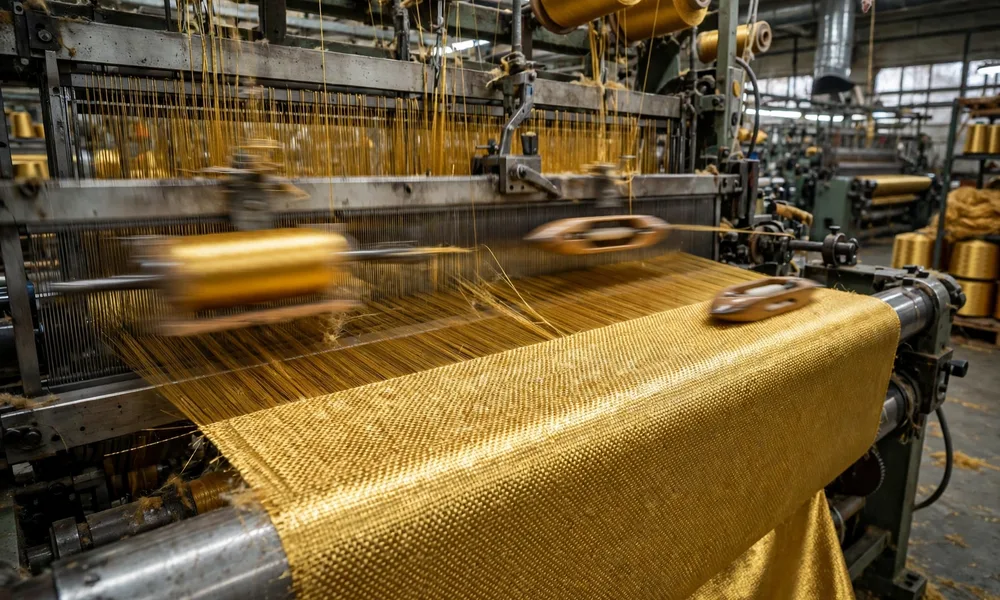
For composite use, the yarn is woven into cloth on industrial looms, most often in a plain or twill weave. The weave matters more than it looks: a tight plain weave gives stability and even strength in both directions, while a twill weave drapes more easily over curved moulds. Weavers must keep the tension perfectly even, because a slack thread in the cloth becomes a wrinkle in the finished part, and a wrinkle is a failure waiting to happen. The golden cloth that comes off the loom is already recognisable as Kevlar to anyone who has seen a bulletproof vest, and it is surprisingly soft to the touch.
Step 6: Impregnating with resin
Cloth alone is flexible; a composite is rigid. To make the leap, the fabric is impregnated with epoxy resin to form prepreg — pre-impregnated sheets that are sticky to the touch and stored in freezers until use. The resin content is controlled to a fraction of a percent, because too much resin adds weight without strength, and too little leaves dry spots that can delaminate under load. The science of getting resin and fibre to bond echoes the precision seen in carbon fibre weave engineering, where the fibre architecture and the matrix must work as one. Workers lay the prepreg into moulds by hand, layer by layer, orienting each sheet so the fibres point along the loads the part will carry — a craft that no machine has fully replaced.
Step 7: Curing and testing
The laid-up part goes into an autoclave, a giant pressurised oven, where heat and pressure cure the epoxy into a solid matrix gripping every fibre. A typical cure runs for hours at around 120 to 180 degrees Celsius, and the pressure squeezes out any trapped air. Once cooled and trimmed, the part is inspected with ultrasound, which can find voids invisible to the eye. Samples from every production run are pulled apart in testing machines to verify tensile strength, and ballistic panels are shot — literally — to prove they stop what they are rated to stop. Only then does a Kevlar composite leave the factory, whether it is destined for a racing yacht, a spacecraft, or a vest that may one day save a life. The machining of finished composite parts demands the same care as titanium machining, because a careless cut frays fibres and opens a path for failure.
Specifications
| Property | Kevlar 29 | Kevlar 49 |
|---|---|---|
| Density | 1.44 g/cm³ | 1.44 g/cm³ |
| Tensile strength | ~3.6 GPa | ~3.6 GPa |
| Tensile modulus | ~70 GPa | ~112–135 GPa |
| Elongation at break | ~3.6% | ~2.4% |
| Decomposition temperature | ~500°C | ~500°C |
| Typical weave | Plain / twill | Plain / twill / unidirectional |
| Common uses | Vests, ropes, cables | Composites, aircraft, boats |
Price
Kevlar is not cheap, but it is far from the most expensive advanced fibre. Raw Kevlar yarn typically costs an estimated $25 to $50 per kilogram depending on grade and order size, while woven Kevlar fabric sells for an estimated $30 to $80 per square metre, and finished ballistic panels or composite parts cost many times more once cutting, moulding, testing, and certification are counted. The price reflects a process that cannot be rushed: the acid spinning, the heat drawing, and the batch-by-batch testing all cost money, and there is no shortcut that preserves the strength. All prices here are estimates, not quotes.
Rare Fact
When NASA landed its Mars rovers, the airbags that cushioned their bouncing touchdown were woven from Kevlar — the same fibre that stops bullets was trusted to protect a billion-dollar robot slamming into another planet. Stephanie Kwolek, who discovered it by refusing to throw away a strange-looking liquid, never got rich from Kevlar itself: DuPont owned the patent.


