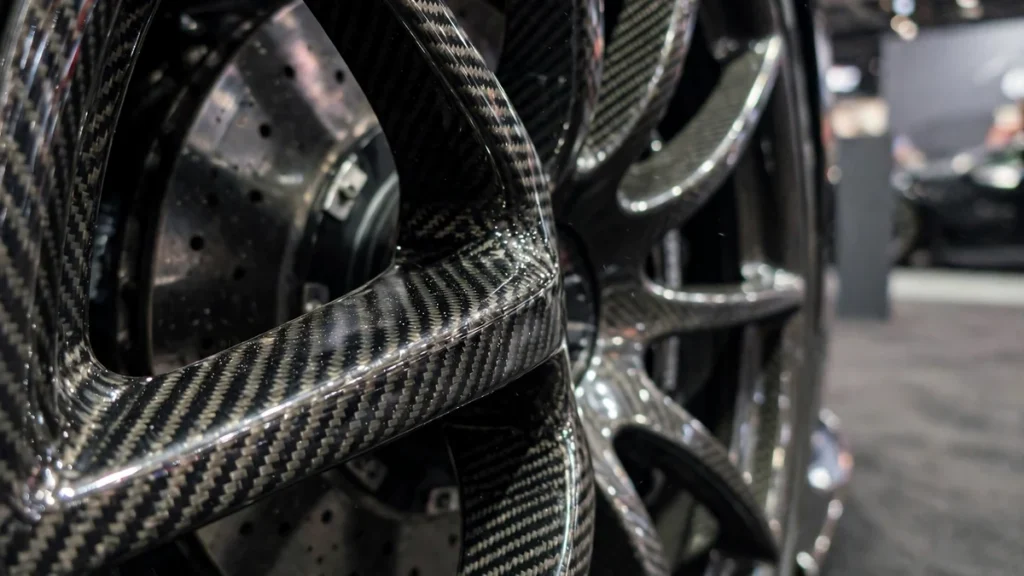
Hold a piece of carbon fibre up to the light and it does something no ordinary cloth can do. The black fabric catches the sun and throws it back in a ripple of silver-grey diagonals, each tiny bundle of threads gleaming like polished metal. It is soft in the hand, and you can bend it and fold it without a sound — yet this same cloth, once set in resin and cured, becomes the skin of Formula 1 cars, the wings of airliners, and the frames of the fastest bicycles on the planet.
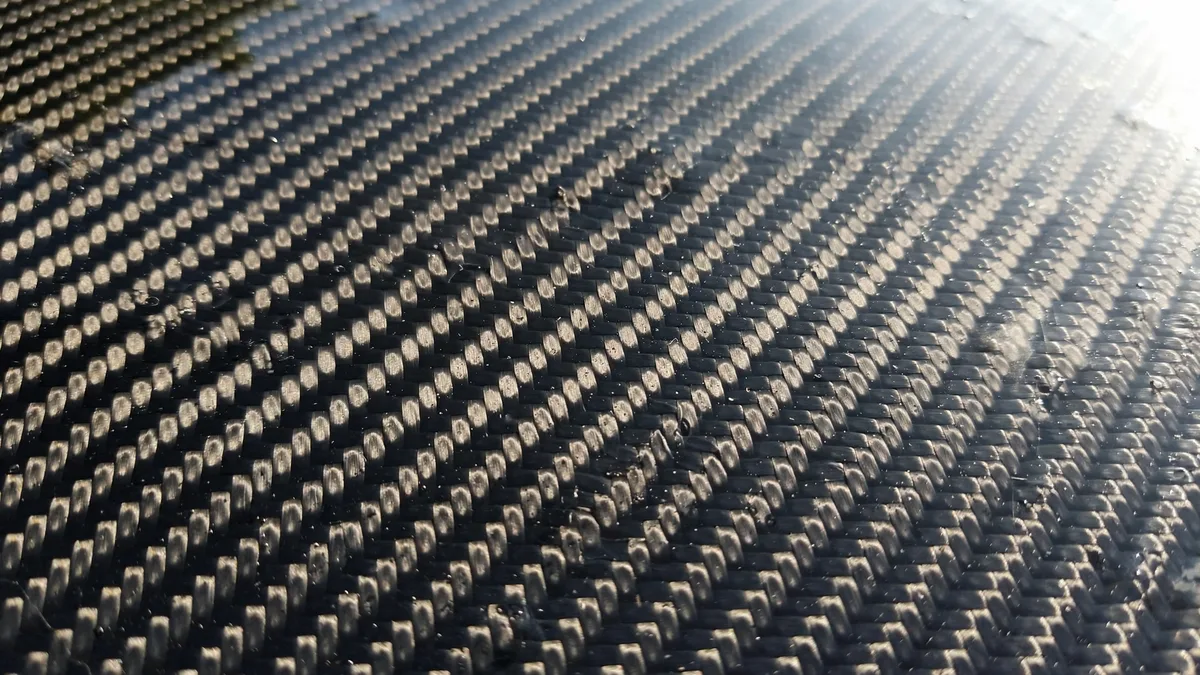
The pattern is the giveaway: bundles of carbon threads, called tows, passing over and under each other. In the most common pattern, the twill weave, each tow steps diagonally across the one below it, and that diagonal gives carbon fibre its famous chequered look. Makers call it 2×2 twill, and car makers leave it uncovered on purpose — a badge of engineering that drivers pay extra to show off.
Behind that pattern lies a set of numbers that decides whether a part will be feather-light and unbreakable, or heavy and brittle. Tow size, areal weight, tensile strength, fibre volume — these are the specifications printed on every roll of carbon fabric. This guide translates them into plain English: what each number means and how the weaves compare.
How It Works
Step 1: Spinning the carbon tow
Everything starts with a tow, a bundle of thousands of hair-thin carbon filaments. A standard 3K tow contains 3,000 filaments, each roughly five to ten micrometres across — about a tenth the width of a human hair. The filaments are made by heating a precursor fibre, usually polyacrylonitrile, until almost everything but carbon burns away. One filament alone is fragile; bundled into a tow, the filaments share the load and become a thread strong enough to weave.
Step 2: Weaving the cloth
The tows are woven on a loom in one of three classic patterns. In a plain weave, each tow passes over one tow and under the next, giving a tight, stable cloth that resists fraying but is stiff and hard to drape. In a twill weave, each tow passes over two and under two, stepping sideways each row, which creates the diagonal pattern and a cloth that drapes far more easily. A satin weave passes over several tows before dipping under one, making the smoothest, most flexible fabric of all. Most car and bike parts use twill because it balances stability, drape, and looks.
Step 3: Cutting the plies and setting their direction
A single layer of carbon cloth is called a ply, and no real part is made from one ply alone. The fabric is cut into shapes and laid up in a stack, with each ply rotated to a different angle — commonly 0, 45, and 90 degrees. The fibres in each ply are strong in the direction they run, so rotating the plies means the finished part is strong in every direction instead of just one. A part pulled mostly in one direction uses more 0-degree plies; a part that will be twisted needs 45-degree plies.

Step 4: Wetting out with resin
Dry carbon cloth has almost no strength of its own — the magic happens when it is soaked in resin. The resin fills the tiny gaps between the filaments, glues the plies together, and locks the weave in shape. In a hand layup, resin is brushed into the cloth; in resin infusion, dry cloth is sealed under a vacuum bag and resin is drawn through it by suction. Prepreg cloth arrives with the resin already in it, measured to the gram. The ratio matters: too much resin adds weight and nothing else, and too little leaves dry spots that can fail.
Step 5: Curing under heat and pressure
Once the cloth is wet with resin, the part must be cured — heated so the resin hardens into a rigid solid. In a workshop this might mean an oven; in a factory it means an autoclave, a pressurised oven that squeezes the laminate while it bakes, pressing out trapped air. A typical cure runs at around 120 to 180 degrees Celsius for one to two hours. Curing is where a carbon part is truly born: before it, a soft stack of cloth; after it, a solid shell that can carry a racing car’s loads. The same science shapes a full carbon fibre curing process, because a rushed cure leaves a weak part.
Step 6: Trimming and finishing
Out of the mould, the part is rough around the edges. Excess material is trimmed away, usually with diamond-coated tools, because ordinary steel blades blunt almost instantly on carbon. The edges are sealed, holes are drilled with special care — a careless drill can split the layers apart, a failure called delamination — and the surface is sanded and clear-coated. The clear coat makes the weave shine through on a finished bonnet or frame, and protects the epoxy from ultraviolet light. Quality is checked by tap test, listening for a dull thud that betrays a hidden void. This attention to finish is why a structural shell such as a carbon monocoque so demanding to build, and the tooling problems are close cousins of the challenges in machining titanium.
Carbon Fibre Weave Specs
| Specification | Typical range |
|---|---|
| Weave type | Plain, 2×2 twill, or satin (4- or 8-harness) |
| Tow size | 1K to 12K filaments per tow (3K most common) |
| Areal weight | About 160 to 600 grams per square metre |
| Tensile strength | About 3,500 to 7,000 megapascals for the fibre |
| Tensile modulus | About 230 to 300 gigapascals (standard modulus) |
| Density | About 1.5 to 1.8 grams per cubic centimetre |
| Ply thickness | About 0.2 to 0.3 millimetres per cured ply |
| Fibre volume fraction | About 50 to 65 percent in a cured laminate |
What Does Carbon Fibre Weave Cost?
Carbon fibre is not cheap, and the weave is only part of the bill. Standard 3K twill fabric is estimated to cost roughly $20 to $80 per square metre, depending on tow size, weave, and quantity, while aerospace-grade prepreg is estimated at roughly $40 to $150 per square metre. Finished parts cost far more than the cloth alone, because the labour of layup and curing dominates the price. All prices are estimates only and vary widely by grade, supplier, and volume. It has got cheaper as production has scaled up, but it remains several times the price of fibreglass or aluminium — which is why it appears where weight matters most.
A Rare Fact
Carbon fibre is far older than the space age most people associate it with. In 1879, Thomas Edison made the first practical carbon filaments by baking cotton thread and bamboo strips until they were almost pure carbon, and used them inside his early electric light bulbs. Those filaments were carbon fibre in all but name — thin, black, and made by heating an organic fibre until only carbon remains. Modern carbon fibre came only in the 1960s, when researchers at the Royal Aircraft Establishment in England turned the same trick into the high-strength material we know today.
The weave is the part you can see, but the specifications are the part that matters. A 3K twill at 200 grams per square metre tells an engineer how the cloth will drape, how strong the finished part will be, and how much it will weigh. Learn to read those numbers and the diagonal pattern stops being a decoration and starts being a language.