It is a thread you cannot see, made from a material that should not exist in the form it takes. A carbon nanotube is a sheet of carbon atoms rolled into a tube so narrow that fifty thousand of them side by side would still be thinner than a human hair — and yet, gram for gram, it is stronger than steel and stiffer than diamond. On their own, nanotubes are a laboratory curiosity: a black powder that clumps, tangles and refuses to be handled. Turned into a composite, though — mixed, aligned and locked inside a resin or a metal — they become one of the most extraordinary engineering materials ever made, light enough for spacecraft and tough enough for armour. Getting them from powder to product is one of the hardest manufacturing journeys in modern engineering.
The challenge is not the nanotube itself but everything around it. Nanotubes love to stick to each other, forming knots that behave like weak spots. They are also so small that they slip through ordinary quality checks, and their properties depend on details — length, diameter, purity — that vary from batch to batch. Here is how that happens, step by step.
How Carbon Nanotube Composite Is Made
Step 1: Growing the nanotubes
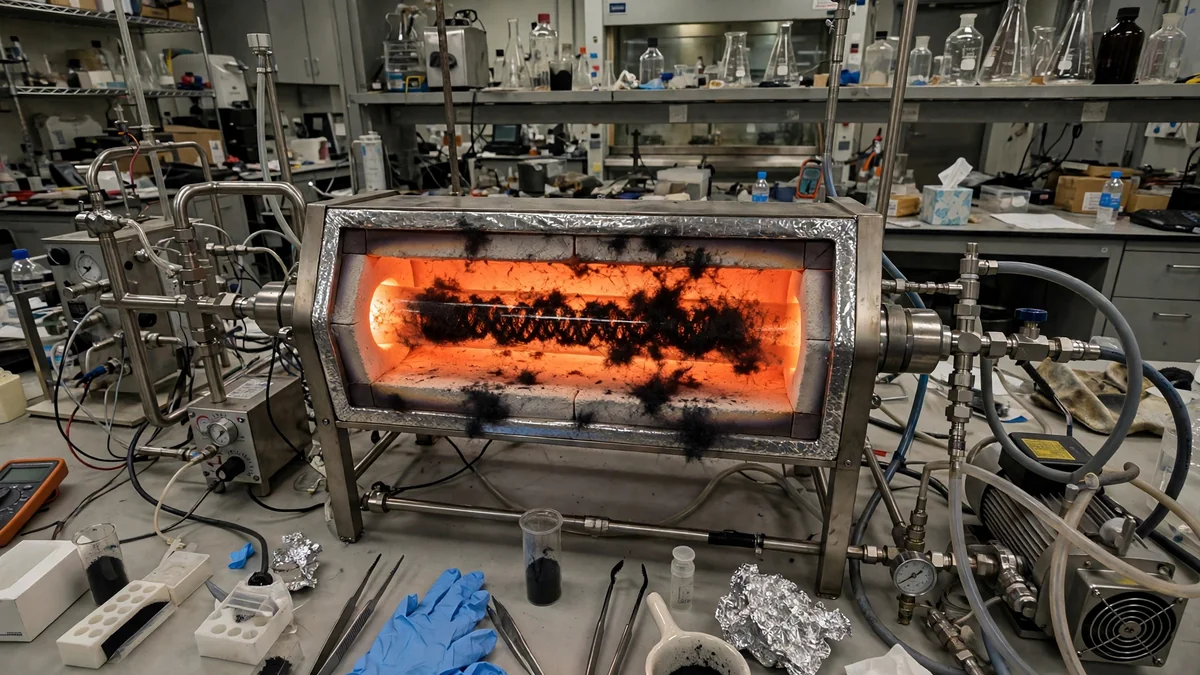
Most commercial nanotubes are grown by chemical vapour deposition. A carbon-containing gas, usually methane or ethylene, flows over tiny particles of iron, cobalt or nickel catalyst inside a furnace heated to 600 to 1,000 degrees Celsius. Carbon atoms released from the gas assemble on the catalyst particles and grow outward as hollow tubes, layer by layer, until the catalyst is exhausted or the gas is switched off.
Step 2: Purifying the harvest
Fresh nanotubes are dirty. The harvest contains leftover catalyst metal, amorphous carbon that never formed tubes, and tubes of many different diameters tangled together. Purification usually starts with an acid wash that dissolves the metal catalyst, followed by oxidation — a controlled burn that removes the amorphous carbon faster than it attacks the tubes themselves. The material is then filtered, washed and dried. The care taken here echoes the discipline of other advanced materials, from Kevlar composite to the fibre work behind modern armour.

Step 3: Dispersing the nanotubes
This is the step that makes or breaks the material. The purified nanotubes are mixed into a liquid resin or a solvent using high-shear mixing, ultrasonication or ball milling — violent-sounding methods that are tuned carefully, because too much energy snaps the tubes and too little leaves them clumped. Often the tube surfaces are chemically treated first, adding small molecular groups that help them bond to the resin and stop them from re-clumping.
Step 4: Aligning the reinforcement
Randomly scattered nanotubes strengthen a composite in every direction a little. Aligned nanotubes strengthen it enormously in one direction — which is exactly what a structural part needs. Alignment can be achieved by drawing the nanotube material into sheets or yarns, by applying electric or magnetic fields while the resin is still liquid, or by spinning the nanotubes into continuous fibres that are then woven or wound like any other textile. The most advanced products start as nanotube yarns, spun directly from a reactor or drawn from a forest of vertically grown tubes, and those yarns are handled much like carbon fibre — a parallel explored in carbon nanotube composite materials engineering, where the fibre and the matrix are designed together.
Step 5: Forming the composite
With the nanotubes dispersed or aligned, the composite itself is formed. For resin composites, the nanotube-loaded resin is infused into a mould or laid up with reinforcing fabric, then cured under heat and pressure in an oven or autoclave — the same curing discipline used for carbon fibre parts. For metal-matrix composites, the nanotubes are mixed into molten aluminium or magnesium, or pressed into a metal powder that is then sintered.
Step 6: Curing, consolidation and finishing
Curing locks the structure in place. Thermoset resins harden through a chemical reaction driven by heat, while thermoplastic composites are melted, pressed and cooled into shape. After curing, the part is demoulded, trimmed and machined — drilled, cut and finished like any other composite, with the added care that machining dust from nanotube composites must be captured and controlled.
Step 7: Testing and proving the material
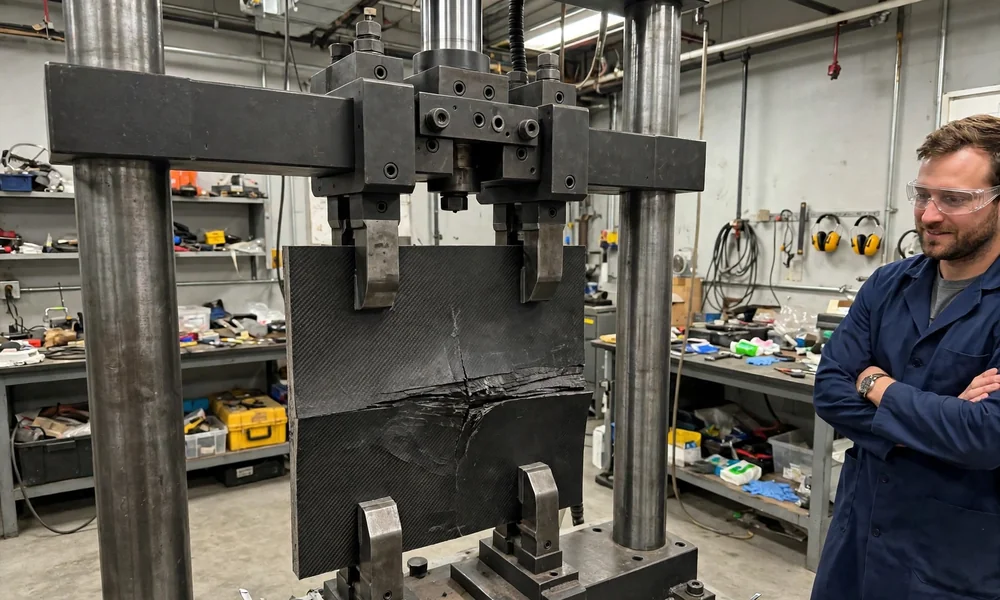
Because nanotubes are invisible to the eye, testing a nanotube composite relies on instruments. Electron microscopes check dispersion and alignment, Raman spectroscopy confirms the tubes survived processing undamaged, and mechanical tests measure tensile strength, stiffness and fatigue life against the design targets. Electrical conductivity is tested too, since many nanotube composites double as sensors or shielding. Batches that fail are traced back to their growth run, their dispersion log and their cure cycle — and this traceability is what separates a research sample from a product that can be sold into an aircraft or a medical device. The same verification mindset governs the wider family of advanced composites, including graphene composite, where the filler is measured in atoms and the proof is in the test data.
Carbon Nanotube Composite at a Glance
| Specification | Detail |
|---|---|
| Nanotube diameter | About 1–2 nm for single-walled, 10–50 nm for multi-walled |
| Theoretical tensile strength | Up to around 100 GPa for an individual tube |
| Density | Roughly 1.3–1.4 g/cm³, far lighter than steel |
| Growth method | Chemical vapour deposition over metal catalysts |
| Typical loading in composite | 0.1–5% by weight, rarely more |
| Host materials | Epoxy and other resins, aluminium, magnesium, ceramics |
| Key advantage | Extreme strength and stiffness per gram, plus electrical conductivity |
| Main drawback | Dispersion difficulty, high cost, batch-to-batch variation |
What Does It Cost?
Carbon nanotubes remain expensive, and that sets the price of everything made from them. Industrial-grade multi-walled nanotubes cost tens to hundreds of dollars per kilogram, while high-purity single-walled tubes can cost thousands of dollars per gram in small quantities — although bulk prices fall sharply at scale. As rough estimates, a nanotube-enhanced resin for a specialist application can cost several times more than the same resin without nanotubes, and a finished composite component for aerospace or defence can run into thousands of dollars. Those figures are estimates, not quotes — the real number depends on tube type, purity, loading level and production volume.
A Rare Fact
In 1991, when carbon nanotubes were first clearly identified, the microscopes used to see them were barely able to resolve structures that small — the tubes were discovered almost by accident in the soot left over from an experiment making a completely different carbon material. Within a decade, researchers had measured a single nanotube’s strength and found it exceeded every known fibre. The material went from soot in a lab to the strongest thread ever measured in less than ten years, and manufacturing has spent the decades since learning how to use it without breaking it.
Carbon nanotube composites are still a young technology, and much of what they promise — space elevators, unbreakable cables, aircraft that sense their own damage — is still ahead of us. But the manufacturing path is now real: grow the tubes, purify them, spread them evenly, align them, lock them in place, and prove the result. The strongest material ever measured is slowly becoming a material you can actually buy.


