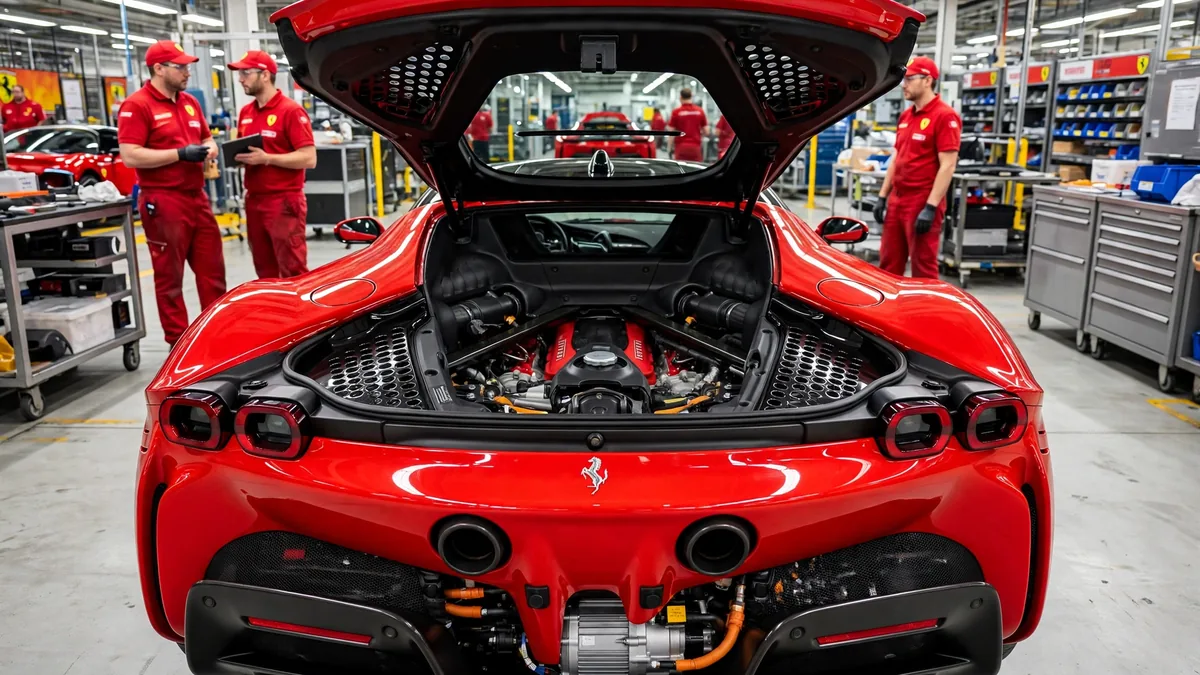
There is a room in Maranello where the loudest silence in the car world happens. A Ferrari SF90 sits on the line, its body painted and polished, and a team of technicians gathers around the rear of the car to install the thing that makes it a Ferrari: a twin-turbo V8 engine, bolted to three electric motors, producing more power than any road car the company had ever built before it. The SF90 was Ferrari’s first plug-in hybrid, and the first time the famous prancing horse had to share its engine bay with a battery pack. Building it meant teaching a company famous for twelve-cylinder engines to think like a battery company, without forgetting how to make a car sound like a Ferrari.
The numbers explain the stakes. The SF90 pairs a 4.0-litre twin-turbocharged V8 with three electric motors for a combined output of 1,000 horsepower, and it can drive silently on electricity alone for short distances around town. That combination is designed into the car from the first sketch, with the battery sitting low behind the seats and the motors at the front axle and beside the gearbox.
How It’s Made
Step 1: Building the chassis
Everything starts with the chassis, a mix of aluminium and carbon fibre that is both the car’s skeleton and its safety cell. The chassis is assembled on a jig that holds every part to within a fraction of a millimetre, because the hybrid system leaves no room for error: the battery, the motors, and the cooling pipes all have to fit into spaces measured in centimetres. Carbon fibre panels are bonded to aluminium sections with adhesives and rivets, a technique borrowed from racing cars. The result is a structure that is lighter than steel yet stiff enough to keep the car’s handling sharp, and it is the same carbon fibre discipline that shapes a racing monocoque, as our look at carbon monocoque production explains.
Step 2: Machining the V8 engine
The V8 at the heart of the SF90 is a 4.0-litre twin-turbocharged unit, and it is built largely by hand. Engine blocks are cast, then machined on computer-controlled mills that cut the cylinder bores to tolerances measured in microns. Pistons, crankshafts, and connecting rods are weighed and matched so that each cylinder works identically to the others, and the two turbochargers are balanced at speeds above 100,000 revolutions per minute. A single technician follows each engine through much of its assembly, signing off on every stage.
Step 3: Making the battery pack
While the engine is being built, the battery pack is assembled in a separate clean area. The SF90’s lithium-ion pack holds 7.9 kWh of energy, made up of cells grouped into modules and sealed into a case that sits low in the car, behind the seats and ahead of the engine. The case is cooled by liquid, because a battery that overheats loses power and ages fast, and every cell is tested before it is fitted. The pack is heavy — around 70 kilograms — so placing it low and central is what keeps the car’s centre of gravity down and its handling intact. This is the same battery engineering that powers pure electric cars, as our look at how an EV battery pack is made shows, adapted here to live beside a hot turbocharged engine.
Step 4: Fitting the electric motors
The SF90 uses three electric motors: two on the front axle, one for each front wheel, and a third sandwiched between the V8 and the eight-speed dual-clutch gearbox. The front motors give the car all-wheel drive and allow it to drive on electricity alone, while the rear motor fills in the gaps in the engine’s power delivery, smoothing out the moments when the turbos are still spooling up. Each motor is a compact unit of copper windings and permanent magnets, assembled to tolerances as tight as the engine’s, and each one is tested on a bench before it meets the car. The front motors also recover energy under braking, feeding it back into the battery.

Step 5: Marrying engine, motors, and body
The moment the car comes together is called the marriage: the powertrain, already assembled as a complete unit, is lifted into the chassis, and the body is lowered over it. Technicians connect the high-voltage orange cables, the cooling lines for the battery and the motors, and the wiring that lets the car’s computers talk to all three power sources at once. The software is as important as the hardware here: it decides, hundreds of times a second, how much power comes from the engine and how much from each motor, and it has to do it without the driver ever noticing the handover. Getting the aerodynamics right around all this hardware is its own discipline, and it is why Ferrari spends so long on active aerodynamics.
Step 6: Testing every system
A finished SF90 is tested more thoroughly than almost any car on the road. It goes onto a rolling road, where its wheels spin against drums while engineers measure power, braking, and the hybrid system’s behaviour at every speed. It is driven on Ferrari’s Fiorano test track by professional test drivers, who check the handling, the brakes, and the way the car switches between electric and petrol power. The battery is charged and discharged repeatedly, the motors are run at full power, and every warning light and cooling fan is checked. Only when the car passes every test is it signed off and handed to its owner.
Specs
| Specification | Detail |
|---|---|
| Powertrain | 4.0-litre twin-turbo V8 plus three electric motors (plug-in hybrid) |
| Combined output | 1,000 horsepower (986 hp in some markets, quoted as 1,000 CV) |
| Battery | 7.9 kWh lithium-ion, liquid-cooled, mounted low behind the seats |
| Gearbox | Eight-speed dual-clutch automatic |
| Drive | All-wheel drive (front axle driven electrically) |
| Electric-only range | About 25 km (15 miles) in eDrive mode |
| 0 to 100 km/h | About 2.5 seconds |
| Top speed | About 340 km/h (211 mph) |
| Chassis | Aluminium and carbon fibre, mid-engine layout |

Price
The SF90 Stradale launched at a price of around $625,000 (estimate, based on typical launch pricing), making it one of the most expensive Ferraris ever sold when it arrived, and well above the price of the company’s V8 sports cars that came before it. The cost reflects the hybrid hardware — the battery, the three motors, and the power electronics — plus the hand-built V8 and the carbon fibre chassis. Used examples now trade at prices that vary widely with mileage and specification, but the car remains a landmark: the moment Ferrari’s flagship became a hybrid.
Rare Fact
The SF90 can reverse without ever starting its engine. In reverse gear, the car is driven purely by its front electric motors, with the V8 switched off — the first time a Ferrari road car could move backwards in silence. It is a small detail, but it captures what the car is: a machine that can be a silent electric car in a city centre and a 1,000-horsepower supercar on a race track, and the engineering that makes both possible lives in the same chassis, built by the same hands, in the same factory in Maranello.