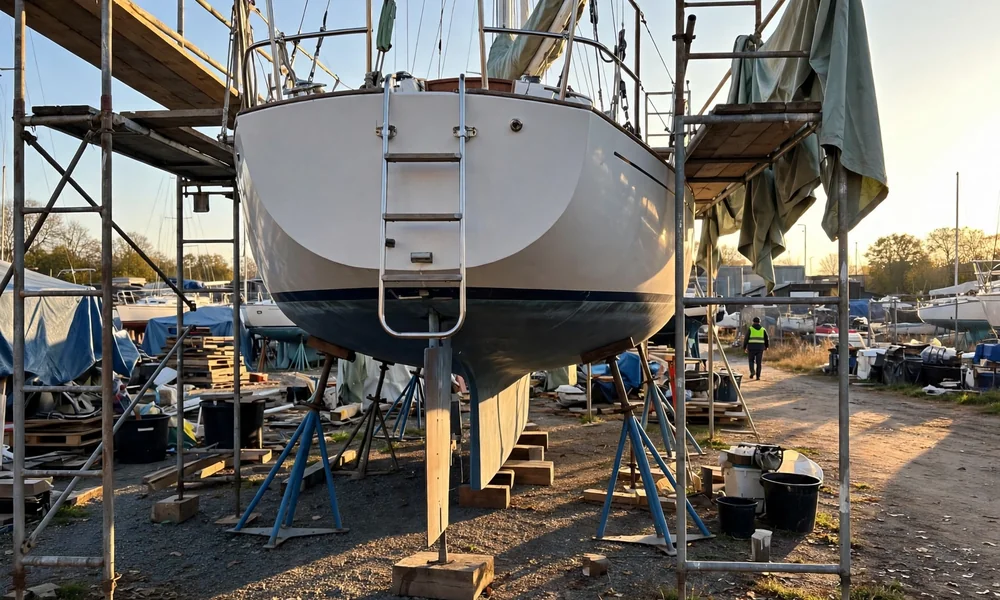
Stand in a dry dock and look at the stern of a large yacht, and your eye will be drawn to a flat, fin-shaped blade hanging below the hull, just behind the propeller. It looks simple, almost crude, a slab of metal or composite with a smooth skin. That blade is the rudder, and it is one of the most important parts of the whole yacht. It steers a vessel worth millions, it carries enormous loads every time the yacht turns, and if it fails, the yacht cannot be controlled at all. A yacht rudder can cost its builder tens of thousands of dollars (estimate), and on a large yacht far more, for a part that spends its whole life underwater and unseen.
The surprise is how much force this quiet blade must handle. Water is heavy, and at speed it pushes against the rudder with a force measured in tonnes. The rudder must turn that force into a precise steering response, stay perfectly smooth so that it does not slow the yacht down, and survive years of salt water, impacts, and vibration without weakening. Together, those demands explain its price.

Why the Yacht Rudder Costs So Much
1. It is shaped like a wing, and built like one
A rudder is not a flat plate. Its cross-section is shaped like an aircraft wing, carefully designed so that water flows smoothly over both sides and produces lift in the direction the helmsman wants. That shape must be accurate to within millimetres over a blade several metres tall, or the rudder will create drag, vibration, and poor steering. The shape is developed with computer modelling and tank testing, then built in a mould, and the cost of getting it right is a large part of the price.
2. The structure inside is more complex than it looks
Inside the smooth skin of a yacht rudder is a skeleton of stainless steel or carbon fibre, with a central stock, the thick shaft that connects the blade to the steering gear, and a framework that spreads the loads evenly. The stock alone can be a forging weighing hundreds of kilograms, machined to a precise fit and polished to a mirror finish where it passes through its bearings. The propeller that works just ahead of the rudder is built with the same care, and the two are designed together as a system.
3. It lives in salt water, and salt water is merciless
Everything about a rudder must resist corrosion, because it spends its life submerged in salt water. The blade is usually made from marine-grade stainless steel, bronze, or a composite skin over a steel frame, and every joint, bolt, and bearing is chosen for its resistance to the sea. The rudder is also fitted with anodes, small blocks of zinc that corrode first and protect the rest of the metal. The materials are expensive, and the work of sealing and protecting them is skilled and slow.
4. The bearings must be perfect, and perfectly sealed
The rudder stock turns inside bearings at the top and bottom of the blade, and those bearings must allow the rudder to move freely while keeping salt water out of the yacht. They are precision-machined, often from special polymers or bronze, and fitted with seals that are tested under pressure. If a bearing wears or a seal fails, water enters the yacht and the steering becomes stiff or loose. The keel that carries the yacht’s ballast below is built to a similar standard of strength, and the rudder’s bearings receive the same attention.
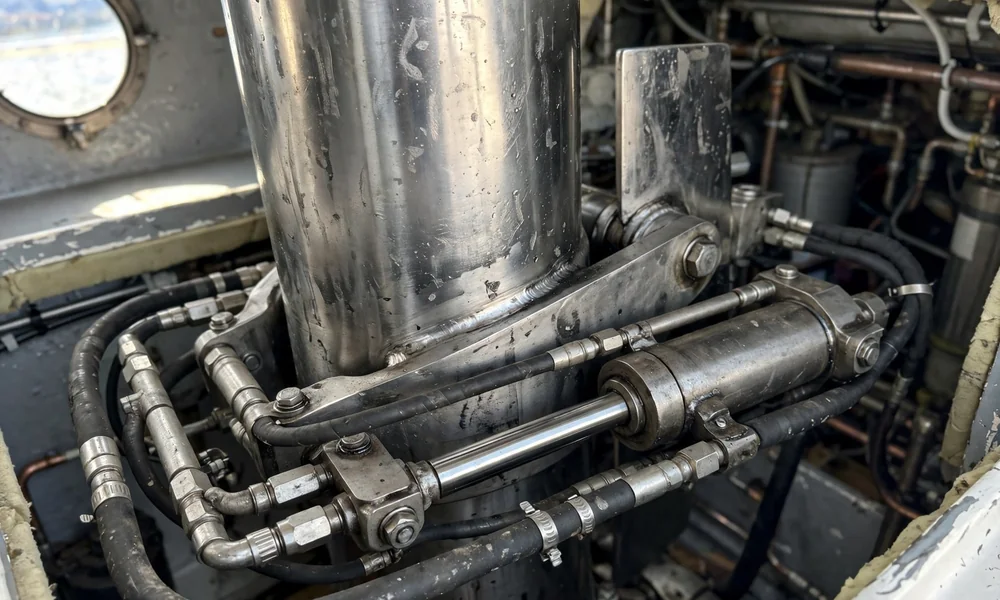
5. The steering gear behind it is a machine in its own right
Above the rudder, inside the yacht, sits the steering gear: a hydraulic or electric system that turns the stock, holds it against the force of the water, and gives the helmsman feedback through the wheel. On a large yacht this system includes pumps, rams, valves, and an autopilot that can steer the yacht for days at a time. The stabilizer fins that keep a yacht steady at sea use similar hydraulics, and the rudder’s steering gear is built to the same standard of reliability, because a failure at sea is not an option.
6. It is tested in ways a car part never is
Before a yacht rudder is approved, it is tested on rigs that push and pull it with forces far beyond those it will meet at sea, and the complete steering system is run through thousands of cycles. The yacht itself is then sea-trialled, with the rudder put hard over at speed to check that it responds cleanly and does not vibrate or stall. Any problem found at this stage means the yacht returns to the yard, and the rudder is removed, adjusted, and tested again. That cycle is slow and expensive, and it is built into the price.
7. Every rudder is made for one yacht
There is no standard yacht rudder. Each one is designed for a specific hull, a specific propeller, and a specific steering system, and it is built once, in a yard that may produce only a handful of yachts each year. The moulds, the tooling, and the design work must all be paid for by a single rudder, and the craftspeople who build it are specialists whose skills are rare. Low volume and high skill together make the rudder far more expensive than its simple appearance suggests.
Yacht Rudder at a Glance
| Specification | Detail |
|---|---|
| Shape | Wing-like foil section, accurate to millimetres |
| Construction | Stainless steel, bronze, or composite skin over a steel frame |
| Rudder stock | Forged and machined shaft, sometimes weighing hundreds of kilograms |
| Bearings | Precision bronze or polymer, pressure-sealed against salt water |
| Steering gear | Hydraulic or electric, often with autopilot |
| Loads | Water forces measured in tonnes at speed (estimate) |
| Key materials | Marine stainless steel, bronze, carbon fibre, zinc anodes |
| Main cost drivers | Custom design, forging and machining, sealing, low volume |
What Does It Cost?
A rudder for a large yacht typically costs the builder somewhere between twenty thousand and one hundred thousand dollars (estimate), with the steering gear behind it adding a similar sum. On a superyacht, the complete rudder and steering installation can cost several hundred thousand dollars (estimate). The forging and machining of the stock, the moulding of the blade, and the fitting of the bearings account for much of that figure (estimate), and the design and testing add more. It is a large sum for a blade that is never seen, but it is the blade that keeps the yacht going where its captain points it.
A Rare Fact
On some large yachts, the rudder is so big that it cannot be removed without lifting the yacht out of the water and cutting an opening in the hull, so it is designed to last the entire life of the vessel without ever being taken off. Its bearings are inspected by divers, its anodes are replaced underwater, and its surface is checked by hand whenever the yacht is hauled out. A part that is never meant to be removed has to be built right the first time, and that is one more reason it costs what it does.


