Every petrol engine has a dilemma built into it. Squeeze the fuel and air mixture hard and you get more power from every drop, but squeeze it too hard under boost and it explodes before the spark plug fires, a destructive rattle called knock. Run a gentle squeeze and the engine is safe, but it wastes fuel at a cruise. For a hundred years, every engine had to pick one ratio and live with it.
Then Nissan built an engine that refuses to choose. A variable compression engine changes its compression ratio while it is running, running a high ratio when you cruise gently and a low ratio when you demand full power, getting the best of both worlds from the same four cylinders. This is what it is, and how it works.
What Is a Variable Compression Engine?
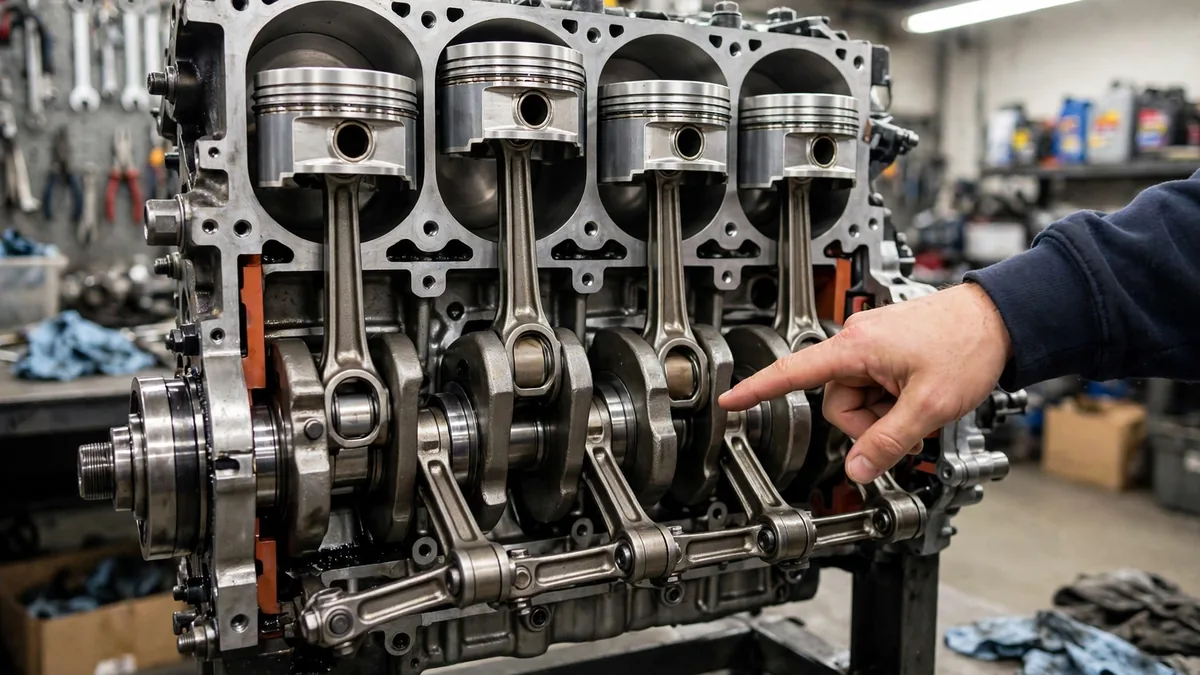
A variable compression engine is a petrol engine that can change its compression ratio, the ratio between the volume of the cylinder when the piston is at the bottom of its stroke and the volume when it is at the top, while the engine is running. The only production example is Nissan’s VC-Turbo, a 2.0-litre turbocharged four-cylinder, codenamed KR20DDET, which varies its ratio continuously from 8:1 under full boost to 14:1 at light cruise. It debuted in the Infiniti QX50 in 2018 and later appeared in the Nissan Altima, QX55, QX60, Murano, and Rogue.
Step 1: The compression ratio is the engine’s bargain with physics
Compression ratio is simple arithmetic: how much the piston squeezes the air and fuel mixture before it ignites. A high ratio, 14 parts squeezed into 1, extracts more energy from every drop of fuel, because the burning mixture expands further and pushes the piston harder on its way down. But under heavy load, especially with a turbocharger forcing extra air in, the mixture can ignite before the spark, causing knock, which can destroy an engine. A low ratio, 8:1, is safe under boost but wastes fuel when the engine is cruising gently and knock is not a risk.
Step 2: A multi-link replaces the connecting rod
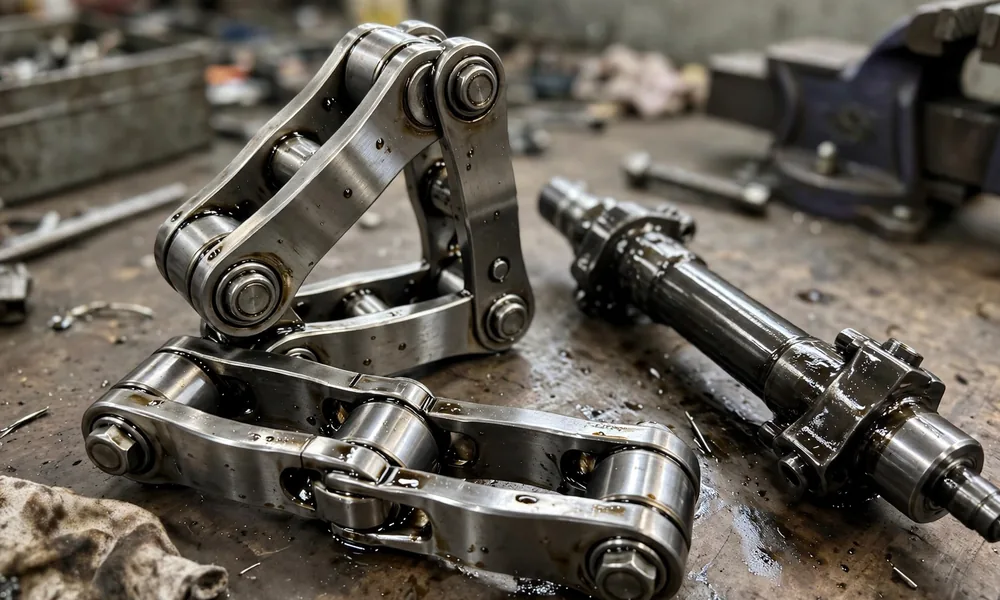
In a normal engine, each piston is joined to the crankshaft by a single connecting rod, a simple beam. The length of that rod, the throw of the crankshaft, and the size of the cylinder fix the piston’s travel forever. The VC-Turbo throws that beam away and replaces it with a multi-link system, four steel links arranged in a diamond. An upper link, or U-link, connects to the piston pin at its top. At its bottom it does not wrap around the crankpin directly; instead it joins a lower link, or L-link, a roughly triangular arm that rides on the crankpin. A third arm, the control link, connects the L-link to an eccentric journal on a control shaft that runs the full length of the engine block, parallel to and below the crankshaft.
Step 3: A harmonic drive turns the control shaft
The control shaft is the engine’s way of changing its mind. When the engine computer decides the ratio needs to change, an electric motor, a harmonic drive, rotates an actuator arm, which turns the control shaft. The shaft’s eccentric journal moves the anchor point of the control link, which pulls the lower link up or down, which changes the angle of the multi-link, which raises or lowers the piston’s top dead centre, the highest point it reaches. The change is tiny, about a millimetre of piston travel, but it transforms the engine’s character. The whole adjustment happens continuously, while the engine is running, under load, at thousands of revolutions per minute.
Step 4: Low ratio for power, high ratio for cruising
The logic is simple once the mechanism exists. When the driver demands power, pressing the throttle hard, the engine drops to its lowest compression ratio, 8:1, and lets the turbocharger do its work. The low ratio keeps knock away even under full boost, so the engine can deliver its full output, around 248 to 268 horsepower depending on the model, without restraint. When the driver lifts off and settles into a cruise, the engine raises the ratio toward 14:1, squeezing every mile from every litre. At low load it also runs an Atkinson cycle, holding the intake valves open longer to cut pumping losses.
Step 5: The turbocharger and the injection system play their part
The variable compression mechanism does not work alone. The VC-Turbo uses a high-efficiency turbocharger with an electric wastegate, which controls boost pressure precisely and with minimal lag, so the engine can call on extra air the moment the driver asks for it. It also uses both direct injection and port injection, switching between them to get the cleanest, most complete combustion at each load. Boost control is covered by how a hypercar turbocharger works, and the hybrid route to the same goal by how a hybrid powertrain works.
Step 6: The links bring two unexpected bonuses
Changing the compression ratio was the goal, but the multi-link brought gifts with it. Because the upper link stays more vertical as it moves, it pushes the piston straighter down the bore, so the piston presses less hard against the cylinder wall, and friction falls, which helps fuel economy further. And because the piston’s motion between top and bottom dead centre becomes more symmetrical, the engine vibrates less, so Nissan could leave out the balance shafts that a normal four-cylinder needs, saving weight and complexity. A tiny three-cylinder with the same refusal to compromise is in the Koenigsegg Gemera engine, explained.
Variable Compression Engine Specifications
| Specification | Typical figure |
|---|---|
| Example engine | Nissan VC-Turbo KR20DDET |
| Configuration | 2.0-litre turbocharged inline four |
| Compression ratio | 8:1 to 14:1, continuously variable |
| Power | About 248 to 268 hp, depending on model |
| Mechanism | Multi-link, U-link, L-link, control link |
| Actuator | Harmonic drive electric motor |
| Turbocharger | High-efficiency, electric wastegate |
| Injection | Direct and port injection |
How Much Does a Variable Compression Engine Cost?
There is no shop price for a variable compression engine on its own, because it is sold as part of a car. The VC-Turbo appears in mid-size SUVs and sedans that typically cost an estimated $35,000 to $55,000, and the engine itself is one of the most expensive parts of the car, with its precision multi-link mechanism costing far more to make than a conventional four-cylinder. It remains the only variable compression engine you can buy.
A Rare Fact
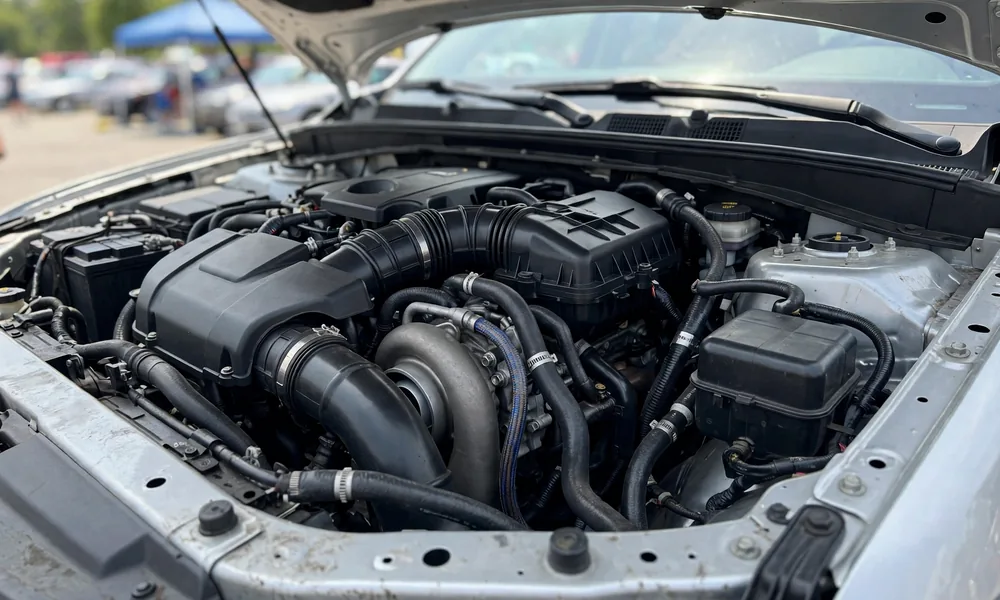
Here is something few people realise: the idea of a variable compression engine is more than a century old, and Nissan was not the first to try it. Engineers have proposed moving cylinder heads, pistons within pistons, and variable-volume combustion chambers since the early days of the petrol engine, and every attempt failed on complexity, sealing, or cost.
So the next time a turbocharged SUV pulls away hard and then settles into a quiet, frugal cruise, remember what is happening inside the block: a harmonic drive turning a shaft, a shaft moving a link, a link raising a piston by a millimetre, and an engine changing its mind about physics in the middle of a journey. The variable compression engine does not beat the old compromise by choosing a side. It beats it by refusing to choose at all.