A superyacht wine cellar is a small room that has to do an impossible job: keep hundreds of bottles at a perfect, steady temperature while the room itself is moving, rolling, and crossing climate zones, all without making a sound that reaches the cabins above. The best cellars are feats of engineering disguised as furniture, with humidity control, vibration isolation, and cooling systems that keep working when the yacht is running on batteries at anchor. This ranking covers the best superyacht wine cellars, judged on storage, climate control, design, and how well they survive life at sea.
Wine is fragile cargo. A bottle stored at the wrong temperature ages badly, a bottle shaken by engine vibration throws sediment, and a bottle exposed to light loses its character. The cellars on this list are the ones that treat wine as a system, not as a display cabinet, and that is why they cost what a small house costs.
How we ranked them
Four criteria decided the order. Climate control matters most: a cellar that cannot hold a steady 12 to 14 degrees Celsius and around 70 percent humidity in the tropics is a wine rack, not a cellar. Capacity and layout is second, since a great cellar stores bottles of every size, from half bottles to large formats, and lets the crew find any bottle without disturbing the rest. Vibration and noise isolation is third, because a cellar next to a generator room that hums through the racks is a slow way to ruin good wine.
8. A standard built-in wine fridge
Many superyachts carry a built-in wine fridge rather than a cellar, and it earns last place honestly: it is a competent appliance doing a job it was not designed for. A good marine wine fridge holds temperature well and looks smart behind glass, but it stores a few dozen bottles at most, it vibrates with the boat, and it usually shares a cooling circuit with the galley, which means it warms up every time the galley works hard.
7. The under-stair display cellar
The under-stair cellar is a design-led solution: a glass-fronted display built into the main stairwell, showing off a curated selection of bottles where guests can see them. It looks spectacular, and as a display it is hard to beat, but as storage it is compromised. The glass lets in light and heat, the location is one of the warmest parts of the yacht, and capacity is limited to a few dozen bottles.
6. The galley-adjacent cellar
A cellar built next to the galley is the practical choice: the crew can reach it without crossing guest spaces, and the cooling plant can share services with the galley refrigeration. The best of these hold temperature well and store several hundred bottles in proper racking, with a small tasting area for the sommelier to work. The weakness is noise and vibration from the galley and its machinery, and the temptation to treat the cellar as overflow storage for the galley.

5. The walk-in lower-deck cellar
The walk-in cellar on the lower deck is the first proper cellar on this list: a dedicated room, usually amidships where motion is least, with its own cooling plant, humidity control, and racking for 500 bottles or more. The location is the clever part, since amidships is the most stable part of the boat and the furthest from engine vibration. The best superyacht libraries ranked shows the same thinking applied to books: a quiet, stable, dedicated room is worth more than a bigger space in the wrong place.
4. The climate-zoned cellar
A climate-zoned cellar divides its space into separate temperature zones, so reds, whites, and sparkling wines each rest at their ideal temperature rather than a single compromise. This is the cellar for a yacht with a serious wine programme, and it is usually paired with a database that tracks every bottle, its drinking window, and its provenance. The engineering is demanding, since each zone needs its own cooling and its own controls, and the doors between zones have to seal perfectly.
3. The vibration-isolated cellar
The third-ranked cellar type is defined by what it removes rather than what it adds: vibration. These cellars mount their racking on isolated platforms, decouple the cooling plant from the structure, and line the room with damping materials, so the bottles never feel the engines, the generators, or the sea. The result is wine that ages as it would on land, which is the whole point of a cellar. They are expensive to build and they take up more space than a standard cellar, since the isolation eats into the room, but for a yacht that carries old and fragile bottles, there is no substitute.
2. The tasting-room cellar
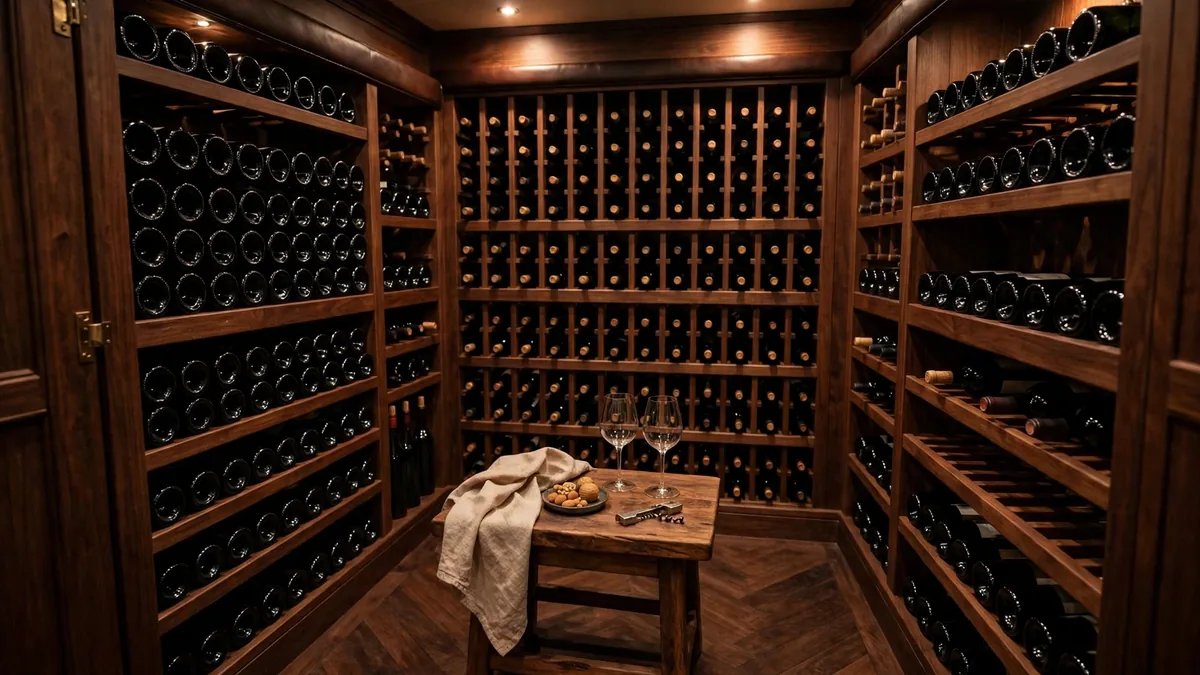
The tasting-room cellar combines storage with a small, beautiful room where guests can taste wine with the sommelier, and it is the most complete experience on this list. The storage is proper, with climate control, humidity, and vibration isolation, but the room is also designed as a destination: warm lighting, a tasting table, and glass that shows the bottles without exposing them to harmful light. The best superyacht spas ranked applies the same logic to wellness, and the lesson is identical: the best rooms on a yacht are the ones that do their technical job invisibly and their experiential job memorably.
1. The full below-decks cellar with separate cooling plant
The best superyacht wine cellar is a full below-decks room with its own separate cooling plant, and it wins because it treats wine storage as a ship’s system rather than a piece of furniture. The room sits amidships, low in the hull where temperature is naturally stable, and its cooling plant is independent of the galley and the air conditioning, with its own backup power so a generator failure does not cook the collection. Racking is individual, vibration-isolated, and sized for every format from half bottles to double magnums. Humidity is held steady, light is minimal, and the crew can inventory the whole collection without moving a bottle they do not need. The most affordable electric yachts ranked for 2027 shows how far yacht engineering has come at the accessible end, and this cellar shows how far it goes at the top: a room that keeps wine perfect while the world outside rolls, heats, and cools around it.
The verdict
If you are building a superyacht and you care about wine, build the full below-decks cellar with its own cooling plant, and put it amidships, low down, with isolated racking. If the budget or the space does not allow that, a vibration-isolated walk-in cellar is the next best thing, and a climate-zoned cellar is the pick for a yacht with a serious wine programme and a sommelier aboard. What not to do is rely on a display fridge or an under-stair showcase as your only storage: they are for showing wine, not for keeping it. The best cellars are the ones you never notice, because the wine inside them never gives you a reason to.