Pop the cover on a Koenigsegg Gemera and you expect a huge engine. It is a four-seat hypercar with 1,700 horsepower, after all, and hypercars are supposed to have engines the size of furniture. Instead you find something that looks almost modest: a compact three-cylinder engine, just two litres, small enough that you could wrap your arms around it. Then you look closer and realise the small engine is doing the work of an engine three times its size, and it does it without a camshaft, one of the oldest parts in the history of the car.
The Gemera’s engine is called the Tiny Friendly Giant, and it is one of the strangest and cleverest engines ever fitted to a production car. This is how it works, and why three cylinders can power a car that outruns almost everything on the road.

How It Works
The Tiny Friendly Giant, or TFG, is a two-litre, twin-turbocharged three-cylinder engine that makes 600 horsepower on its own, or about 300 horsepower per litre. That is roughly three times the specific output of an ordinary family car engine. It achieves that with two big ideas: very high boost pressure, and valves that are opened by computer-controlled actuators instead of a camshaft.
Step 1: Air is forced in by two turbochargers
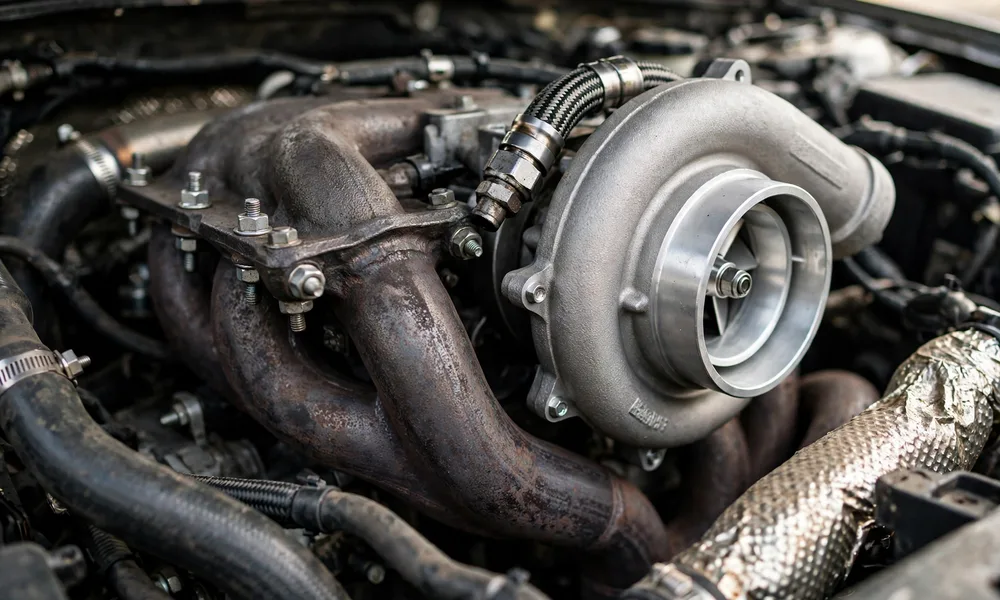
The TFG breathes through two turbochargers, one for each exhaust pulse pattern of the three cylinders, which spin up using exhaust gas and force far more air into the engine than it could ever draw in by itself. At full boost the turbos push the intake pressure to several times atmospheric, cramming a huge mass of air into a small space. More air means more fuel can be burned, and more fuel burned means more power from the same small cylinders. The story of how this engine is put together is told in the account of how the Koenigsegg Gemera engine is made.
Step 2: Freevalve opens each valve on its own
Here is the radical part. A normal engine has a camshaft, a spinning metal shaft with lobes that push the valves open in a fixed pattern. The TFG has no camshaft at all. Instead, each valve has its own actuator, a small pneumatic and hydraulic device that opens and closes that one valve exactly when the engine computer tells it to, by exactly the amount needed. This system is called Freevalve, and it means the engine can change its valve timing, lift and duration from one combustion cycle to the next, something a camshaft could never do. At low speed the valves open gently for efficiency; at full throttle they open wide and stay open longer for power.
Step 3: Cylinders switch off when they are not needed
Because every valve is independent, the TFG can shut down cylinders completely when cruising. The computer simply stops opening the valves on one or two cylinders and stops injecting fuel there, so the engine runs as a one-cylinder or two-cylinder for economy, then wakes the sleeping cylinders in a fraction of a second when the driver asks for power. The TFG can choose any combination, and it can even vary the firing order, which lets it smooth out the vibrations that usually make three-cylinder engines feel rough.
Step 4: Three electric motors fill the gaps
The petrol engine does not work alone. The Gemera carries three electric motors: one on the crankshaft of the engine and one driving each rear wheel. Together they add about 1,100 horsepower, taking the car’s total to 1,700 horsepower. The motors do two things the petrol engine cannot: they deliver instant torque from zero revs, filling in the moment before the turbos spool up, and they drive each rear wheel independently, which lets the car steer itself with power, pushing the outside wheel harder through a corner. The battery is a small, high-power 800-volt pack, built for short bursts of huge power rather than long electric range, and it recharges from the engine and from braking.
Step 5: The nine-speed gearbox blends it all together
All of this power flows through Koenigsegg’s Light Speed Transmission, a nine-speed gearbox with seven clutches that can change gear almost instantly, and can even skip gears, jumping from seventh to fourth in one shift when the driver demands it. The gearbox talks to the engine computer and the electric motors constantly, so when a gearchange happens, the electric motors fill the tiny gap in torque and the shift feels seamless. It is the gearbox that lets a three-cylinder engine, three electric motors and four seats all behave like a single machine.
Step 6: The engine drinks almost anything
The TFG is designed to run on ordinary petrol, on E85 ethanol, and on renewable fuels such as methanol and a synthetic fuel called Vulcanol, which is made from captured carbon dioxide. Because Freevalve controls the valves so precisely, the engine can adapt its combustion to whichever fuel is in the tank, changing timing and lift to suit.
Specifications
| Specification | Typical value |
|---|---|
| Engine | 2.0-litre twin-turbo three-cylinder (TFG) |
| Engine power | 600 horsepower, 600 Nm of torque |
| Electric motors | Three, one on the crankshaft and one per rear wheel |
| Total power | 1,700 horsepower |
| Valve system | Freevalve, camshaft-free |
| Gearbox | Nine-speed Light Speed Transmission |
| 0 to 100 km/h | 1.9 seconds |
| Top speed | Over 400 km/h (estimated) |

What It Costs
The Koenigsegg Gemera is priced at around $1.7 million, with only 300 cars planned, and that figure is an estimate based on the manufacturer’s announced pricing. The price reflects far more than the engine: a carbon-fibre monocoque, four seats, dihedral doors and hand-built everything. But the engine is the heart of the value. A camshaft-free engine with independently controlled valves is a technology no other production car has, and building one requires machining and electronics that are closer to aerospace than to ordinary car manufacturing. For buyers who want even more, a 2,300-horsepower V8 version is offered instead, using the same electric motors with a five-litre twin-turbo V8 in place of the TFG.
A Rare Fact
The Tiny Friendly Giant has no camshaft, no timing belt and no timing chain, which means it has none of the parts that most engines rely on to keep their valves in time. If the Freevalve computer fails, the valves simply stay shut and the engine stops, which is why the system has multiple layers of backup power and control. Even stranger, the engine’s tiny size was a deliberate choice: Koenigsegg wanted a four-seat hypercar, and a small engine left room for rear seats and luggage. The result is a car that carries a family and outruns a Bugatti, and the Bugatti’s own answer to the same problem, a sixteen-cylinder engine of enormous size and complexity, shows just how different two paths to the same goal can be. The story of that rival engine is told in how the Bugatti W16 engine works, and the reasons such an engine costs so much are laid out in why the Bugatti W16 engine is so expensive.
Three cylinders, no camshaft, two turbos and three electric motors. The Gemera’s engine is small enough to hug and powerful enough to humble almost anything on the road, and it works because Koenigsegg threw away a hundred years of camshaft thinking and started again.


