At eight knots, the world slows down. The engine hums at a low, easy note, the bow pushes a gentle wave aside, and the horizon stays in the same place for hours. There is no rush on a trawler yacht, and that is the point. While other yachts burn fuel to go fast, a trawler yacht is built to go far, to cross oceans at walking pace, and to arrive with fuel to spare, a full fridge, and a crew that is rested rather than rattled. It is the slowest yacht in the marina, and often the one that has travelled the furthest.
The trawler yacht descends from working fishing trawlers, the tough steel boats that spent weeks at sea in bad weather. Yacht builders kept the deep, heavy displacement hull and the single, reliable diesel engine, then added the things fishermen never had: a proper saloon, a full galley, comfortable cabins, and enough tankage to cross an ocean. The result is a yacht that looks old-fashioned and behaves like a small ship, and that is exactly why its owners love it.

How a Luxury Trawler Yacht Works
1. The displacement hull: built to push water aside, not climb over it
A trawler yacht has a displacement hull, a deep, rounded shape that sits in the water and pushes it aside as it moves, rather than planing on top of it like a speedboat. That shape is inefficient at high speed, but at eight to ten knots it is superbly efficient, and it gives the boat a soft, rolling motion in a seaway rather than a hard slam. The hull is usually steel or heavy fibreglass, with a bulbous bow below the waterline to smooth the flow and a full keel to protect the propeller and to keep the boat tracking straight.
2. One engine, run gently, for thousands of hours
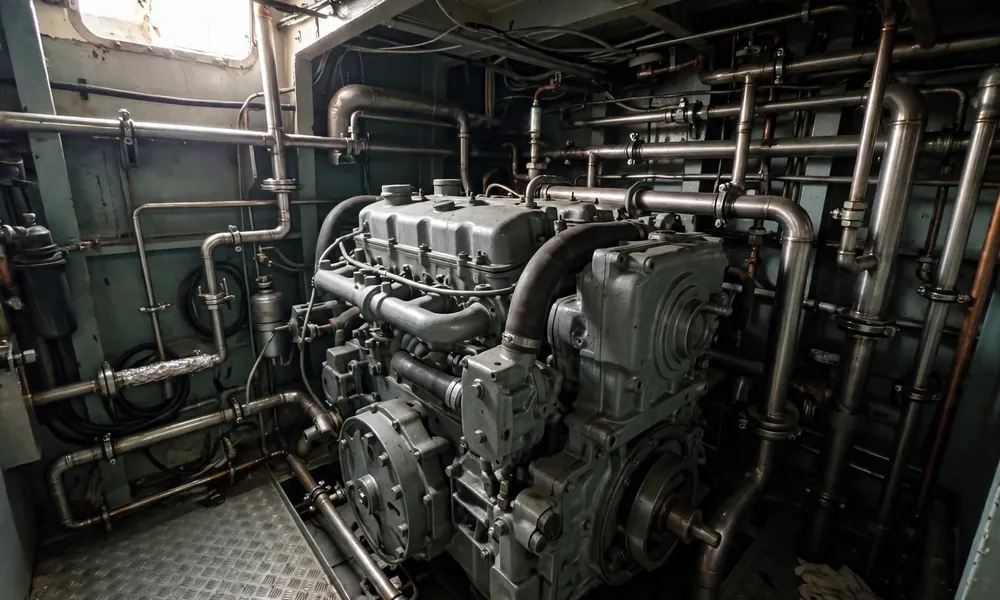
Most trawler yachts have a single main diesel engine, often a commercial-grade unit of a few hundred horsepower, running at low revs for hour after hour. A single engine is simpler, cheaper to maintain, and more fuel-efficient than twins, and the boat carries a small wing engine or a get-home system in case the main engine fails. Fuel is carried in large tanks, often holding ten thousand litres or more, which is what gives the boat its range. The engine room is kept clean, well-lit, and easy to work in, because on a long passage the owner or the engineer will check it every few hours.
3. Stabilisers: the secret to a comfortable ride
A round-bilged displacement hull rolls in a beam sea, so trawler yachts rely on stabilisers to keep life comfortable. The most common system is a pair of fins that extend from the hull below the waterline and move up and down, driven by hydraulics, to counteract the roll. At anchor, the fins can be centred and the boat can use a gyroscopic stabiliser instead, a heavy spinning wheel below deck that resists rolling. Together, these systems cut the roll by more than half, turning a passage that would be tiring into one where dinner can be served on a level table. The fin system is related to the stabilisers on much larger ships, described in our guide to how a ship stabiliser works, but here it is tuned for a private yacht and its guests.
4. Power, water, and living off the grid
A trawler yacht is designed to be self-sufficient for weeks. A generator provides electricity for air conditioning, cooking, and the navigation systems, and many modern boats add solar panels and large lithium battery banks to reduce generator hours. A watermaker turns seawater into fresh drinking water, so the boat does not need to carry all its water in tanks. The galley is a proper kitchen, the saloon has space for a dining table and a sofa, and the cabins are arranged for a couple and a few guests, with a crew cabin for longer trips. The fishing heritage of the design is still visible in the boats it came from, including the craft described in our guide to how a luxury fishing yacht is made.
5. Navigation, anchoring, and the tender
On the bridge, or more often on the flybridge, the captain works with radar, electronic charts, an autopilot, and satellite communications that can reach anywhere on Earth. The autopilot steers for hours, holding a course while the crew keeps watch, and the navigation systems are backed up by paper charts and a second, independent set of instruments. At the bow, a heavy windlass handles an anchor and chain sized for a boat that may anchor in a remote bay in a gale. On the stern, or on the boat deck, sits the tender, a small rigid inflatable boat with an outboard engine, used for going ashore where there is no marina. The electric systems that support all of this have much in common with those on newer yachts, as explained in our guide to how an electric yacht is made.
6. Planning a passage: slow, steady, and far
A trawler yacht passage is planned like a small expedition. The crew studies the weather, chooses a route that keeps the wind and waves on the most comfortable quarter, and calculates fuel with a large reserve, usually enough for a third more than the planned distance. The boat leaves at dawn, settles into its cruising speed, and the watch system begins: two or three hours on, then rest, around the clock. Days pass in a rhythm of navigation checks, engine checks, meals, and sleep, and the boat covers about two hundred nautical miles a day.
Specifications
| Specification | Typical figure |
|---|---|
| Length overall | 20 to 30 metres |
| Beam | 6 to 7 metres |
| Cruising speed | 8 to 10 knots |
| Range | 3,000 to 5,000 nautical miles |
| Fuel capacity | About 10,000 to 20,000 litres |
| Main engine | Single diesel, about 400 to 800 horsepower |
| Guests | 6 to 10, plus 2 to 4 crew |
| Hull material | Steel or heavy fibreglass |
Price
A luxury trawler yacht is a substantial purchase, but it is less expensive than a fast superyacht of the same length, because the engines are smaller and the systems are simpler. A new trawler yacht of about twenty-five metres is estimated to cost about 3 to 10 million dollars, depending on the builder, the materials, and the standard of the interior, while a well-kept used boat is estimated to cost considerably less. Those figures are estimates only. Running costs are modest by yacht standards, with fuel, berthing, insurance, and maintenance estimated at about 5 to 10 percent of the purchase price each year, and the long range means owners can cruise to places where marinas are few and far between.

A Rare Fact
Some trawler yachts carry a bulbous bow that looks like a torpedo welded to the front of the hull, and it saves real fuel. The bulb creates its own wave that cancels out the bow wave, reducing drag by several percent at cruising speed. On a boat that may burn fuel for a week without stopping, a few percent is hundreds of litres saved on every ocean crossing.
The trawler yacht is not for people in a hurry. It is for people who enjoy the journey as much as the destination, who like the sound of a diesel running gently for days, and who would rather cross an ocean slowly and comfortably than fly over it. In a world that keeps getting faster, the slowest yacht in the marina may also be the wisest.


