A luxury electric boat does not smell of fuel. In the workshop the hull sits on its cradle, and where a diesel engine would sit there is a clean, quiet space waiting for a battery pack and an electric motor. There are no exhausts to route, no fuel tanks to fit, and no oil to wipe from the floor, and the whole build feels more like assembling a large piece of electronics than a traditional boat.
That cleanliness is the point, and it is also the challenge. An electric boat trades the range of diesel for silence, instant torque, and running costs that are a fraction of a fuel-burning boat, but only if the batteries, the motor, and the hull are designed together from the start. This is how a luxury electric boat is made.
Step 1: The hull, shaped for efficiency
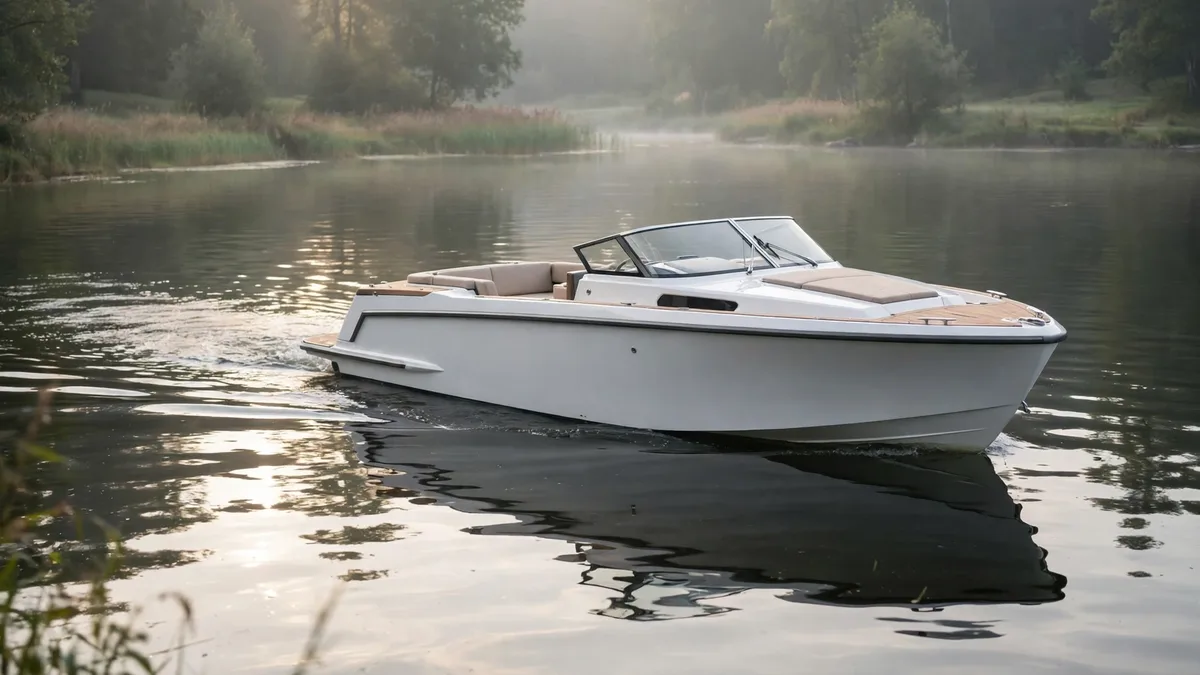
The build starts with a hull designed to slip through the water with as little resistance as possible, because every watt saved is range gained. The shell is laid up in a mould from fibreglass and carbon fibre with a foam core, keeping it light, and the shape is long and fine, with a flat run aft that lets the boat plane easily at speed.
Weight is watched at every stage. Batteries are heavy, so the hull, the deck, and the interior must all be lighter than on a diesel boat to make room for them. Bulkheads are bonded in while the hull is still in the mould, giving stiffness without the weight of extra framing.
Step 2: The battery pack
The battery pack is the heart of an electric boat, usually a large lithium-ion bank of one hundred to several hundred kilowatt-hours, built from modules wired together and housed in a sealed, waterproof case low in the hull. The case sits on the centreline, where its weight keeps the boat stable, and it is fitted with cooling channels and a battery management system that watches every cell.
That management system is a safety device as much as a performance one. It balances the cells, limits charging when they are hot, and shuts the pack down if anything goes wrong. How an electric boat is made follows the same battery-first logic on a smaller boat, where the pack is a bigger share of the whole build.
Step 3: The electric motor and the drive
The motor itself is small for the power it makes, often a compact permanent-magnet unit that weighs a fraction of a diesel of the same output. It is mounted low in the hull and connected to the propeller through a short shaft or a pod drive that hangs below the hull, steering the boat by turning the whole pod.
There is no gearbox to speak of, because an electric motor makes full torque from a standstill. The throttle is a simple electronic control, and reverse is just the motor spinning the other way, which makes docking a quiet, precise business.
Step 4: Charging, wiring, and controls
With the motor in, the charging system goes in next: an onboard charger, a shore-power inlet, and heavy cables run through conduits to the battery pack. High-voltage cables are orange, routed away from low-voltage wiring, and every connection is torqued and sealed against moisture, because salt water and high voltage are a combination no builder takes lightly.
The helm gets a digital display instead of a row of dials, showing battery level, range, and power draw in real time. Solar panels on the roof can trickle charge the pack at anchor, adding a little range on sunny days.
Range anxiety is the honest trade-off, and builders answer it with careful numbers rather than promises. The display shows live range at the current speed, and easing off by just a few knots can nearly double the distance the battery will carry the boat. Most owners learn to cruise gently and arrive with charge to spare.
Step 5: The interior
The interior of a luxury electric boat is built around the silence. Without engine noise or vibration, the joiners can use lighter panels and larger windows, and the saloon feels more like a quiet room than a machine space. Light wood, soft fabrics, and a full galley fill the space where fuel tanks and exhausts would have sat on a diesel boat.
Air conditioning runs from the battery pack, and the whole boat is designed to be lived in at anchor without running a generator. How a luxury electric yacht is made shows the same silence-led design on a much larger boat, where the battery bank is big enough to run the hotel systems for days.

Step 6: Testing, range trials, and handover
A finished electric boat is tested on the water before it is sold, and the most important test is range. The boat is run at cruising speed until the battery is low, measuring speed, power draw, and distance, because the range figure on the brochure must match what the owner will actually get. Charging is tested too, from a marina post and from a fast charger where one is available.
Noise is measured in every seat, and the answer is usually near silence, just wind and water. The best electric boat brands ranked lists the makers turning this quiet technology into finished boats, from small day boats to large luxury cruisers.
Specifications
| Detail | Specification |
|---|---|
| Hull material | Fibreglass and carbon fibre with foam core |
| Length overall | Around 7 to 12 metres |
| Battery capacity | Around 100 to 300 kilowatt-hours |
| Motor power | Around 100 to 400 kilowatts |
| Top speed | Around 25 to 35 knots |
| Cruising speed | Around 15 to 20 knots |
| Range at cruising speed | Around 60 to 120 nautical miles |
| Charging | Shore power and fast charging |
| Passengers | Usually 8 to 12 |
| Displacement | Around 3 to 8 tonnes |
Price
The estimated price of a luxury electric boat is around 250,000 to 800,000 dollars, and that figure is an estimate only, because the cost depends on battery size, motor power, and the level of interior finish. The battery pack accounts for a large share, followed by the motor and the hull. A buyer is paying for a boat that runs almost silently, costs very little to run per mile, and can be charged from the same socket as a car.
A rare fact
Few people know that an electric boat can recover energy while it sails. When the boat is towed or pushed along by wind, the propeller can spin the motor backwards and act as a generator, feeding power back into the battery. The effect is small, a few percent of the pack on a long passage, but it is free energy, harvested from the same water the boat is moving through.
When the boat finally leaves the dock and the helm pushes the throttle forward, there is no roar, just a rising hum and a clean wake. That quiet is the achievement of a hull shaped for efficiency, a battery built like a vault, and a motor that does its work without fuss.


