Dawn had not yet broken over the canyon when the captain throttled back and the crew went quiet. Somewhere below, a thousand feet down, a marlin was circling the spread of lures trailing behind the boat. Then a rod bent double, line screamed off the reel, and the cockpit came alive. The angler strapped into the fighting chair, the captain worked the throttles to keep the fish off the stern, and the mate stood ready with the gaff.
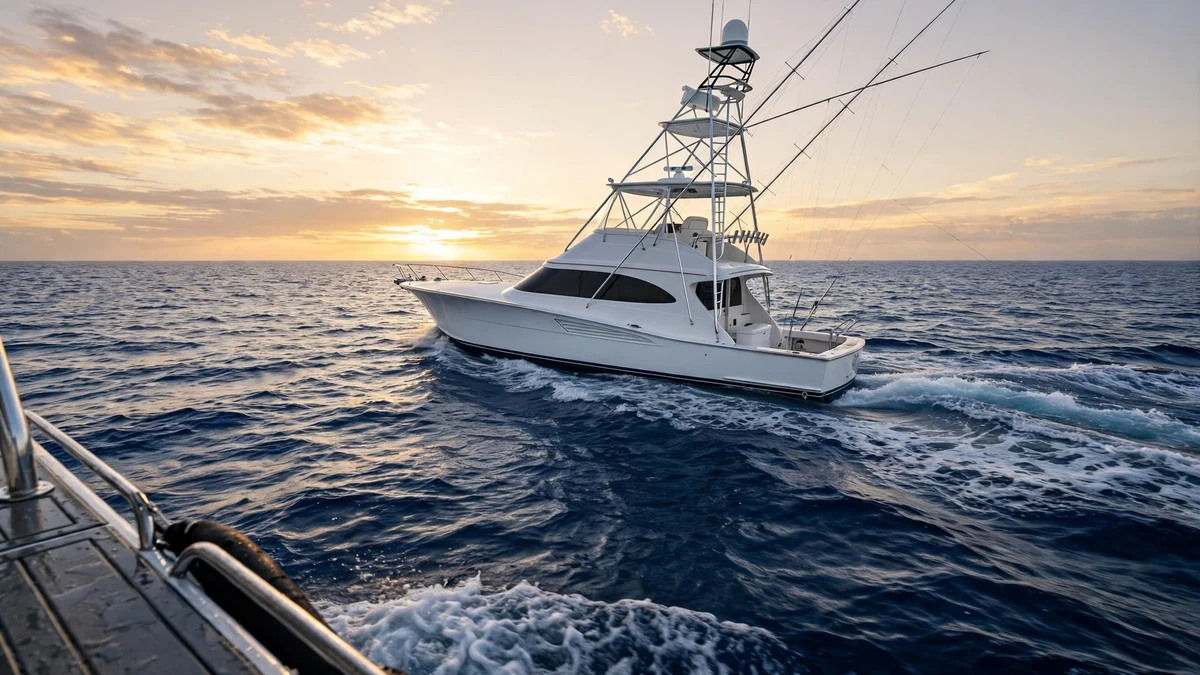
A luxury fishing yacht, usually called a sportfisher, is two boats in one: a serious offshore fishing machine and a comfortable yacht. The cockpit is a working deck built for blood, bait, and heavy tackle, while a few steps up the salon is air-conditioned, the cabins are panelled in teak, and dinner is served on linen.
How a Luxury Fishing Yacht Is Made
A sportfisher starts with the fishing, and the fishing starts with the hull. Naval architects design a hull with a sharp, deep-V entry to cut through head seas at thirty knots, a wide beam for stability when the boat is drifting, and a flat run aft so it backs down fast on a fish. The hull must be quick enough to reach the fishing grounds before dawn and tough enough to take a beating in a following sea, and those two demands shape every line of the design before the interior is even sketched.
Step 1: Designing the hull for speed and the backing down
The most unusual demand on a sportfisher hull is backing down: when a fish is hooked, the captain throws the boat into reverse and chases it, sometimes at ten knots backwards, while the angler fights from the cockpit. The transom must be built to take the full force of the water, the cockpit must drain instantly, and the hull must track straight in reverse without broaching. It is the one manoeuvre no other yacht is designed around, and it drives the whole hull shape.
Step 2: Laying the hull in fibreglass and carbon
The hull is laid up in a mould, layer by layer, from fibreglass cloth and resin, with carbon fibre used in the high-load areas around the engines and the tower. The laminate is vacuum-infused so the resin fills every fibre and the hull comes out light and stiff, and the stringers and bulkheads are bonded in to give the hull the rigidity it needs at speed.
Step 3: Building the fishing cockpit
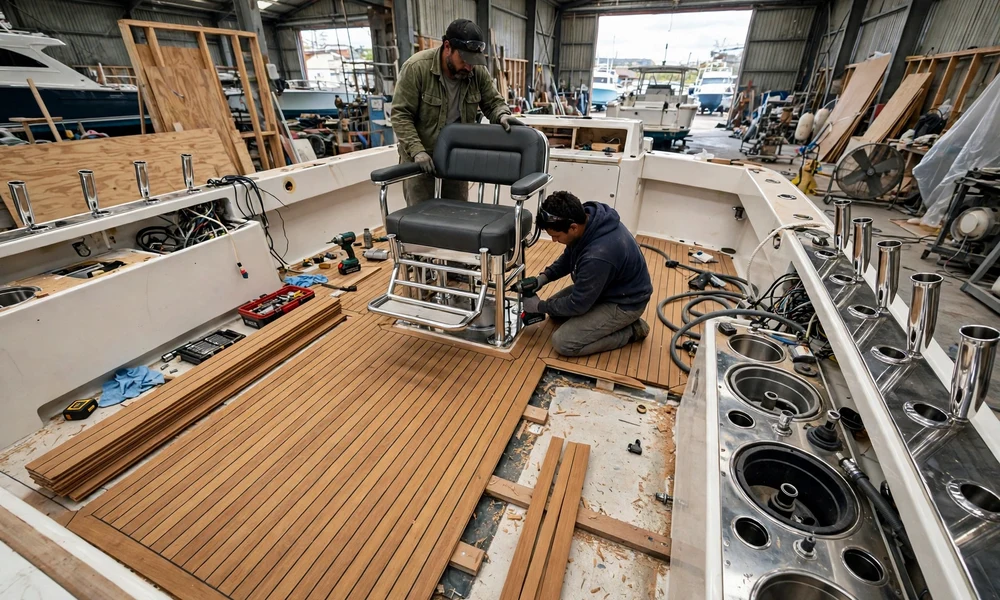
The cockpit is the working heart of the boat, and it is built like a commercial fishing deck dressed in teak. The sole is self-bailing, with scuppers big enough to clear a wave in seconds. Live wells are built into the transom to keep bait alive, with pumps that circulate fresh seawater constantly. Rod holders are set into the gunwales, a bait freezer sits under a hatch, and a fighting chair is bolted through the deck to a steel foundation that can take the pull of a thousand-pound fish. Everything in the cockpit is washable, because by the end of a day it will be covered in salt, bait, and blood, and it must hose clean in minutes.
Step 4: Fitting the tower and the flybridge
Above the cockpit rises the tower, the tall aluminium structure that carries the tuna tower and the flybridge helm. The tower gives the captain a view from ten metres up, high enough to spot birds working bait and the dark shape of a marlin in the water. It is built from welded aluminium tube, faired and painted to match the hull, and it is bolted through the deck to the hull structure, because at thirty knots in a head sea the tower takes enormous loads.
Step 5: Installing the engines and the electronics
Power comes from two large diesel engines, each producing 1,000 to 2,000 horsepower, driving the boat through shafts and propellers or through pod drives. The engine room is fitted with sound insulation, because a luxury boat must be quiet below, and the fuel tanks are sized for a range of several hundred miles. The electronics are the other half of the fishing system: sonar that reads the bottom in a thousand feet of water, a fish finder that marks bait and game fish, radar, and satellite weather, all shown on glass displays at both helms. Charging the house batteries and running the air conditioning at anchor takes serious power, and how electric yacht charging works shows how modern yachts manage that load without running the main engines all night.
Step 6: Fitting the luxury interior and sea trials
With the fishing systems in place, the interior is fitted out like a small hotel. The salon gets a galley, a dining table, and a lounge with a television; the cabins below get double berths, en-suite heads, and air conditioning. The finish is teak, leather, and stainless steel, built to survive salt air without losing its shine. Then comes the sea trial, where the yard tests the top speed, the backing down, the tower in a head sea, and the live wells at full flow. Only when the boat raises fish and rides well does it get its name on the transom and its keys handed over. The ground tackle is specced to hold the boat in an open anchorage, and the luxury yacht anchor it carries is sized for a boat that will anchor in deep water far from shelter. The winches that handle the lines and the dredges must be just as reliable, and yacht winch specs explain what the numbers mean when a winch is asked to pull hard all day.
Luxury Fishing Yacht Specifications
| Specification | Typical figure |
|---|---|
| Length | 18 to 30 metres |
| Top speed | 35 to 45 knots |
| Engines | Two diesels, 1,000 to 2,000 hp each |
| Hull material | Fibreglass and carbon fibre, vacuum-infused |
| Fuel capacity | 5,000 to 10,000 litres |
| Range | 400 to 600 nautical miles |
| Fighting chair | Bolted to a steel foundation in the cockpit |
What a Luxury Fishing Yacht Costs
A luxury fishing yacht is one of the most expensive boats per metre afloat. A new eighteen-metre sportfisher typically costs an estimated $2 million to $4 million, while a thirty-metre flagship with a full tower, triple engines, and a custom interior can reach an estimated $8 million to $12 million.
A Rare Fact About Luxury Fishing Yachts
The tuna tower on a sportfisher is not there for the view alone. From ten metres up, the captain can see a marlin’s dark shape in the water, the birds working a bait ball, and the colour changes where currents meet, all of which are invisible from the main helm. Some captains can spot a fish from a mile away by the way the water moves, and the tower is the tool that makes that possible. It is a crow’s nest, a helm station, and a fishing instrument all at once.

The next time you see a white sportfisher heading out before dawn, tower swaying gently, outriggers spread, think of the two boats inside it: the fishing machine below, built to back down on a marlin at ten knots in reverse, and the yacht above, built to serve dinner on linen the same evening. A luxury fishing yacht is the only boat that has to do both jobs at the highest level, and the fact that it does is why it costs what it costs.


