On a factory floor in the early morning, a coil of steel as tall as a person is unrolled, cut, and pressed into the shape of a car that does not exist yet. The luxury electric hatchback looks small and simple from the kerb, but its birth is one of the most choreographed processes in modern manufacturing.
What makes the build special is the way electric power changes the order of things. There is no engine to lower in from above, no exhaust to thread underneath, and no fuel tank to hide. This is the story of how a luxury electric hatchback is made, step by step, from raw metal to the first drive out of the factory gate.

How It’s Made
Step 1: The press shop shapes the steel
Every hatchback begins in the press shop, where huge presses stamp flat sheets of steel and aluminium into doors, roofs, bonnets, and floor panels. Each press closes with thousands of tonnes of force, and the metal takes its shape in a fraction of a second. The panels are checked by hand and by laser, because a door that is a millimetre out will never close with the soft, expensive thunk a luxury buyer expects. Nothing is wasted: offcuts are collected and sent straight back for recycling.
Step 2: The body shop welds the shell together
In the body shop, robots take over. More than a hundred robotic arms spot-weld the pressed panels into a complete body shell, placing thousands of welds with a precision no human hand could match. The shell is the skeleton of the hatchback, and its stiffness matters twice as much in an electric car, because a stiff body keeps the cabin quiet and protects the battery in a crash. When the shell passes inspection, it is washed, dipped in a rust-proofing bath, and dried, ready for paint.
Step 3: Paint, layer by layer
The paint shop is the cleanest part of the factory, and it has to be, because a single speck of dust can ruin a finish. The body is dipped in a primer that protects it from rust, then sprayed by robots with a base coat of colour and two layers of clear lacquer. Between coats, the body is baked in an oven until the paint hardens to a deep, glassy shine. A luxury hatchback gets extra attention here: the paint is inspected under bright lights, and any tiny flaw is polished out by hand.
Step 4: The battery is built and sealed
While the body is being painted, the battery is built in a separate clean area. Hundreds of individual cells are grouped into modules, wired together, and fitted with cooling channels that keep them at the right temperature in summer and winter. The modules are sealed inside a strong metal case that is watertight and crash-resistant, and every battery is tested before it leaves the area: charged, discharged, and checked for any cell that behaves differently from its neighbours. It is also the part that decides how far the car will go, so the testing is slow, careful, and never skipped.
Step 5: The marriage of body and battery
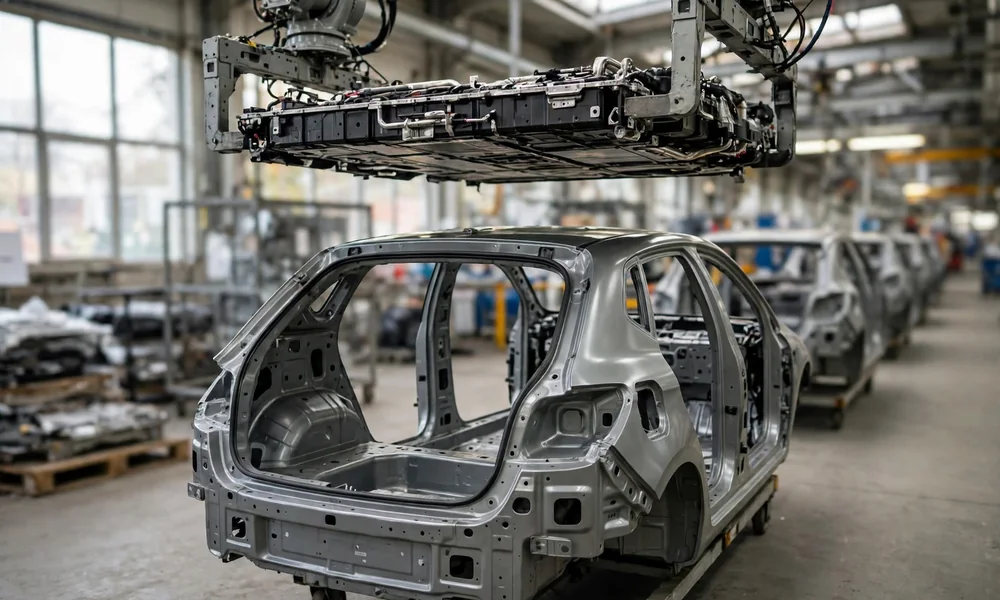
This is the moment the car becomes electric. The painted body shell travels along the line on a conveyor, and the battery rises from below on a lift, guided into place by lasers. Workers and robots bolt it to the floor, connect the high-voltage cables, and seal the joints. Because the battery is flat and low, the cabin floor stays flat too, which is why the rear seats of a hatchback have proper legroom despite the short body. The electric motor, the inverter, and the charging unit are fitted at the same stage, along with the suspension and the steering.
Step 6: The cabin and the trim
With the mechanical parts in place, the car moves to the trim line, where the cabin is fitted out. Seats, dashboard, screens, carpets, and door panels arrive in sequence, each one matched to the exact car on the line. The dashboard is slim and carries a wide central screen, the seats are upholstered in leather or a premium recycled fabric, and sound insulation is tucked behind every panel to keep the cabin quiet at speed. It is at this stage that the hatchback stops looking like a machine and starts looking like a car someone would want to own.
Step 7: Testing, water, and the road
No hatchback leaves the factory without being tested. First, it is driven onto rollers and run through its gears, brakes, and steering while computers listen for faults. Then it passes through a water test, where high-pressure jets simulate a storm, checking that not a drop gets into the cabin or the battery case. Finally, a driver takes it onto a short test track, listening for rattles, checking the brakes, and confirming that the car accelerates smoothly and silently. Only then does it get its final polish and its paperwork.
Key Specifications
The figures below describe a typical current luxury electric hatchback; individual models vary.
| Specification | Typical figure |
|---|---|
| Battery capacity | 50 to 70 kWh |
| Power output | 150 to 250 horsepower |
| Range | 350 to 500 kilometres |
| 0 to 100 km/h | 6 to 8 seconds |
| Top speed | Around 160 to 180 km/h |
| Charging | 10 to 80 percent in about 25 to 35 minutes on a fast charger |
| Boot space | 350 to 450 litres, more with seats folded |
| Seating | Five seats |
How Much Does It Cost?
A luxury electric hatchback typically costs from around $40,000 to $65,000, depending on the maker, the battery size, and the trim level. That is an estimate based on current premium models, and the price can rise with a larger battery, all-wheel drive, or a higher specification interior. The battery alone accounts for a large share of the cost, which is why the build spends so much time on it. For the petrol-era version of the same story, how a luxury hatchback is made shows the older process. For the numbers in detail, the luxury electric hatchback specs explained breaks down what each figure means. And if the price seems high for a small car, why a luxury electric hatchback is so expensive explains where the money goes.

A Rare Fact
Here is a detail from the factory floor that owners never see: the body of a luxury electric hatchback is often stiffer than the body of a sports car twice its price. The reason is the battery case, which is bolted so firmly to the floor that it becomes part of the structure, bracing the car against twisting. Engineers discovered that this extra stiffness also makes the car quieter, because a body that does not flex does not creak, and it makes the car handle better, because the suspension has a solid platform to work from. The battery was designed to store energy, and it ended up holding the car together as well.
The luxury electric hatchback proves that a small car can be built like a flagship. Pressed, welded, painted, and tested with the same care as a car three times its size, it leaves the factory as a quiet, clever machine that fits anywhere and does everything. It began as a coil of steel, and it ends as the car you reach for every single day.