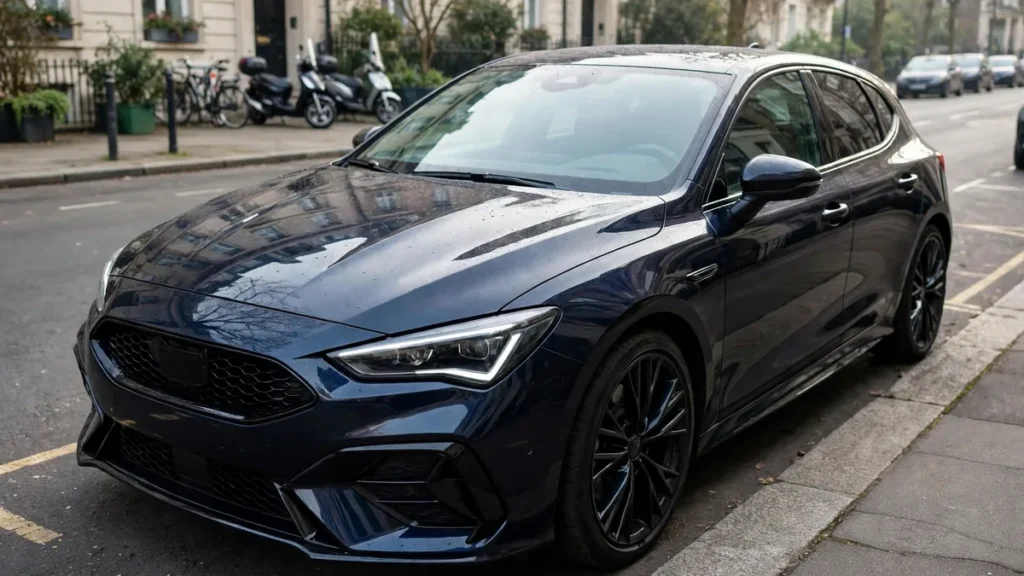
In a German factory, a car body the size of a small living room moves slowly down a line of robots, and at each station something precise happens: a door is fitted, a seam is welded, a panel is checked by a laser that can see a gap thinner than a hair. The car is a luxury hatchback, the smallest car its maker builds, and the factory treats it with the same care it gives its flagship saloons, because a small luxury car is judged more harshly than a big one: every rattle, every rough edge, every cheap feeling is noticed at once, and there is nowhere to hide it.
This is how a luxury hatchback is made, in seven steps, from the first steel to the day the car is handed over to its owner: the body, the paint, the engine, the interior, the electronics, the testing and the final inspection that proves it all works.

Step 1: Stamping a body from steel that is stronger than it looks
Everything starts with the body, and a luxury hatchback body begins as flat sheets of steel, some of them high-strength steel that is thinner and lighter than ordinary steel but harder to shape. The sheets are pressed in giant dies, machines that stamp out doors, roofs and floor pans in a single blow, and the panels are checked by hand and by laser, because a panel that is a millimetre out will show as a crooked shut line on the finished car. A small car has less steel to hide behind than a big one, so the body must be right the first time, and the guide to how a luxury sports car works follows a larger, faster car through the same factory logic, where the body is the foundation everything else is bolted to.
Step 2: Painting a small car to a big standard
The paint on a luxury hatchback is applied in a hall cleaner than an operating theatre, because a single speck of dust in the paint shows on a small car more than on a large one. The body is washed, primed, and sprayed by robots that lay down coat after coat, each one baked in an oven before the next, until the paint is deep, even and hard enough to resist stone chips.
Step 3: Fitting an engine that is small, quiet and strong
A luxury hatchback cannot have a big engine, so its engine must be small, quiet and strong all at once. Most use a turbocharged four-cylinder, often with a hybrid motor that fills in the power at low revs, and the engine is built on its own line, where it is assembled, tested and run before it ever meets a car. The engine is then lowered into the body from above, a moment the factory calls the marriage, and the guide to luxury supercar specs, explained sets out the numbers for a very different kind of engine, where the power is ten times greater and the silence is not part of the deal.
Step 4: Building an interior that feels bigger than the car
The interior of a luxury hatchback is where the car earns its price, because the buyer sits in it every day and touches everything. The dashboard is a single moulded piece, covered in soft material rather than hard plastic, and the seats are shaped and stitched by hand, with leather that is cut from hides inspected for marks.
Step 5: Wiring the electronics that run the car
Behind the dashboard, a luxury hatchback carries more computing power than the first spacecraft, and the wiring is fitted by hand, loom by loom, because a robot cannot thread cables through a body the way a person can. The car has a central screen, a digital instrument display, and sensors that watch the road, the traffic and the driver, and they are all connected by a network that must work perfectly, because a fault in the wiring can stop the car. The guide to how a luxury electric SUV works follows a larger car through the same electronic testing, where the battery and the motors add a whole second system to check.
Step 6: Testing a small car harder than a big one
Before it leaves the factory, every luxury hatchback is tested, and the testing is harder than for a bigger car, because a small car is expected to do everything a big car does, on worse roads, with less room for error. The car is driven over a test track with bumps, potholes and a water trough, and it is checked for rattles, leaks and squeaks, because a rattle in a small car is louder than a rattle in a big one. The brakes are tested, the lights are tested, and the car is driven at speed on a straight, where a technician listens for wind noise around the doors and windows.
Step 7: Final inspection, and the day the car meets its owner
The last step is the final inspection, and it is done by a person, not a machine. An inspector walks around the car with a light, looking for paint flaws, panel gaps and trim faults, and then sits inside, testing every switch, every seat adjustment and every screen, before the car is washed, polished and covered for delivery. The inspector signs the car off, and the signature is the factory’s promise that the car is ready, and the car is then loaded onto a transporter, still covered, and taken to the dealer, where its owner will see it for the first time.

What it costs
A luxury hatchback typically costs an estimated $35,000 to $70,000, depending on its engine, its trim and the standard of its interior. The estimate covers the car alone, not the insurance, the servicing or the options, which are a real part of buying a small car with a big badge, and which can add thousands before the car ever leaves the showroom.

A rare fact
One detail few buyers ever learn is that the paint on a luxury car is measured in microns, millionths of a metre, and the total thickness of all the coats together is thinner than a human hair. The robots spray it to a tolerance of a few microns, and the inspectors measure it with a gauge that reads through the paint to the steel below, because paint that is too thin will chip and paint that is too thick will crack, and the difference between the two is smaller than the width of the hair the paint is thinner than.
Follow the seven steps in order, body first, then paint, engine, interior, electronics, testing and inspection, and a luxury hatchback stops looking like a small car with a big price and starts looking like what it is: a car built to the same standard as the largest car its maker builds, in a package that must do more with less, and do it quietly, every day, for years.