Close the door of a luxury car and the world goes quiet. Then the music starts, and it does not sound like it comes from speakers at all. It sounds like the band is sitting in the cabin with you, the singer just over your shoulder, the bass warm in your chest. That feeling is not an accident. It is the result of a speaker built like a fine instrument and placed with the care of a concert hall designer.
A luxury car speaker has a hard job. It must turn a tiny electrical signal into sound that fills a small, oddly shaped room full of leather, glass and people, while the car shakes, the engine hums and the wind roars outside. Doing it well takes a precise driver, a clever amplifier and a cabin tuned like an instrument. Here is how a luxury car speaker works, from the electric signal to the sound that reaches your ears.
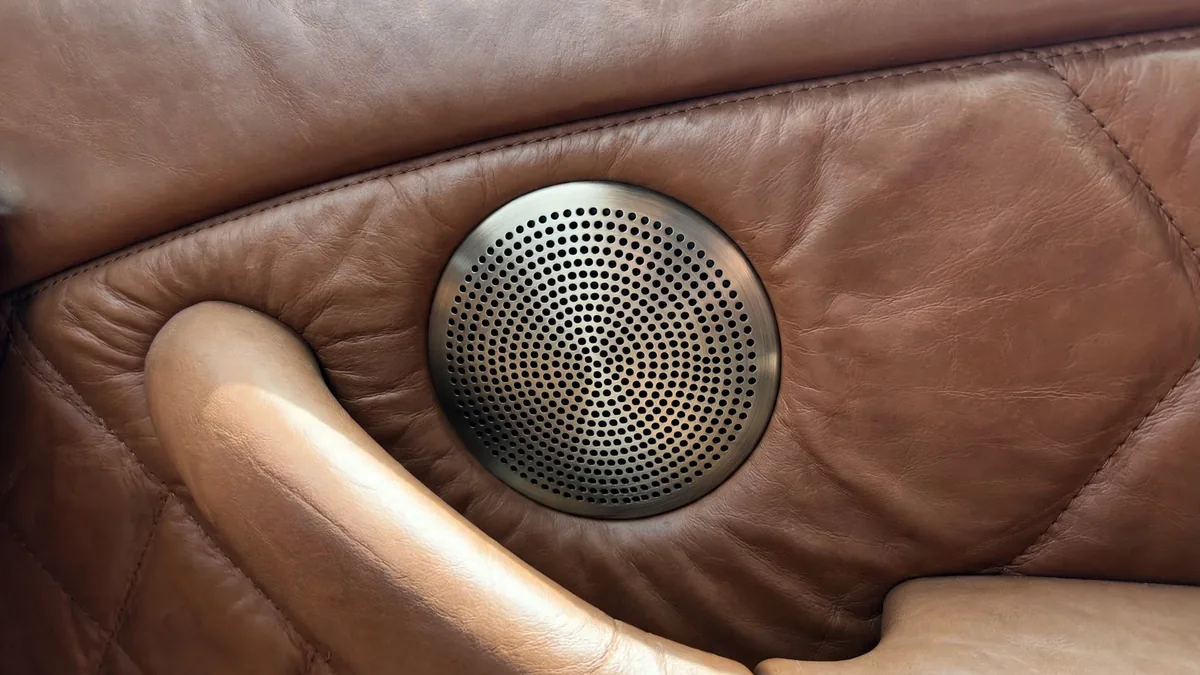
How It Works
Step 1: The amplifier turns a whisper into power
Everything starts with the amplifier, a box of electronics usually hidden under a seat or in the boot. The music signal from the car’s computer is far too weak to move a speaker, so the amplifier strengthens it, sometimes to hundreds of watts, while keeping it clean and free of distortion. Luxury systems use a separate amplifier channel for each speaker, so the tweeter that makes high notes and the woofer that makes bass each get their own carefully tuned power.
Step 2: The voice coil turns electricity into movement
The strengthened signal travels to the speaker, where it meets the voice coil, a tight winding of copper wire sitting in a strong magnetic field. When the music signal flows through the coil, it becomes a tiny electromagnet, and the fixed magnet pushes and pulls it back and forth, hundreds or thousands of times a second. The coil is glued to the speaker cone, so every movement of the coil becomes a movement of the cone. This is the heart of the whole system: electricity in, movement out, with nothing in between but a magnetic field.
Step 3: The cone pushes the air
As the cone moves in and out, it pushes the air in front of it, and that moving air is what our ears hear as sound. A big, slow movement makes a low bass note, while a tiny, fast movement makes a high treble note. Luxury car speakers use cones made from paper mixed with fibres, woven glass, or even ceramic and beryllium, because the cone must be stiff enough not to bend and light enough to move quickly. The cone’s edge, called the surround, is a soft ring of rubber or foam that lets the cone move freely while holding it centred. The way a luxury wireless speaker works follows the same physics in a small box on a shelf, but a car speaker must do the same job while bolted to a shaking door. When the cone moves exactly as the signal tells it to, the sound is clean; when it bends or lags, the sound turns muddy.
Step 4: The magnet and basket hold everything steady
Behind the cone sits the motor of the speaker: a strong permanent magnet, often made from neodymium, held in a steel basket that bolts to the car door. The magnet must be powerful, because a stronger field means the coil moves more precisely with less power, and it must be heavy, because mass absorbs vibration. The basket is cast or stamped to hold the magnet, the cone and the coil in perfect alignment, and it is sealed so dust and damp from inside the door cannot reach the moving parts.
Step 5: The crossover sends each note to the right speaker
No single speaker can play every note well, so a luxury car uses many: small tweeters for high notes, mid-range drivers for voices, and large woofers for bass. A device called a crossover splits the music signal and sends each part to the speaker built for it, so the tweeter never has to struggle with bass and the woofer never has to squeak out treble. In a luxury car the crossover is digital, running inside the amplifier, and it can be tuned for each seat, so the driver hears a balanced sound even though the speakers sit at different distances. The specifications of a luxury wireless speaker show how power, frequency range and driver size are measured, and the same numbers decide whether a car speaker sounds thin or full.
Step 6: The cabin itself becomes part of the instrument
The last step is not a part at all, but the car itself. Engineers tune the whole cabin like a concert hall, placing speakers in the doors, the dashboard, the roof and even the headrests, then measuring the sound at every seat with microphones. They add felt, foam and heavy mats to stop panels rattling, and they use the car’s own noise-cancelling system to hush the engine and tyre roar so the music stands out. When the tuning is done, the sound seems to come from nowhere and everywhere at once, as if the cabin itself were singing. The way a luxury wireless speaker is made ends at the factory door, but a car speaker is only finished when it has been tuned inside the very car it will live in. That final tuning is what turns a set of parts into a concert hall on wheels.

Car Speaker Specifications
| Specification | Typical Luxury Car Speaker System |
|---|---|
| Speakers per car | 16 to 30 speakers |
| Total power | 800 to 2,000 watts |
| Frequency range | 20 Hz to 20,000 Hz |
| Woofer size | 6.5 to 9 inches in the doors |
| Tweeter material | Silk, ceramic or beryllium dome |
| Magnet type | Neodymium permanent magnet |
| Crossover | Digital, tuned per seat |
The Price
A luxury car sound system costs an estimated $3,000 to $7,000 as a factory option, depending on the brand and the number of speakers. The finest systems, with more than twenty speakers and over 1,500 watts, cost an estimated $7,000 to $12,000. Replacing a single blown door speaker costs an estimated $200 to $600 including fitting, while a failed amplifier costs an estimated $1,000 to $2,500 to replace.
A Rare Fact
Some luxury cars hide a speaker in the headrest of every seat. These tiny drivers play a small part of the sound directly beside each passenger’s ears, which lets the system create a personal bubble of music for each person. The driver can listen to navigation prompts that only they hear, while the passenger enjoys a song, and neither disturbs the other.

Listening to music in a luxury car is a small daily pleasure that most owners take for granted. The door closes, the cabin hushes, and a favourite song fills the space like warm light.
A luxury car speaker is proof that sound is a physical thing, made by moving air with great precision. Its coil dances in a magnetic field thousands of times a second, its cone pushes the air in perfect time with the music, and its cabin is tuned so every note arrives at the ear exactly as the artist intended. When it all works, the car disappears and only the music remains. For a machine bolted inside a door, that is a remarkable performance.