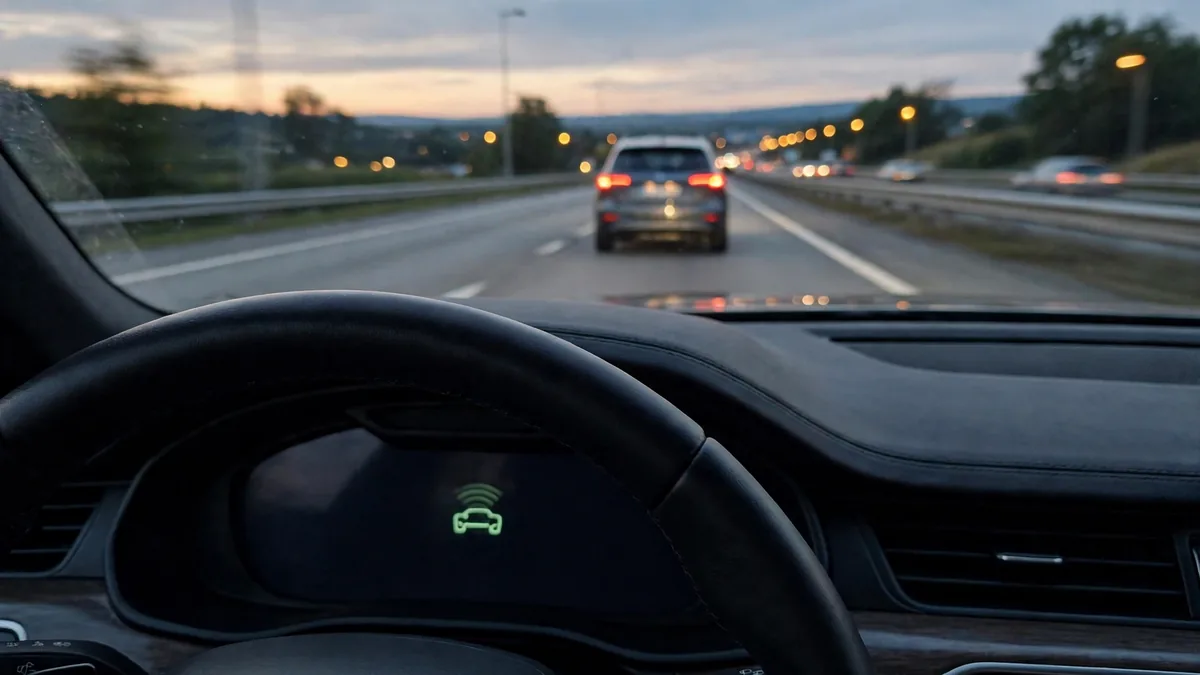
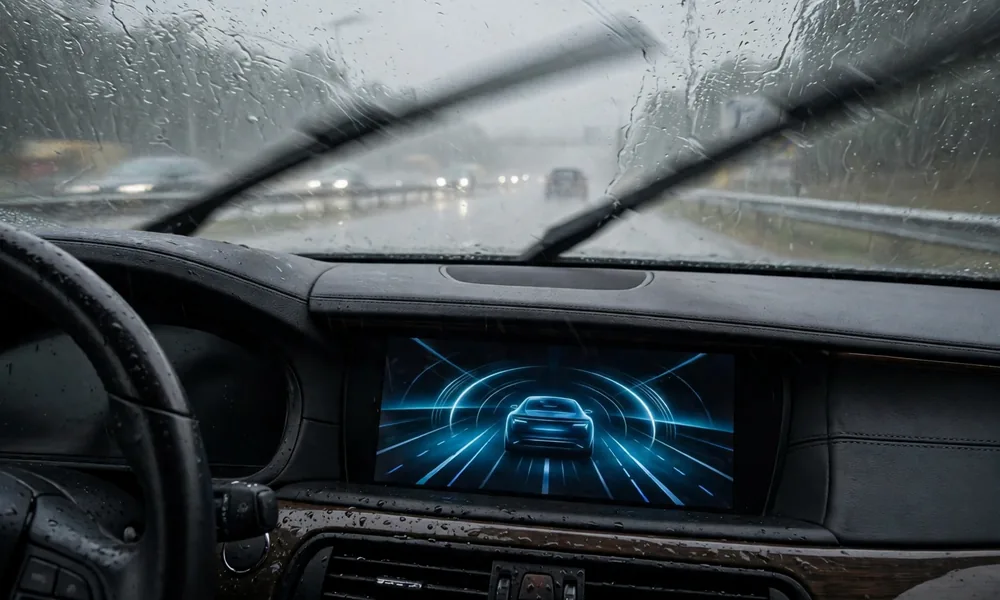
The rain on the motorway was the kind that turns the world grey: spray from every lorry, wipers at full speed, and tail lights appearing out of the murk only a few car lengths ahead. The driver had set the cruise control hours earlier and had not touched the pedals since, except to change lanes. The car slowed when the traffic slowed, sped up when it cleared, and kept its distance without being asked. He could not see far ahead. The car could.
What could see was radar, a sensor hidden behind the front badge that sends out radio waves and reads the echoes. It works in rain, fog and darkness, where cameras struggle, and it is the sense behind adaptive cruise control, emergency braking and much of a luxury car’s safety. It is also expensive, far more expensive than its size suggests, because the waves it uses, the precision it needs, and the testing it demands all cost money.
Why Luxury Car Radar Costs So Much
1: The sensor works at frequencies that are hard to build
Car radar usually works at 77 gigahertz, a frequency so high that the waves are only a few millimetres long. Building electronics that can send and receive at that frequency, cleanly and reliably, needs special materials and careful manufacturing. The tiny antenna array inside the sensor must be made to tolerances measured in fractions of a millimetre, because a small error changes where the sensor thinks an object is. A luxury car typically carries one long-range radar at the front and shorter-range radars at the corners, and each one is a small feat of engineering.
2: It must see through weather that blinds everything else
Radar’s great strength is that rain, fog, snow and darkness barely affect it. Radio waves pass through water droplets that would scatter light, which is why the car in the rain could still judge the distance to the lorry ahead. Makers test radar in rain chambers, in fog tunnels and on frozen test tracks, checking that it still spots a car, a motorcycle and a pedestrian when the weather is at its worst. That testing is slow and expensive, and it is one of the reasons the sensor costs what it does.
3: The sensor must tell a car from a sign, a bridge and a bin
A radar sensor sees reflections from everything: cars, lorries, road signs, bridges, crash barriers and litter bins. The software must sort the reflections into objects, decide which ones are moving, and work out which ones are actually in the car’s path. A metal sign beside the road must not trigger the brakes, but a car slowing ahead must. This sorting is done with years of collected road data, and the software is updated as new edge cases appear. The cost of that data, and of the engineers who turn it into decisions, is baked into every sensor. The same challenge of reading the road reliably shapes the car’s other electric systems, as our guide to EV battery pack specs explains.
4: The badge it hides behind is part of the system
Most drivers never see their car’s radar, because it sits behind the front badge or behind a smooth panel in the grille. That badge is not ordinary plastic: it must let radio waves through without weakening or bending them, and it must stay free of ice and thick dirt. Some cars heat the badge to melt frost, and some use a special coating that sheds water. If a driver fits an aftermarket badge, a number-plate holder or a thick layer of paint in front of the sensor, the radar can go blind. The badge looks like decoration, but it is really a window, and making a window that is invisible to radio waves is costly.
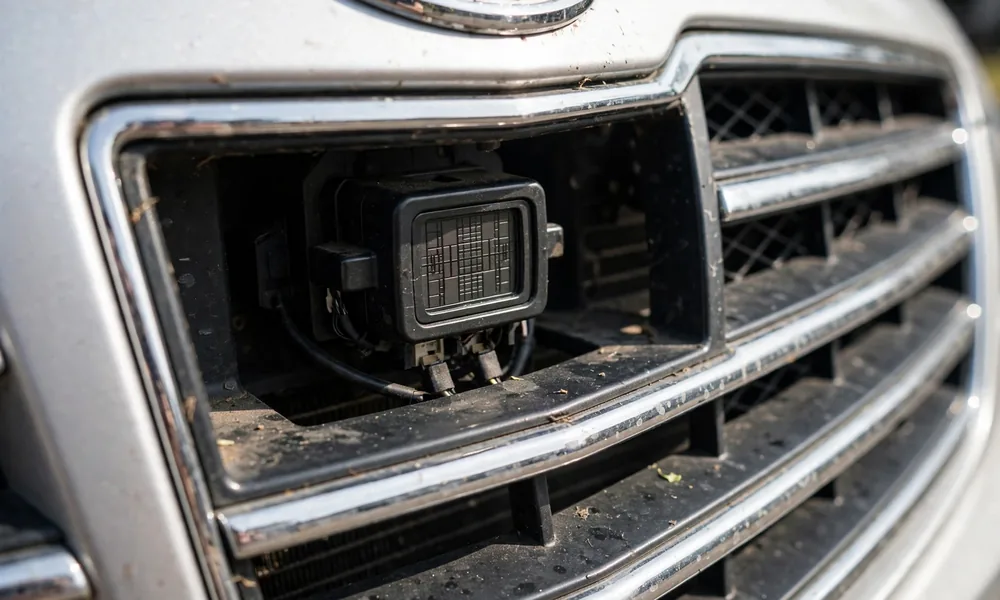
5: Aiming and calibration take time, tools and a test drive
A radar sensor that is aimed even slightly wrong will misjudge distances, and a misjudged distance at motorway speed is dangerous. After the sensor is fitted, or after a front-end repair, a technician must aim it with a special reflector placed at a measured distance, then drive the car so the system can confirm its readings against the real world. The process needs dealer-only software and can take an hour or more.
6: It is the backbone of the car’s safety and driver assistance
Radar does not work alone. It feeds adaptive cruise control, automatic emergency braking, cross-traffic alerts and sometimes the blind spot system, so one sensor supports several features that buyers expect as standard on a luxury car. That sharing makes the car safer and simpler in one sense, but it also means the radar must meet the safety standards of every system it serves. A failure is not just a lost convenience; it can disable the emergency braking. The sensor is therefore built, tested and certified to a higher standard than a comfort feature would ever need, and the certification adds cost at every step. The way these systems share information across the car is part of the modern luxury cabin, as our guide to how a luxury car infotainment system is made explains.
Luxury Car Radar Costs at a Glance
| Cost driver | Typical figure | Why it costs |
|---|---|---|
| Operating frequency | 77 gigahertz | Millimetre waves need precise, costly electronics |
| Long-range detection | About 150 to 250 metres | Sees traffic far ahead in rain and fog |
| Option or package price | Estimated $1,500 to $3,500 | Sensors, software, testing and certification |
| Single sensor replacement | Estimated $800 to $1,800 | Part plus aiming and calibration time |
| Calibration session | Estimated $200 to $500 | Reflector rig, software and a test drive |
| Systems it feeds | Cruise, braking, cross-traffic | One sensor supports several safety features |
What the Price Buys, in Plain Terms
All prices above are estimates, not quoted prices, and they vary with the brand and the model. What the money buys is a car that can still judge distance when the driver can barely see, and that will brake for the car ahead even if the driver is a second too slow. Radar rarely gets thanked, because its best days are the ones when nothing happens. On a wet motorway at dusk, though, it is the sense the driver leans on most, and it is the one that never gets tired, never blinks, and never looks away from the road.
A Rare Fact About Car Radar
Car radar and police speed guns use the same basic idea, and early car radars were so crude that they sometimes reacted to the metal in road signs and overhead gantries. The fix was not a stronger sensor but a smarter one: modern radar measures not only distance but the speed of each reflection, so it can tell a stationary gantry from a slowing car. The ones in luxury cars today are the result of decades of learning what to ignore.
The next time the rain closes in and the cruise control keeps its distance without a word, it is worth remembering the small sensor behind the badge. It is not much to look at, and it will never appear in a brochure photograph, but it is watching the road in a way no human eye can, through spray and darkness, at a speed no human could match. That quiet, tireless watch is what the money buys, and on a long wet drive, it feels like money well spent. The same electric ambition that powers the car’s sensing runs through its newest models, as our ranking of the best luxury electric cars 2027 ranked shows.