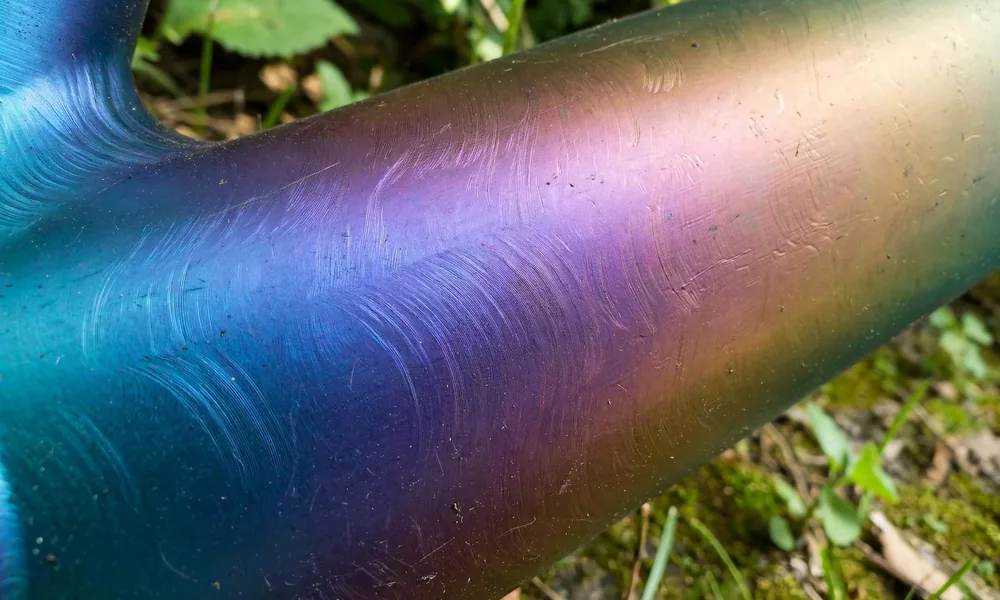
Pick up a black camera body, a blue bicycle frame, or the silver casing of a laptop, and run your thumb across it. The surface feels cool, hard, and faintly silky, nothing like raw metal and nothing like paint. That surface is anodised aluminium: ordinary aluminium that has been given a skin of its own oxide, grown out of the metal itself rather than stuck on top of it.
Anodising is an electrochemical trick. The aluminium part is dipped in an acid bath and wired up as one side of an electric circuit, and the current coaxes the surface into growing a layer of aluminium oxide — the same mineral as sapphire, only a few thousandths of a millimetre thick. Dye can be soaked into the pores of that layer before it is sealed, which is why anodised aluminium comes in colours paint can only envy: deep blacks, rich blues, and reds that never peel, because there is no coating to peel.
The specification sheet for anodised aluminium is short, but every number on it decides how the part will look and last. Coating thickness, hardness, corrosion resistance, wear, colour, and insulation — this guide explains each one in plain English.

The Specs That Matter
1. Coating thickness
Coating thickness is the depth of the oxide layer, measured in microns, and it is the first number any buyer should ask for. Decorative anodising usually runs from about 5 to 25 microns: enough for colour and everyday protection on phones, laptops, and bicycle parts. Hard anodising, used on cookware, machinery, and military parts, runs from about 25 to 100 microns and trades colour range for toughness. The metal underneath starts life as ordinary aluminium, and the journey from raw metal to finished part is told in how anodised aluminium is made.
2. Hardness
The oxide layer is far harder than the aluminium beneath it. Ordinary decorative anodising reaches roughly 250 to 400 on the Vickers hardness scale, while hard anodising reaches roughly 400 to 600 — for comparison, the aluminium alloy underneath measures only about 100 to 150. That hardness is what makes anodised surfaces shrug off keys, coins, and belt buckles, and it is why hard-anodised frying pans survive metal utensils that would shred a non-stick coating.
3. Corrosion resistance
Anodising thickens that skin by a thousand times, and corrosion resistance is usually quoted as hours survived in a salt-spray test — a cabinet that mists the part with salty fog around the clock. Decorative anodising typically survives about 300 to 1,000 hours before the first pits appear, while a well-sealed hard-anodised layer can pass 1,000 hours and beyond. Where the part will live decides the number that matters — a laptop needs far less protection than a boat fitting, and the test behind the claim is explained in how anodised aluminium works.

4. Wear resistance
Wear resistance is how the surface survives rubbing, and it is measured with a Taber test: a weighted abrasive wheel spins against the surface, and the weight lost after a set number of turns is recorded. A hard-anodised layer typically loses only a few milligrams per thousand cycles, several times less than decorative anodising, which is why it is specified for parts that slide, pivot, or get handled all day — hinges, gears, tool handles, and the rails of sliding doors.
5. Colour and lightfastness
Anodised colour is not painted on; dye soaks into the microscopic pores of the oxide and is then sealed in, so the colour sits inside the surface rather than on it. Lightfastness is how well that colour survives sunlight, rated on a scale where 8 is the best. Good dyes hold their colour for years outdoors, while cheap ones fade in months, turning a rich bronze into a washed-out gold.
6. Electrical insulation
Aluminium conducts electricity beautifully, but its oxide does not conduct at all. A sealed anodised layer is an electrical insulator, with a dielectric strength — the voltage it can block before breaking down — of roughly 30 to 40 volts per micron of thickness. A 25-micron layer can therefore insulate against around 750 to 1,000 volts, which is why anodised aluminium is used for heatsinks and enclosures in electronics, where a metal case must stay cool without shorting the circuits inside.
7. Dimensional growth
Anodising changes the size of the part, and the change is the most commonly forgotten specification of all. Roughly half the oxide thickness grows outward from the original surface and half grows inward, so a 25-micron coat adds about 12 microns to each face — a small number until it closes a bearing bore or tightens a thread. Always check whether the dimensions on the drawing are before or after anodising. The shaping that happens before the bath matters too, and the heavy work of forming aluminium is covered in how aluminium forging is made.
Anodised Aluminium Specs
| Specification | Typical range |
|---|---|
| Coating thickness | About 5 to 25 microns decorative; 25 to 100 microns hard anodised |
| Hardness | About 250 to 400 Vickers decorative; 400 to 600 Vickers hard anodised |
| Corrosion resistance | About 300 to 1,000 hours salt spray decorative; over 1,000 hours hard anodised |
| Wear resistance | Only a few milligrams lost per 1,000 Taber cycles for hard anodising |
| Colour lightfastness | Good dyes rated 7 to 8 on the lightfastness scale |
| Dielectric strength | About 30 to 40 volts per micron of coating thickness |
| Dimensional growth | About half the coating thickness grows outward from the surface |
| Service temperature | About minus 50 to 200 degrees Celsius for the oxide layer |
What Does Anodised Aluminium Cost?
Anodising is one of the cheapest premium finishes available, because the bath does the work and dozens of parts can be processed at once. A small part in a batch run is estimated to cost roughly $1 to $10 to anodise, while a bicycle frame is estimated at roughly $50 to $150, and architectural panels are estimated at roughly $30 to $80 per square metre, depending on colour and thickness. The metal itself is usually the bigger cost: a finished anodised part is only modestly more expensive than the same part left bare, which is why the finish appears on everything from window frames to spacecraft fittings. All prices are estimates only and vary widely by batch size, colour, and supplier.
A Rare Fact
Anodising was invented by accident of timing, not by design. In 1923, two British researchers, Guy Bengough and John Stuart, were trying to protect the aluminium floats of seaplanes from salt water, and they found that running an electric current through the metal in an acid bath grew a thick, protective oxide skin. Their process was patented the same year and is still, a century later, essentially the method used today.
Anodised aluminium is a quiet piece of engineering: a skin thinner than a sheet of paper, harder than the metal it protects, coloured from the inside, and able to keep salt water and sunlight at bay for years. Read the specification — thickness, hardness, salt-spray hours, and wear — and you can tell at a glance whether a part will still look good in five years, or whether the colour was only ever skin deep.