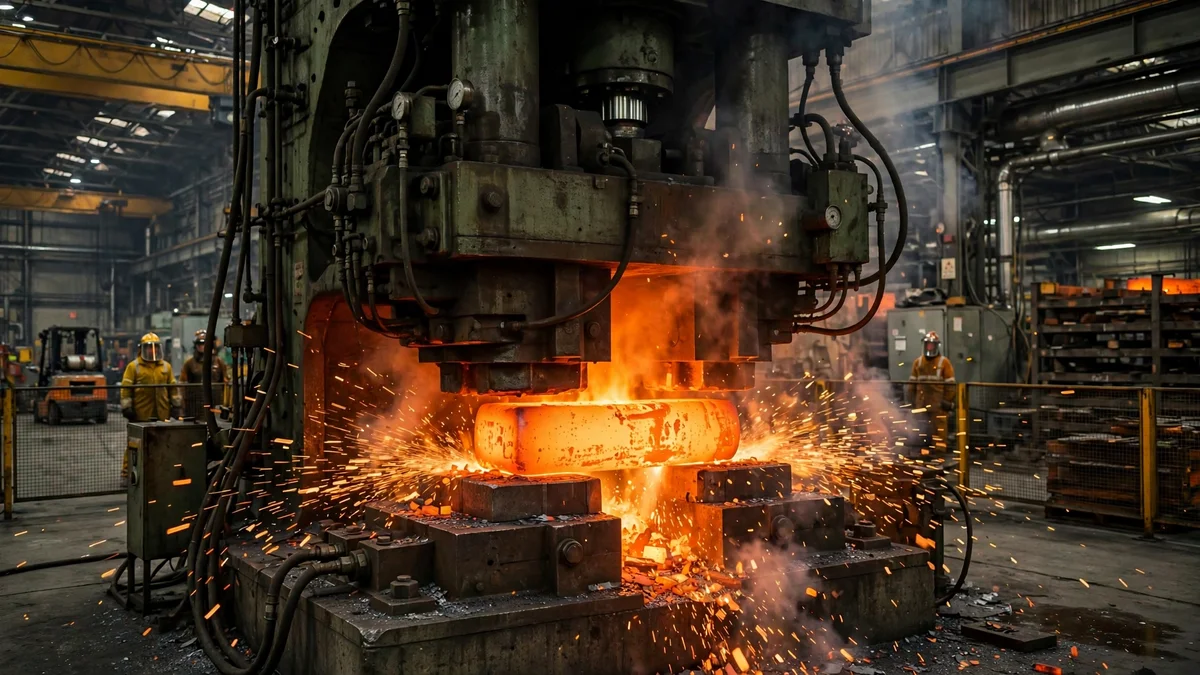
The floor shakes before you hear it. Somewhere behind a wall of heat shields, a hydraulic press the size of a house is closing on a glowing bar of aluminium, and for one long second the whole building seems to hold its breath. Then the press opens, the billet has changed shape entirely, and a part that will one day hold an aircraft wing together is cooling on a rack, still ticking as it shrinks. Forging is the oldest way of shaping metal, and for aluminium it is also the most demanding — a craft where heat, pressure and timing decide whether a part flies or fails.
Aluminium is light, resists corrosion and machines beautifully, which is why it shows up everywhere from bicycle frames to jet engines. But cast aluminium has a weakness: as molten metal cools, tiny voids and a random grain structure form inside it, and those flaws become cracks under stress. Forging solves the problem by never melting the metal at all. Instead, a solid billet is heated until it is soft, then squeezed between shaped dies so hard that its internal grain flows and lines up with the shape of the part. The result is denser, tougher and far more fatigue-resistant than any casting of the same weight. That is why the parts that absolutely must not break — aircraft landing gear, suspension arms, high-performance wheels — are forged, not cast.
How Aluminium Forging Is Made
Step 1: Choosing the alloy
Not all aluminium is equal. Forgers work mostly with heat-treatable alloys from the 6000 and 7000 series — 6061 for general engineering, 7075 where maximum strength matters, as in aerospace. Each alloy has its own forging temperature window, typically between 350 and 500 degrees Celsius, and its own behaviour under the press. The billet arrives as a sawn length of extruded or cast bar, and its chemistry is checked before anything else happens, because the wrong alloy in a critical part is a failure waiting to happen.
Step 2: Heating the billet
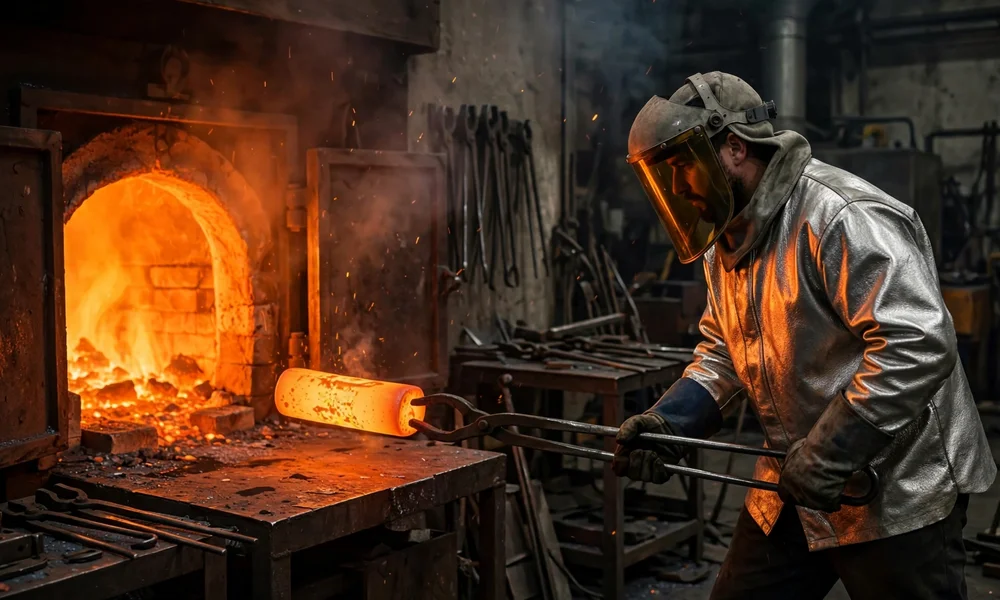
The billet is heated in a gas or induction furnace until it is evenly hot all the way through — soft enough to flow, but well below its melting point. This is a narrower target than it sounds: too cold and the metal cracks instead of flowing; too hot and the grain grows coarse and the surface burns. Operators judge the soak time by billet size, and the glowing bar is moved to the press in seconds, because every moment in the air is heat lost. This careful control of temperature and timing is the same discipline that shapes other precision processes, from titanium machining to composite work.
Step 3: The first blow — breaking down the grain
The hot billet goes into the first die set, and the press delivers a series of blows that flatten and spread the metal. This roughing stage does the most important metallurgical work: it breaks up the original cast grain structure and starts the metal flowing in the direction the finished part needs. Between blows the operator rotates and repositions the billet, and a graphite-based lubricant keeps the metal from sticking to the dies.
Step 4: Shaping in the finishing die
Once the billet is roughly the right shape, it moves to the finishing die — a pair of steel blocks machined to the near-final shape of the part, complete with ribs, webs and curves. One more set of press strokes forces the metal into every corner of the cavity, and excess material squeezes out around the edges as a thin fin called flash. The die itself is a work of engineering: it must survive thousands of blows at high temperature without losing its shape, and it is often the most expensive single item in the whole process.
Step 5: Trimming the flash
While the part is still warm, it goes to a trim press, where a sharp-edged die shears off the flash in a single stroke, leaving the outline of the finished forging. What remains looks like the final component, but it is still soft, its dimensions are still slightly off, and its full strength has not yet been unlocked. The trimmed flash is not wasted — aluminium scrap goes straight back to the melter.
Step 6: Heat treatment and ageing
Now the part is solution heat-treated — heated again, then quenched in water or polymer — which dissolves the alloying elements into the aluminium. Then it is aged, held at a lower temperature for hours, so those elements precipitate out as microscopic particles that pin the grain in place. This is the step that turns a soft forging into a part stronger than many steels by weight. The sequence echoes the curing discipline used in carbon fibre curing, where time and temperature decide the final strength.
Step 7: Machining, inspection and finishing
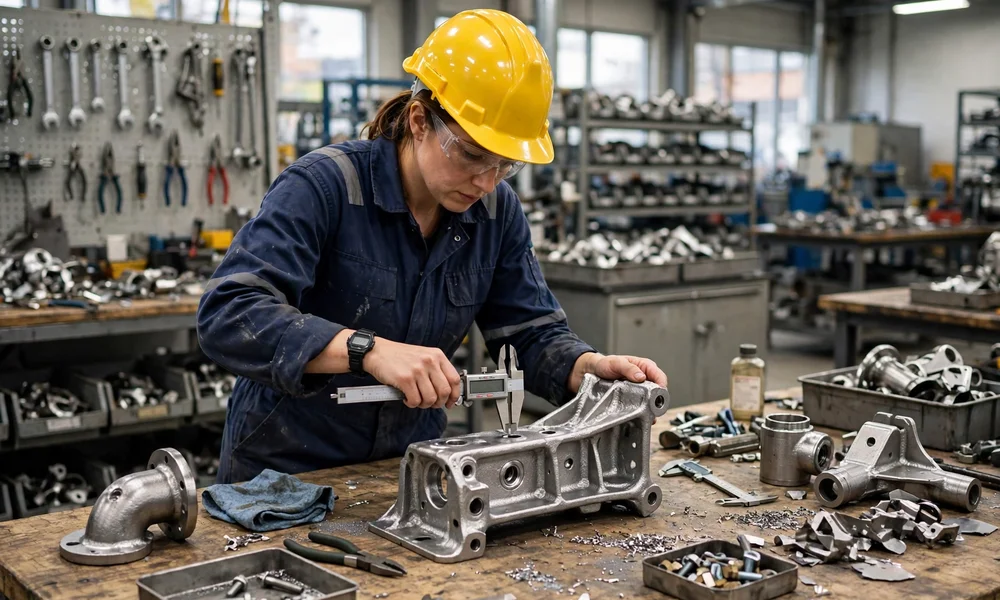
Finally, the forging is machined to its exact dimensions — mating faces milled, holes drilled, surfaces finished — and then inspected. Critical forgings are checked with ultrasound or dye penetrant for hidden flaws, measured against their drawings, and often proof-tested. Only then do they earn their paperwork and ship. A forged suspension arm or a monocoque component may pass through several pairs of hands after forging, and the same obsession with verification runs through the build of a carbon monocoque, where the structure is only as good as its last inspection.
Forged Aluminium at a Glance
| Specification | Detail |
|---|---|
| Common alloys | 6061, 6082, 7075, 2014 |
| Forging temperature | 350–500 °C, depending on alloy |
| Press force | From a few hundred to tens of thousands of tonnes |
| Typical weight range | Under 1 kg to several hundred kg per part |
| Strength gain over casting | Up to roughly double the fatigue strength |
| Main uses | Aircraft structures, wheels, suspension parts, bicycle components, tools |
| Key advantage | Aligned grain flow, no internal voids, high strength-to-weight ratio |
| Main drawback | Expensive tooling and limited shape complexity versus casting |
What Does It Cost?
There is no single price for a forging, because the tooling dominates the cost. A set of forging dies is a major investment, so small batches are expensive per part and large runs bring the unit cost down sharply. As rough estimates, a forged aluminium car wheel typically retails for several hundred dollars each, while a small batch of custom aerospace forgings can run into thousands of dollars per part once tooling, heat treatment and inspection are included. Those figures are estimates, not quotes — the real number depends on alloy, size, volume and how much machining the part needs afterwards.
A Rare Fact
During the Second World War, aluminium forging grew up almost overnight: aircraft production demanded forged propellers, landing gear and engine parts at a scale nobody had attempted before, and the presses built for that war effort were so large that some are still in service today, forging parts for modern jets more than eighty years later. The machines outlasted the war, the aircraft and in some cases the companies that built them — and the grain-flow principles they were built around have not changed since.
Forging will never be the cheapest way to shape aluminium, and it will never be the easiest. But for the parts where failure is not an option, it remains the standard everything else is measured against — a glowing billet, a closing die, and a piece of metal made stronger by being squeezed rather than melted.


