You are walking through a museum, and as you look at a painting, text appears beside it — the artist’s name, the year, and a note about the brushwork. Nothing blocks your view. The words seem to float in the air, printed on the world itself. Then you look away, and they are gone.
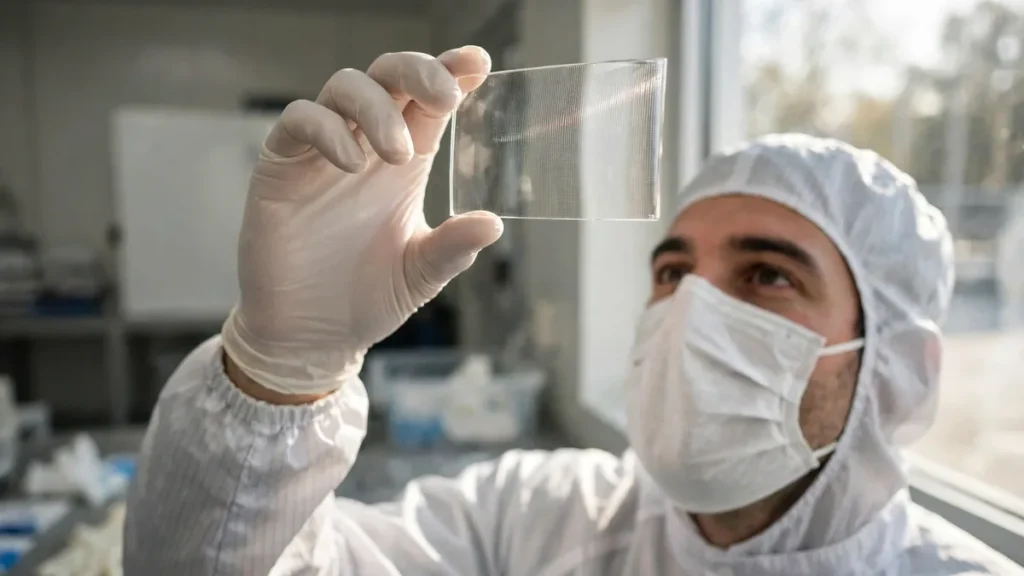
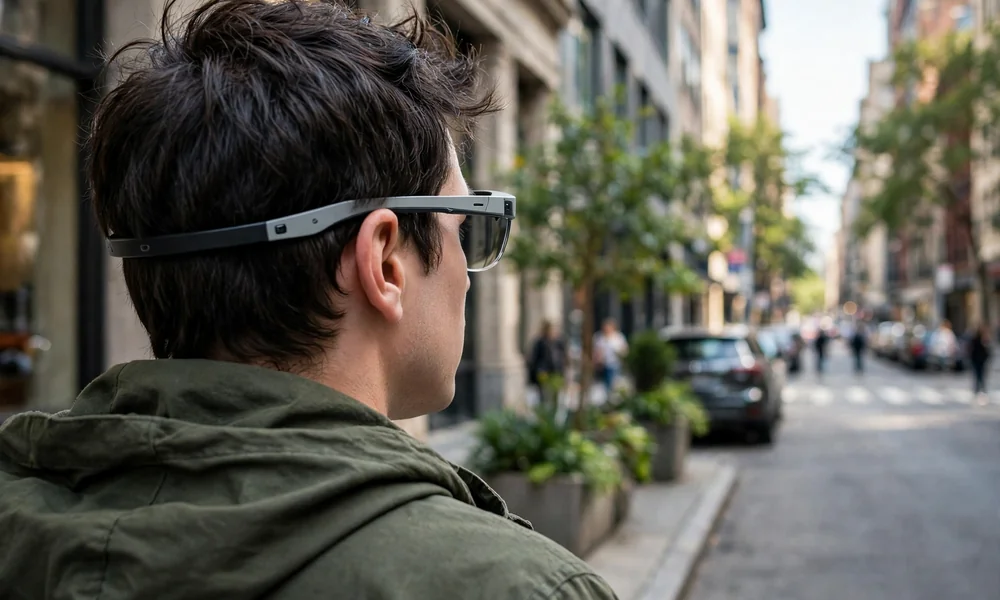
That trick is done by a waveguide, a thin piece of glass inside augmented reality glasses that carries light from a tiny projector to your eye. It makes AR glasses look like glasses instead of a helmet: without it, the projector would sit directly in front of your eye, and the glasses would be a visor. With it, the projector hides in the temple arm, and the lens stays clear.
This guide explains the numbers on an AR glasses waveguide spec sheet in plain English: what field of view means, why brightness is measured differently, how the glass bends light without bending, and which figures decide whether the glasses feel like magic or a foggy window.

The Numbers That Matter on an AR Glasses Waveguide
1. Field of view: how big the picture feels
Field of view is the size of the virtual image as it appears to your eye, typically 30 to 50 degrees diagonally, with the best beyond 50. A narrow field of view feels like reading through a letterbox, while a wider one lets the image fill more of your sight. Widening it makes the waveguide thicker, heavier, and harder to manufacture — the number AR engineers argue about most.
2. Eyebox: how much you can move your eyes
Eyebox is the space in front of the lens where your eye can sit and still see the whole image, typically 10 to 15 mm wide and 8 to 12 mm tall. If your eye moves outside it, the image dims or vanishes at the edges. A bigger eyebox suits more faces and more movement, but it costs brightness, because the same light must spread over a larger area. It is the number that decides whether the glasses feel natural or demand that you hold your head perfectly still.
3. Brightness: measured in nits, and why it is different
Brightness is measured in nits, and an AR waveguide typically delivers 500 to 2,000 nits to the eye, with some reaching 3,000 or more. That sounds dim next to a phone screen, but the waveguide’s light is added to the real world, not shown instead of it, so it competes with sunlight coming through the lens. A display bright enough indoors can vanish outdoors, which is why makers quote brightness alongside transparency, typically 80 to 90 percent. The camera lens is covered in the smartphone camera lens specs guide.
4. Waveguide thickness and weight: the glasses test
Waveguide thickness is measured in millimetres: a single layer is typically 1 to 3 mm thick, with a full-colour stack of three layers reaching 3 to 6 mm. Weight decides whether the glasses can be worn all day: a complete pair is typically 40 to 80 grams, against 30 to 40 grams for ordinary spectacles. Every extra layer adds colour and field of view, but also weight and thickness. The material is covered in the AR glasses waveguide materials engineering guide.
5. Efficiency: how much light reaches your eye
Efficiency is the share of the projector’s light that reaches the eye, and it is the waveguide’s most brutal number — typically 1 to 5 percent. The rest is lost at the gratings, scattered inside the glass, or leaked out of the edges. That low efficiency is why AR glasses need such a bright projector: most of the power goes into making light that never reaches the eye. Improving efficiency by even one percentage point is a major achievement, and it is the number that decides battery life more than any other. The sensor that locates the glasses is covered in the LiDAR sensor specs guide.
AR Glasses Waveguide Specs
| Specification | Typical range |
|---|---|
| Field of view | 30 to 50° diagonal, 50°+ on the best |
| Eyebox | 10 to 15 mm wide, 8 to 12 mm tall |
| Brightness at the eye | 500 to 3,000 nits |
| Transparency | 80 to 90% |
| Waveguide thickness | 1 to 3 mm per layer, 3 to 6 mm stacked |
| Glasses weight | 40 to 80 g |
| Optical efficiency | 1 to 5% |
| Waveguide type | Diffractive, holographic, or geometric |
How an AR Glasses Waveguide Works
Step 1: The micro-display makes the image. A tiny display, smaller than a fingernail, creates the image — a few millimetres across, too small to look at directly. It can be micro-OLED, liquid crystal, or laser-scanning.
Step 2: The projector focuses the light. A small lens system collimates the light, making its rays parallel, so the image appears to come from far away rather than a centimetre in front of your face.
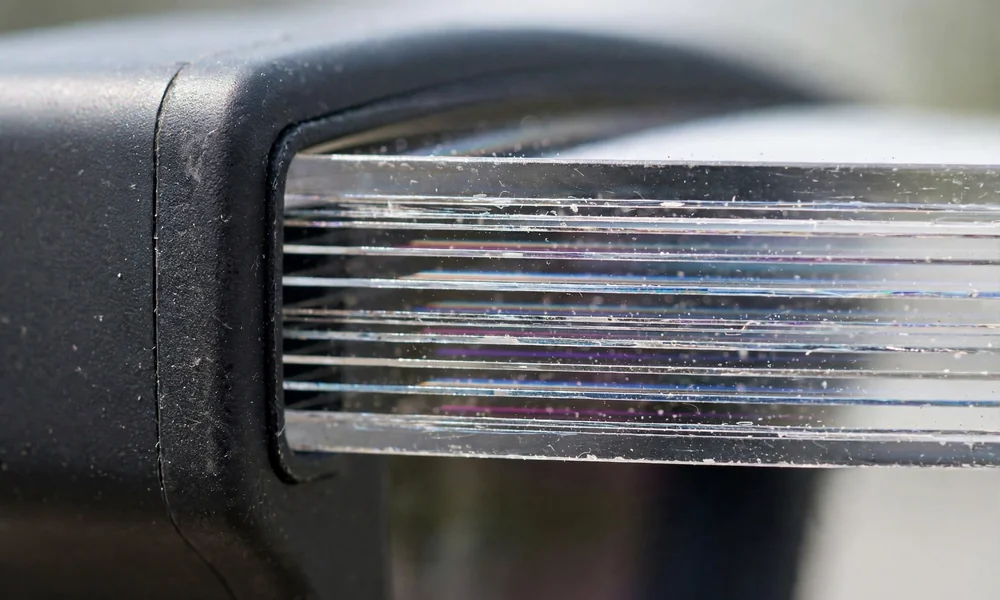
Step 3: The gratings catch and carry the light. At the lens edge, a microscopic grating — lines finer than a wavelength of light — bends the incoming rays into the glass at a steep angle, steeper than the angle at which light can escape. The rays then travel inside the lens by total internal reflection, bouncing from surface to surface like light in a fibre-optic cable, until they reach the area in front of your eye.
Step 4: The out-coupling grating releases the light. A second grating, spread across the viewing area, bends a little light out of the glass at each bounce, so the image is released evenly across the eyebox instead of at a single point.
Step 5: Your eye sees the world and the image together. The released light enters your pupil, and your eye focuses it on the retina alongside the real world, which passes straight through the lens. The two images overlap, and the virtual one appears to float in the real one.
What Do AR Glasses With a Waveguide Cost?
AR glasses with a waveguide are estimated at roughly $300 to $1,000 for consumer models, and $1,500 to $3,500 or more for enterprise and developer models. The waveguide itself is estimated at $50 to $300 per lens, one of the most expensive parts, because the gratings are made with the same lithography machines that make computer chips, and many lenses fail inspection. A full-colour waveguide costs far more than a monochrome one, which is why the first consumer glasses show simple green text and icons. All prices are estimates only.
A Rare Fact
The waveguide was not invented for glasses. It was invented for fighter jets. In the 1960s and 1970s, pilots needed speed, altitude, and targeting information without looking down, so engineers built head-up displays that projected it onto the cockpit windscreen — and the glass that carried the light was an early waveguide. The idea was shrunk for helmets, then glasses, and the gratings inside a modern AR lens are made with the same techniques used to etch computer chips. The technology that lets a museum visitor see a painting’s history floating in the air began as a way to help a fighter pilot.
The spec sheet is the honest version of the magic trick. Field of view tells you how big the picture feels, eyebox tells you how still you must hold your head, and efficiency tells you why the battery is small and the projector is bright. A waveguide is glass that bends light around a corner, and its numbers decide whether augmented reality feels like the future.