Every electric car has a motor, but not every electric car has the same motor. Under the floor of one EV sits a permanent magnet motor the size of a watermelon; under another sits an induction motor with no magnets at all; and under a third sits a pancake-shaped axial flux motor that looks like nothing else on the road.
Understanding these differences matters because the motor shapes the whole car. It decides how quickly the car accelerates, how far it goes on a charge, how much it costs to build, and even how it sounds.
This guide explains the best electric motors for EVs in plain English, ranked by how important each design is to the electric cars on the road today and the ones coming next.
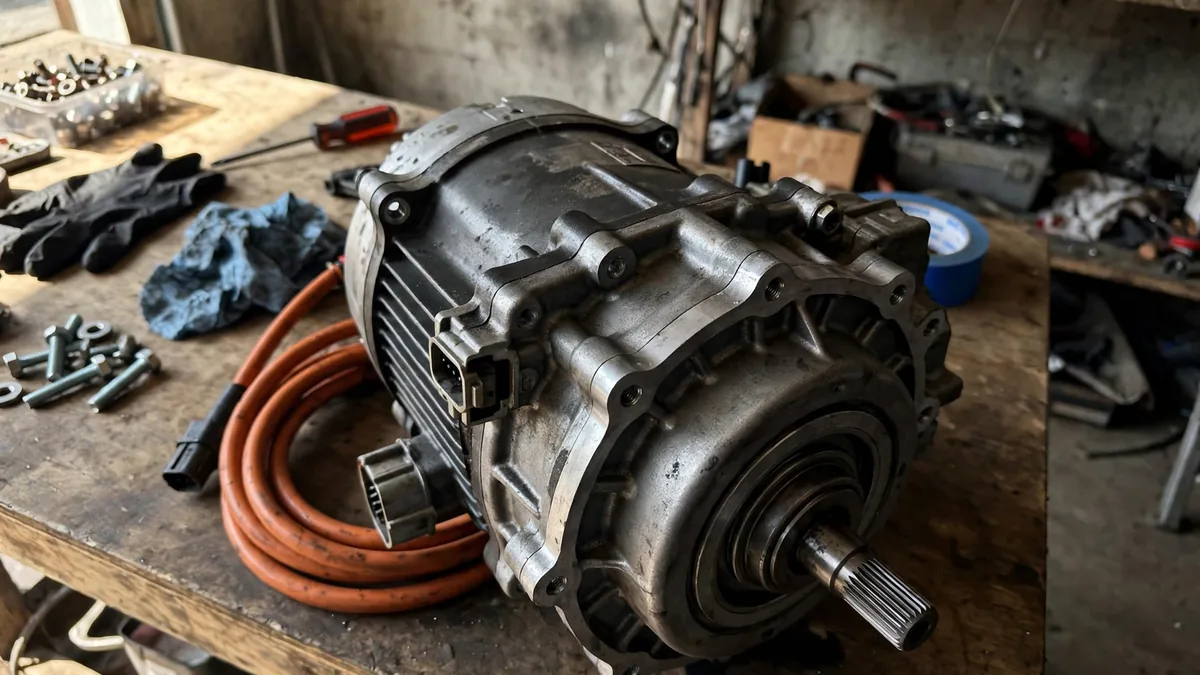
1. Permanent magnet synchronous motor — the efficiency champion
The permanent magnet synchronous motor, usually shortened to PMSM, is the most common motor in modern EVs, and it is the efficiency champion of this list. It uses powerful magnets made from rare-earth metals, fixed to the rotor, and the magnetic field from the stator pulls those magnets around in perfect step with the electricity supply. Because the magnets are always there, the motor does not waste energy creating its own magnetic field, which makes it extremely efficient — often above 95 percent in its best operating range. The downside is cost and supply: rare-earth magnets are expensive, and their mining is concentrated in a few countries. The inverter that feeds it precisely controlled power is explained in how an EV inverter works.
2. Induction motor — the magnet-free workhorse
An induction motor has no permanent magnets at all. Instead, the stator creates a rotating magnetic field that induces a current in the rotor, and that current creates its own magnetic field, which chases the stator’s field around in a circle. Induction motors are cheaper to build than PMSMs because they need no rare-earth metals, they are rugged, and they can spin very fast without the magnet problems that limit a PMSM. Their weakness is efficiency: at low speed and light load, they waste more energy than a permanent magnet motor, because some power is always spent creating the rotor’s magnetic field.
3. Axial flux motor — the pancake that changes everything
Most motors are radial flux: the magnetic field flows outward from the centre, like spokes on a wheel. An axial flux motor turns that geometry sideways, so the field flows along the axis, and the whole motor becomes a flat disc — a pancake instead of a cylinder. The result is a motor that is far shorter, lighter, and more powerful for its size than a conventional design, with power densities that make engineers sit up. The challenge is manufacturing: the flat geometry is harder to cool and harder to build at scale, which keeps costs high for now.
4. Switched reluctance motor — the tough, cheap outsider
A switched reluctance motor has no magnets and no windings on its rotor at all — just a shaped piece of steel that is pulled around by electromagnets in the stator, switched on and off in sequence. It is extremely rugged, it tolerates heat well, and it uses no rare-earth materials, which makes it attractive as magnet prices rise. The problem is refinement: switched reluctance motors are noisy and produce a pulsing torque that drivers can feel, which is why they have stayed mostly in industrial machines rather than cars.
5. In-wheel hub motor — the motor that deletes the drivetrain
An in-wheel motor sits inside the wheel itself, so there is no gearbox, no driveshaft, and no transmission at all — each wheel is driven directly by its own motor. That frees up space in the car, allows true torque vectoring at each corner, and makes the drivetrain almost absurdly simple. The problem is unsprung weight: putting a heavy motor inside the wheel makes the suspension’s job much harder, and the ride and handling suffer. Motors in wheels also live in the worst possible environment, exposed to water, dirt, and every pothole on the road.

6. Dual-motor all-wheel drive — two motors are better than one
Dual-motor all-wheel drive is not a motor type but a system, and it deserves a place on this list because it is how most premium EVs are built today. One motor drives the front axle and another drives the rear, and the car can send power to whichever axle has grip, or run on a single motor when cruising to save energy. The result is faster acceleration, better traction in bad weather, and a safety net if one motor has a problem.
7. Hairpin winding motor — the efficiency upgrade inside the motor
Hairpin winding is not a new motor type but a new way of building the copper windings inside a motor, and it has quietly become one of the most important advances in EV engineering. Instead of round copper wire, the windings are made from rectangular copper bars bent into hairpin shapes and slotted into the stator, packing far more copper into the same space. Hairpin motors are more efficient, more powerful, and easier to cool than their round-wire predecessors, and they are now standard in many new EVs. Making one takes precision machinery, and the winding process itself is a craft, as shown in how EV motor windings are produced.
8. Externally excited synchronous motor — the magnet-free future
The externally excited synchronous motor is the newest answer to the rare-earth problem. It works like a permanent magnet motor, but instead of fixed magnets it uses an electromagnet on the rotor, fed with current through brushes or a wireless transfer system. That means it gets the efficiency and smoothness of a PMSM with no rare-earth metals at all, and the magnetic field can be adjusted on the fly — strong when the car needs power, weak when it needs efficiency. Several manufacturers are already using this design in production cars, betting that the extra engineering is worth freedom from the magnet supply chain. How a compact electric motor is built to survive daily use is shown in how an e-bike mid-drive motor works.
The Takeaway
There is no single best electric motor, only the best motor for a particular car. A long-range family EV wants the efficiency of a permanent magnet motor. A budget car wants the low cost of an induction or reluctance design. A performance car wants two motors, or the compact power of axial flux. For most buyers, the practical advice is simple: a permanent magnet motor gives the longest range, a dual-motor car gives the best traction, and either one will feel faster than the petrol car it replaces. The motor is the quietest revolution in the electric car, and it is the reason EVs feel so different from everything that came before.


