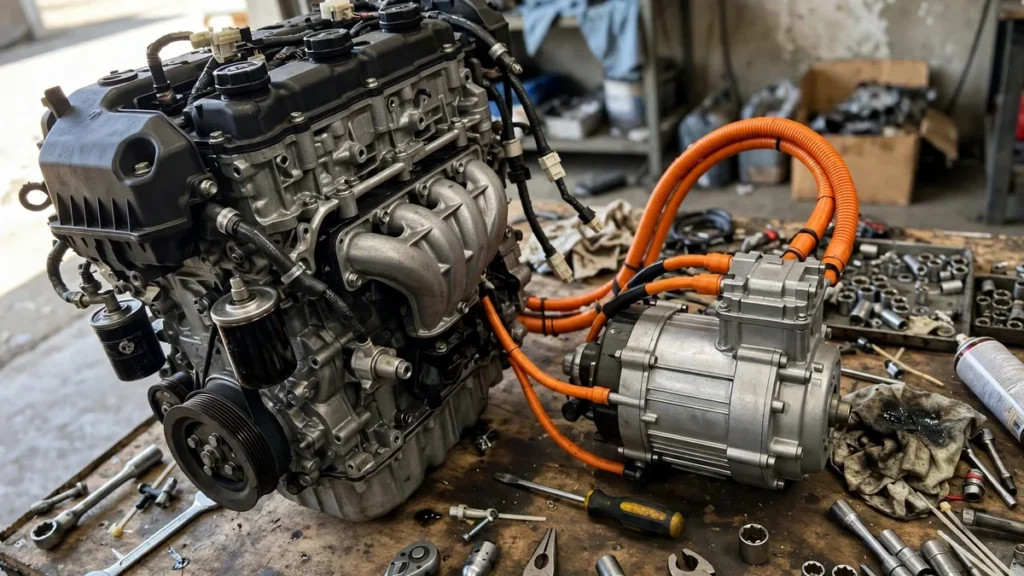
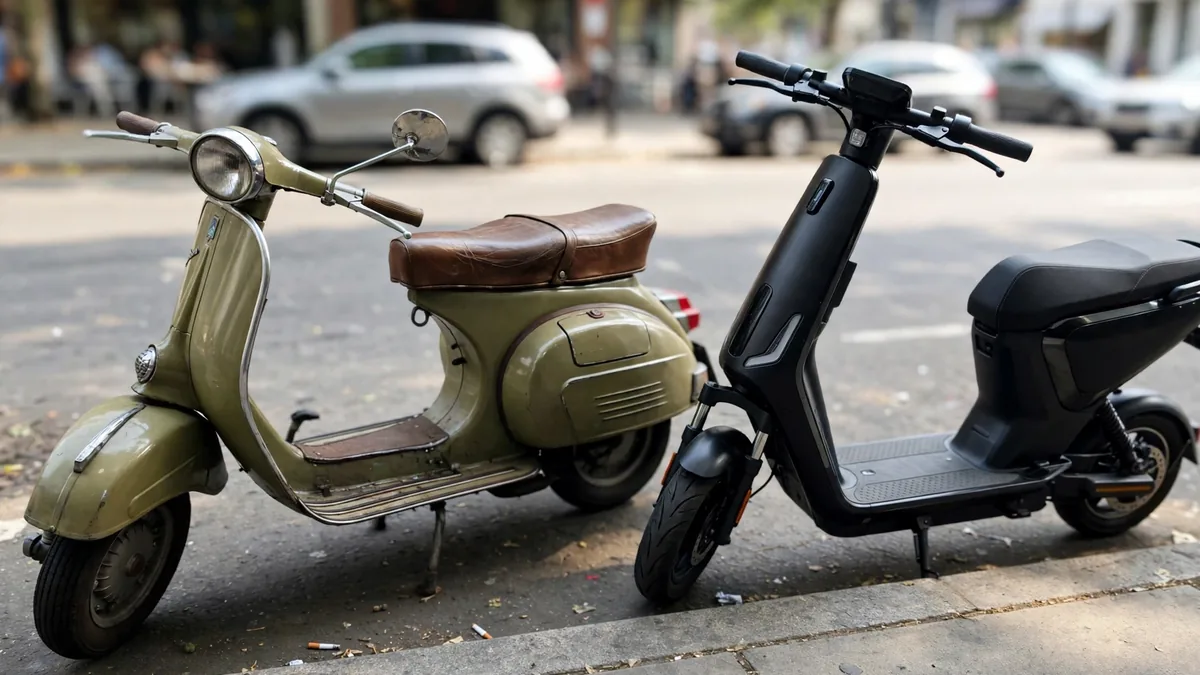
Diesel scooters are rare birds. A handful were built, mostly in India, where the Royal Enfield Taurus put a 325 cc diesel single into a motorcycle frame. They were slow, heavy, noisy and hard to start on cold mornings, and almost all of them have vanished from showrooms. Electric scooters, by contrast, are everywhere now, from cheap city runabouts to the BMW CE 04, a machine with more power than a Vespa GTS 300. The two motors could hardly be more different, and that difference shapes everything about riding one.
This comparison puts the diesel scooter motor and the electric scooter motor side by side on the things that matter: torque, speed, range, running costs, maintenance, noise and city rules. It is not a close contest in most rounds, but diesel still wins one or two. The numbers below come from real machines, including the Vespa GTS 300, the BMW CE 04 and the Silence S01.
1. How each motor makes its power
A diesel scooter motor is a compression-ignition engine, usually a single cylinder of 300 to 400 cc. It squeezes air until it is hot enough to ignite the fuel, with no spark plug, and it makes its best power low in the rev range. The engine is heavy for its output, because diesel combustion runs at very high pressure. An electric scooter motor is a different animal: a compact permanent-magnet or hub motor fed by a lithium battery, with one moving part and no combustion at all. It makes full torque the instant it starts turning, and it is silent until the tyres start to sing.
2. Torque and the traffic-light test
Torque is what a scooter rider feels most, and here the two motors are not in the same league. A diesel single of 325 cc makes roughly 15 to 18 Nm of torque, and only once the engine is spinning at several thousand revs per minute. The Vespa GTS 300, a petrol benchmark, makes 26 Nm at 5,250 rpm from its 278 cc engine. An electric scooter of similar size makes its torque from zero revs. The Silence S01, with a 5.6 kWh battery, accelerates from 0 to 50 km/h in 3.9 seconds, faster than any petrol scooter in its class, and the BMW CE 04 makes 42 hp. At the traffic lights, the electric scooter leaves first, every time.
3. Top speed and the open road
Top speed is where the diesel motor claws a little ground back. A diesel scooter is geared for economy rather than speed, and the old diesel machines topped out at around 80 to 90 km/h, wheezing at full throttle. The Vespa GTS 300 reaches about 129 km/h, and the BMW CE 04 tops out at 120 km/h. The Silence S01 is limited to around 100 km/h, enough for most roads. Where the diesel has a real edge is in holding its speed: a combustion engine does not lose performance as its tank empties, while an electric scooter on a low battery may limit its top speed to protect the cells.

4. Range and refuelling
Range is the diesel motor’s strongest card. A diesel scooter sips fuel at around 2 to 2.5 litres per 100 km, and even a small 7-litre tank gives it 250 to 300 km between fills. Refuelling takes two minutes at any filling station. The Vespa GTS 300, with its 8.5-litre tank and consumption of about 3.3 litres per 100 km, manages roughly 260 km. The BMW CE 04 shows about 130 km of range in real riding, and the Silence S01 manages around 130 km too, while a full charge takes several hours from a household socket. For a long day out with no charging, diesel goes further and refuels faster.
5. Running costs
Running costs favour the electric motor by a wide margin. Electricity is cheap: charging a 5.6 kWh battery like the Silence S01 costs well under a pound at home rates, and even the BMW CE 04’s larger pack costs only a few pounds to fill. A diesel scooter uses little fuel, but diesel is taxed, and the saving over petrol is small on a machine that already uses so little. Over a year of city commuting, an electric scooter typically costs a third to a half as much to run as a combustion scooter. The catch is the purchase price: the BMW CE 04 costs around £12,850, more than double the £5,700 of a Vespa GTS 300. Our guide to the best electric scooters for commuting in 2027 breaks down which models repay that premium.
6. Maintenance and what breaks
Maintenance is where the electric motor’s simplicity pays off. A diesel engine needs oil changes, fuel filters, air filters, glow plugs, injector cleaning and eventually clutch and belt work. It also vibrates, which loosens fasteners over time. An electric scooter has almost nothing to service: no oil, no filters, no exhaust, no clutch, and the motor itself is rated for tens of thousands of hours. The parts that do wear are the tyres, the brakes and the belt or chain, and regenerative braking means the brake pads last far longer than on a combustion scooter. The one big electric worry is the battery, which slowly loses capacity and is expensive to replace.

7. Noise, vibration and the ride
A diesel scooter announces itself from a street away. The clatter of a diesel single at idle is unmistakable, and at speed it drones through the frame and into the rider’s hands. Electric scooters are almost silent, which changes the ride completely: you hear the wind, the tyres and the city instead of your own engine. Some riders miss the sound, but for daily commuting the quiet is a genuine pleasure. Vibration is the other half of the story. A single-cylinder diesel shakes at every speed, while an electric motor is smooth from standstill to top speed, with no gears and no clutch to snatch. The battery that makes it possible is explained in our guide to how an electric scooter battery works.
8. Emissions and the city rules
Emissions decide where you are allowed to ride, and the gap is widening every year. A diesel scooter emits nitrogen oxides and particulates, the two pollutants cities worry about most, and older diesel machines are already banned from low-emission zones in London, Paris and other European cities. Even a clean modern diesel produces local exhaust, while an electric scooter produces none at the point of use. Several cities now offer free parking, lower tolls or bus-lane access to electric two-wheelers, and some plan to ban combustion scooters from their centres entirely within the decade. Diesel’s defenders point out that manufacturing a lithium battery has its own carbon cost, but over the life of the vehicle the electric scooter still comes out ahead. The wider electric two-wheeler market is covered in our ranking of the best electric motorcycles of 2027.
Verdict: which motor wins?
The electric motor wins this comparison by a clear margin. It is quicker off the line, cheaper to run, quieter, smoother, cleaner and far simpler to maintain. Diesel’s wins are real but narrow: longer range, faster refuelling and a lower purchase price on the rare machines that still exist. The problem for diesel is that those machines barely exist any more. Nobody is developing a new diesel scooter, while electric scooters get better batteries, faster charging and lower prices every year. If you ride in a city, buy electric. For 200 km days with nowhere to charge, keep a petrol scooter.