The alarm goes off, you fold the scooter, carry it down two flights of stairs, unfold it on the pavement and ride six miles to the office — then you do it all again in reverse at six in the evening. A commuter scooter lives a harder life than a weekend toy, and the numbers that matter are not the ones on the box. Real-world tests regularly come back 20 to 40 percent lower.
So this ranking is built on the figures that decide whether a scooter works as daily transport: tested range, weight when you have to carry it, braking, charging time and how it copes with potholes, rain and hills. Eight scooters made the cut for 2027, from the lightest folder you can carry onto a train to the long-range workhorse that only needs charging twice a week.
How We Ranked the Commuter Scooters
Each scooter is judged on tested range rather than the maker’s claim, top speed, weight, suspension and tyres, braking, charging time and price. A scooter that is fast but weighs 30 kilos loses points, because sooner or later you will have to carry it.
1. Segway Ninebot Max G3 — Best All-Round Commuter
The Max G3 is the scooter to buy if you only want to buy once. Independent testing measured 28 mph and 24.9 miles of real range, against a maker claim of 50 miles. Hydraulic suspension and 11-inch self-sealing tyres smooth out broken tarmac, and the IPX6 rating shrugs off rain. At 54.2 pounds it is heavy upstairs, but for a daily ride it is the most complete commuter here.
2. Segway Ninebot Max G2 — Best Value All-Rounder
The older G2 remains the sensible buy, often found well below its original price now that the G3 is out. Segway lists a 551 Wh battery and about 43 miles of claimed range, with real-world riding landing in the high twenties to low thirties. A 450-watt motor with 1,000 watts of peak power reaches 22 mph, and traction control and turn indicators are included. At around 24 kilos it is the cheapest durable daily commuter with suspension.
3. NIU KQi 300X — Best for Hills and Heavier Riders
Hills expose weak scooters faster than any other test, and the KQi 300X passes it. Independent testing recorded 23.6 mph and 26.8 miles of tested range, one of the strongest real-world results in this class. It weighs 48.7 pounds, charges in about six hours, and stays composed on rough streets. If your commute climbs, or you are a heavier rider, this keeps its pace when others fade. Our guide to how an electric scooter motor works explains why torque, not peak power, gets you up a hill.
4. Navee ST3 Pro — Best Value Commuter
The ST3 Pro is the value pick, matching the Max G3 almost mile for mile in testing — 24.8 mph and 24.9 miles of tested range — for noticeably less money. The catch is charging: around ten hours from empty, so it needs plugging in the moment you get home. If you can live with that, it is hard to beat on performance per pound spent. A slower charger is a fair trade for a lower price when the scooter sits idle overnight.
5. NIU KQi Air — Best for Trains and Stairs
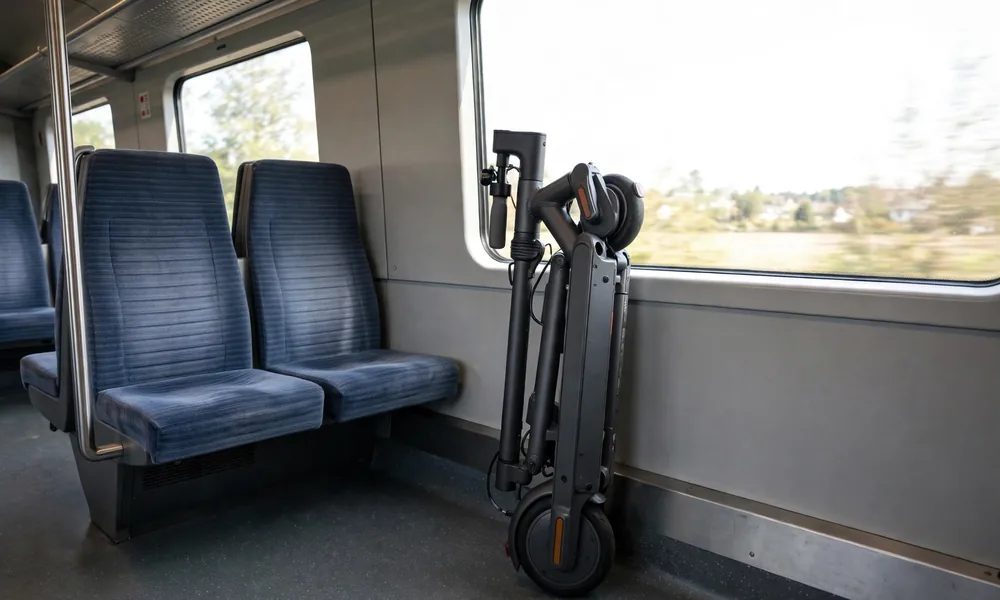
Some commutes are not really about riding. They are about carrying: up the station steps, onto a packed train, down the office stairs. The KQi Air weighs just 26.4 pounds, roughly half the scooters above it, and that changes everything about a mixed commute. Testing still recorded 20.1 mph and 24.2 miles of range, so the lightness costs almost nothing in performance. If your journey mixes riding with carrying, no other scooter here comes close.
6. Apollo City Pro — Best for Comfort
The City Pro is the scooter for riders who refuse to be rattled. Triple-spring suspension, two 500-watt motors, 10-inch tubeless tyres with a puncture-sealing gel layer and an IP66 water-resistance rating make it the most comfortable and weatherproof machine in this ranking. The maker claims up to 38 miles of range and a 28 mph top speed. The price is the problem: about $450 more than the Max G2.
7. Xiaomi Electric Scooter 4 Pro — Best Budget Commuter
At around $649, the Xiaomi 4 Pro is the honest budget pick. It claims 28 miles of range and a 20 mph top speed, and real-world riding lands around 18 to 22 miles, which covers most city commutes with room to spare. It has no suspension to speak of, so rough roads will be felt, but the build is solid and the app is genuinely useful. For a first commuter scooter, it is the cheapest sensible way in. The frame is simpler than it looks, as our guide to how an electric scooter frame is made shows.
8. EMOVE Cruiser S — Best for Long Range
The Cruiser S claims 62 miles of range, the biggest number in this ranking by a wide margin, and even with the usual discount for real-world riding it goes further between charges than anything else here. Top speed is 28 mph, it is built for heavier riders, and the price sits around $999 to $1,199. The trade is bulk: a big, heavy scooter you will not want to carry. But if your commute is long and you hate charging, it can do a full working week on two charges.
Commuter Scooters Compared
| Scooter | Tested range | Top speed | Weight | Best for |
|---|---|---|---|---|
| Segway Ninebot Max G3 | 24.9 miles | 28 mph | 54.2 lb | All-round commuting |
| Segway Ninebot Max G2 | 28 to 34 miles | 22 mph | 53.5 lb | Value all-rounder |
| NIU KQi 300X | 26.8 miles | 23.6 mph | 48.7 lb | Hills and heavier riders |
| Navee ST3 Pro | 24.9 miles | 24.8 mph | 55 lb | Value |
| NIU KQi Air | 24.2 miles | 20.1 mph | 26.4 lb | Trains and stairs |
| Apollo City Pro | 24 to 30 miles | 28 mph | 65 lb | Comfort |
| Xiaomi Electric Scooter 4 Pro | 18 to 22 miles | 20 mph | About 37 lb | Budget |
| EMOVE Cruiser S | About 40 miles | 28 mph | About 52 lb | Long range |
What Does a Commuter Scooter Cost?
A good commuter scooter costs roughly $500 to $1,400, with the sweet spot around $700 to $1,000. Budget picks like the Xiaomi 4 Pro sit near $649, the Max G2 around $699 to $949, and the Apollo City Pro near $1,399. On top of the scooter, budget for a helmet, lights and a lock, and expect tyres and brake pads to be the main running costs.
A Rare Fact
The most efficient speed for an electric scooter is not its top speed. Most scooters cover the most distance per charge at around 10 to 12 mph, which is why makers test claimed range at that gentle pace. Ride at 25 mph and the range can fall by a third or more, because air resistance rises with the square of speed.

The right commuter scooter is the one that fits your actual journey, not the one with the biggest numbers. Short flat ride with stairs and a train: take the lightest scooter you can afford. Long ride with hills: take the one with tested range and torque to spare. And remember that more power is not always more scooter — read our case against overpowered electric scooters before buying something faster than your commute will ever need.


