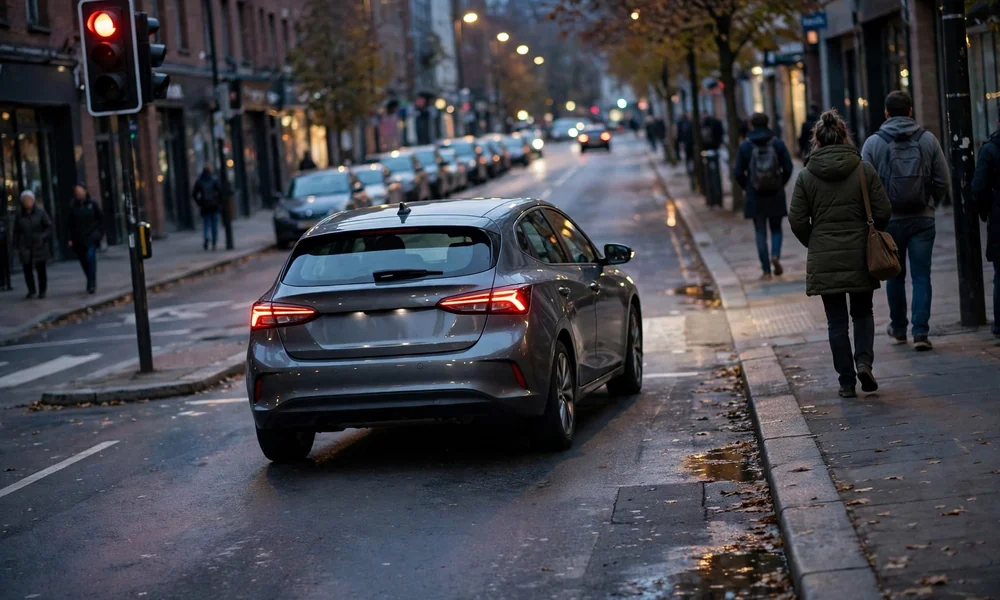
The traffic light turns green, and the car in front pulls away without a sound. No engine note, no shudder, just a smooth, silent glide that makes the car look as if it is being pushed by an invisible hand. That is a hybrid drivetrain doing its favourite trick: letting the electric motor do the easy work and calling on the petrol engine only when it is needed.
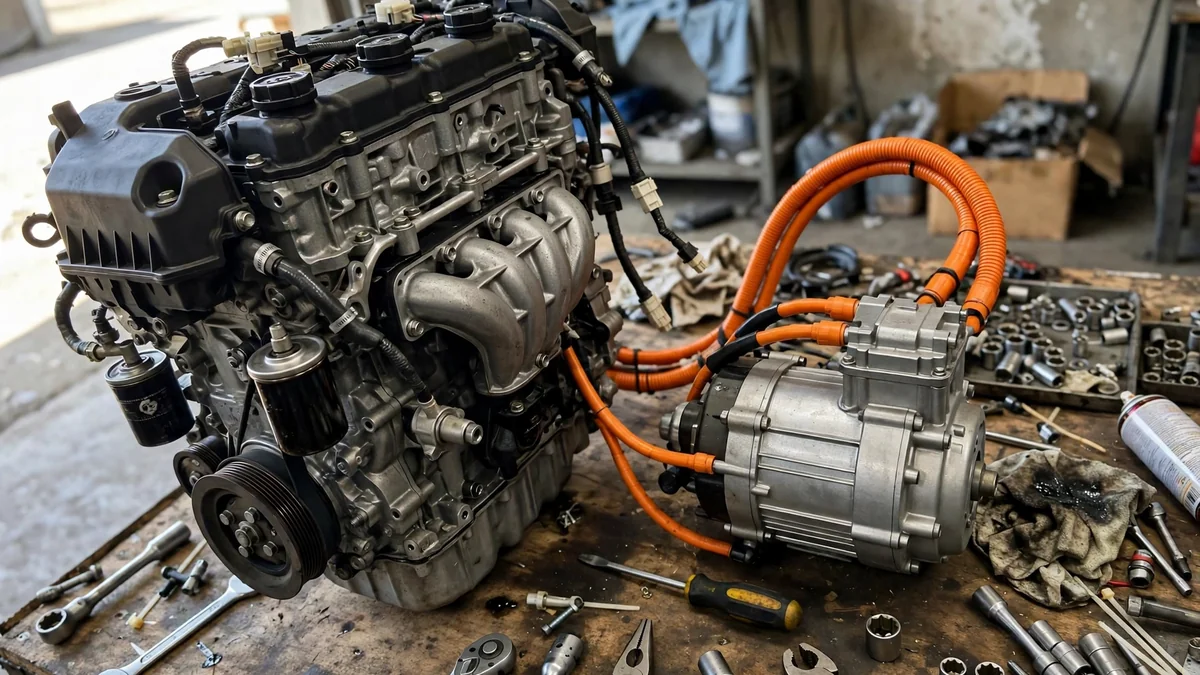
A hybrid drivetrain is two power sources sharing one job. A petrol engine and one or more electric motors are joined through a gearbox and a control system that decides, many times a second, which one should push the car and which one should rest. The electric motor is brilliant at starting from a standstill and crawling through traffic, because it makes its full pulling force the instant it turns. The petrol engine is brilliant at cruising, because it can keep going for hundreds of miles on a tank of fuel. Put together, they cover each other’s weaknesses, and the car ends up using less fuel than either one could manage alone.
The idea is older than most drivers realise, and the engineering behind it is more subtle than the badge on the boot suggests. There is no single hybrid design. What they share is a battery, a set of motors, and a brain that never stops doing the sums.
How It Works
A hybrid drivetrain works by blending two kinds of power so smoothly that the driver never feels the handover. The battery stores energy, the motors turn it into motion, the engine tops the battery up, and the control unit decides the mix. Here is how the parts work together, step by step, from a cold start to a motorway cruise.
1. Starting off on electric power. When the driver presses the accelerator from a standstill, the electric motor does the work alone. It draws power from the battery and turns the wheels directly, with no gears to change and no waiting for an engine to warm up. The motor’s silence is the first thing new owners mention, and the second is how quickly the car moves away from a standstill. This is where a hybrid feels most different from an ordinary car, because the pull is instant and silent.
2. The engine joins in when it is needed. As the speed rises or the driver asks for more power, the petrol engine starts, so smoothly that many drivers do not notice it. A clutch or a planetary gear set blends the engine’s power with the motor’s, and the two push the car together. The difference between a diesel engine and an electric motor is the same trade-off at a smaller scale: one is best at steady work, the other at instant response, and a hybrid uses both.
3. Cruising and charging on the move. At a steady motorway speed, the engine does most of the work, and it also does a second job: it spins a generator that trickle-charges the battery. The control unit watches the battery level constantly, and if it drops too low the engine works a little harder to top it up. The hybrid systems used in modern boats follow the same idea, with an engine and a motor sharing the work so that neither one is wasted.
4. Regenerative braking recovers energy. When the driver lifts off the accelerator or presses the brake, the electric motor runs in reverse and becomes a generator, turning the car’s motion back into electricity and feeding it into the battery. A conventional car throws this energy away as heat in the brake discs; a hybrid catches a useful share of it. The friction brakes are still there for hard stops, but they do far less work than they would in an ordinary car.
5. The battery and the power electronics. The battery sits low in the car, usually under the rear seats or the floor, where its weight helps balance the car. It is a lithium pack, smaller than the battery in a fully electric car, because it only needs to cover short bursts of electric driving. Cooling keeps the whole system at the right temperature, and the way range is measured for an electric scooter shows the same truth that applies here: a battery’s real range depends on how hard it is worked, not just on its size.
6. The control unit makes the decisions. The brain of the system is a control unit that reads the accelerator, the speed, the battery level, the engine temperature, and the road ahead, and decides the mix many times a second. It knows when to run on electricity alone, when to blend, when to charge, and when to let the engine rest. The driver sees none of this, only a small display showing power flowing between the engine, the motor, and the battery. The display turns driving into a quiet game, and owners say it changes how they drive within a week.
7. Plug-in hybrids add a bigger battery. A plug-in hybrid is the same idea with a larger battery that can be charged from a wall socket. It can drive twenty to fifty miles on electricity alone, covering most daily journeys without burning any fuel, and then behave like an ordinary hybrid on longer trips. For drivers with a driveway and a short commute, it is often the cheapest way to drive electric most of the time without ever worrying about range.

Specifications
| Detail | Typical figure |
|---|---|
| System layout | Petrol engine plus one or two electric motors |
| Battery capacity | 1 to 15 kWh, lithium |
| Electric-only range | 1 to 50 miles, plug-in models higher |
| Combined output | 150 to 350 hp |
| Fuel economy | 50 to 70 mpg combined |
| Regenerative braking | Recovers energy when slowing down |
| Transmission | Planetary gear set or dual-clutch automatic |
| Typical lifespan | Battery warranted 8 to 10 years |
Price
A new hybrid car is estimated at roughly $28,000 to $60,000, depending on its size, the power of the system, and whether it is a plug-in model. A compact family hybrid sits near the lower end, while a large plug-in SUV with a big battery and all-wheel drive can pass the upper end. These are estimates, not quotes, and the price does not include the home charging equipment that a plug-in owner usually adds, which is arranged separately.
Running costs are estimated at roughly $1,500 to $3,000 a year, covering fuel, insurance, and servicing. Fuel is the largest saving, and a driver who spends most of their time in town can use far less of it than in an ordinary petrol car, so owners who commute short distances budget carefully and often find the car pays for its premium over time.
A Rare Fact
The first hybrid car was built in 1900, when a young engineer named Ferdinand Porsche fitted electric motors into the wheel hubs of a car and added a petrol engine to charge the batteries. It was called the Lohner-Porsche, and it could drive on electricity alone, on petrol alone, or on both together, exactly like a modern hybrid. The idea waited a century for batteries and electronics good enough to make it affordable. The idea was a century ahead of its time, and it took a hundred years of better batteries and better electronics to make it cheap enough for everyone.


