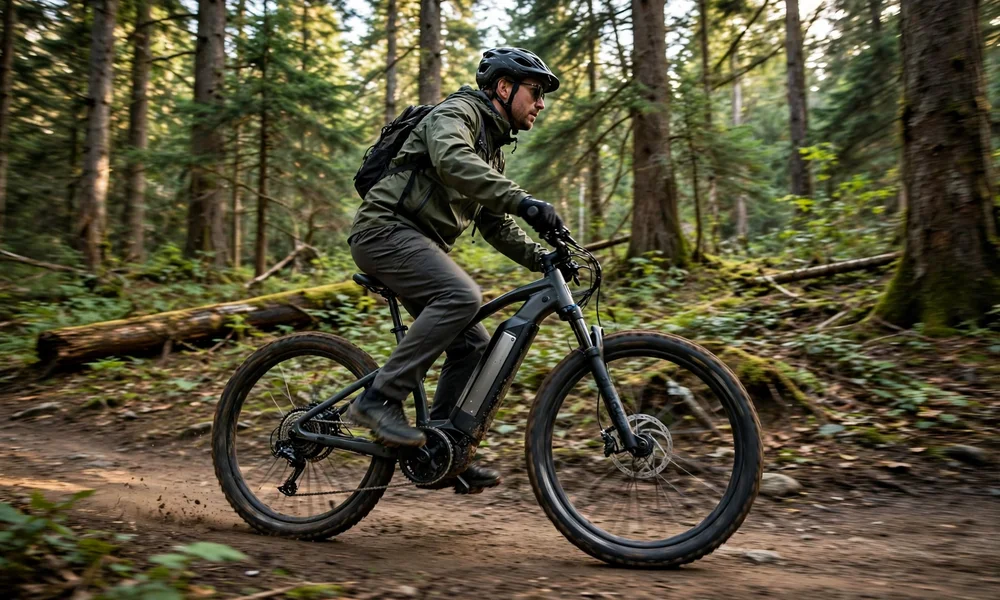
The trail climbs out of the valley in a long green switchback, and halfway up, the legs give out. That is the moment every e-bike rider knows: the pedals turn heavy, the breath shortens, and the hill looks twice as steep as it did from the bottom. Then a thumb presses a button, a quiet hum rises from low in the frame, and the hill gives way. The bike surges forward as if the slope had flattened, and the rider is grinning before the next bend.
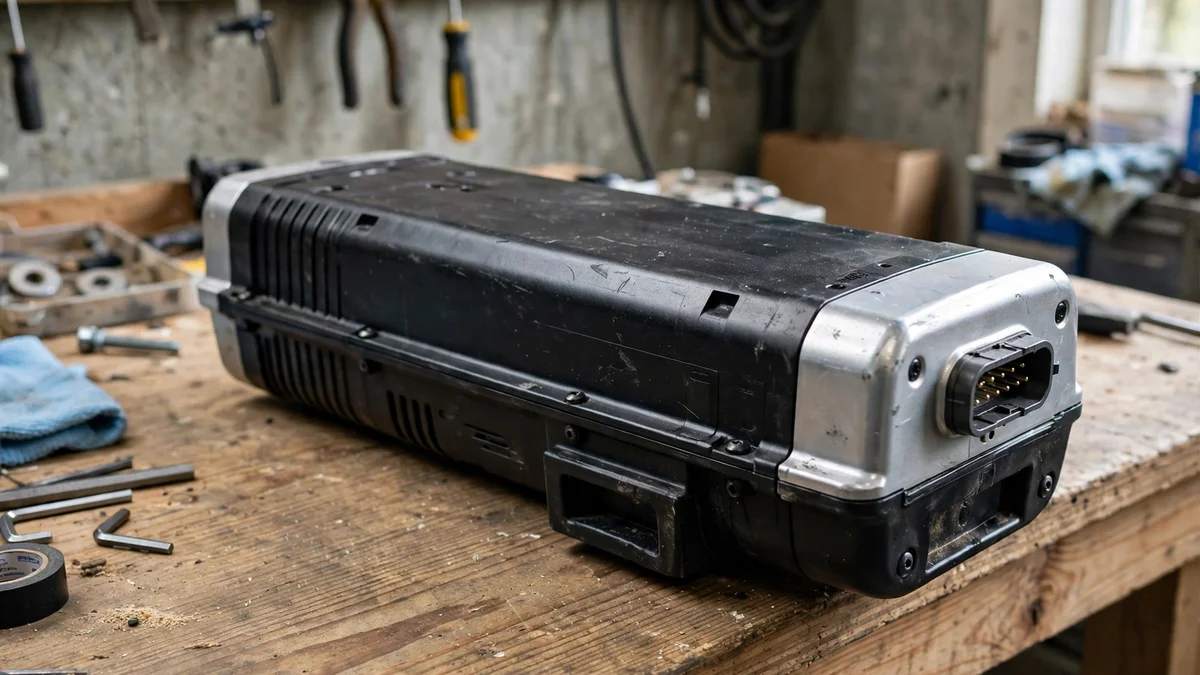
That quiet hum is the battery at work. Bolted into the down tube or clipped to the rack, it is a dense brick of stored energy — hundreds of watt-hours in something roughly the size of a water bottle and a half. It has no moving parts, makes almost no sound, and asks for nothing more than a plug socket at the end of the day. Yet it is the most expensive part of the bike, deciding how far you ride, how hard the motor pushes, and how many years the bike stays useful.
Ask a rider what battery they have and you will get a shrug, then a number half remembered from the brochure: 500 watt-hours, or 48 volts. Those numbers are not decoration. They describe real physics — how much energy the pack holds, how hard it can push current into the motor, and how long it will last before needing replacement. Here is what they mean.
How It Works
Step 1: Cells in series and parallel
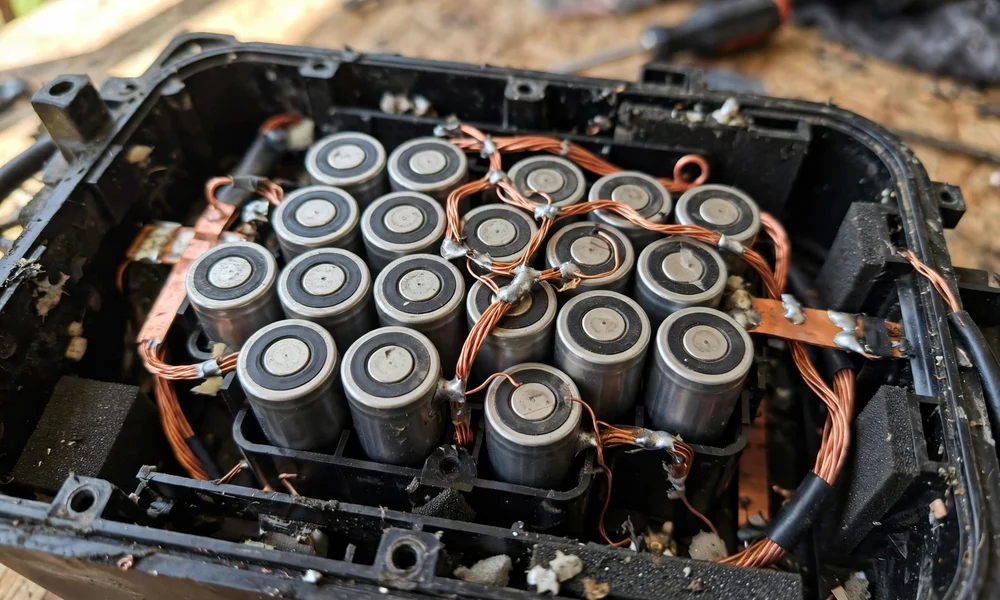
An e-bike battery is not one big battery. It is a bundle of small cylindrical cells — usually the 18650 or larger 21700 format — wired together in a grid. In series, cells add voltage: ten at 3.6 volts make a 36-volt string. In parallel, cells add capacity: more side by side means more amp-hours and more range. A typical 48-volt pack might hold 52 cells — thirteen in series, four in parallel — and every one must share the work evenly, or the weakest drags the whole pack down.
Step 2: The battery management system
Watching over them is the battery management system, or BMS — a small circuit board monitoring every cell group, all the time. It measures voltage, current, and temperature, cutting power if anything goes out of bounds. It stops charging when a group is full, stops discharging when one runs low, and balances the groups so no cell gets overworked. Without a BMS, a lithium-ion pack would be a fire risk; with one, it is a predictable power source that can survive thousands of charge cycles.
Step 3: Voltage and capacity
Voltage is the push, capacity is the tank. A 48-volt pack pushes harder than a 36-volt one, feeding a stronger motor and holding speed better on hills. Capacity, measured in watt-hours, is how much energy the tank holds: voltage multiplied by amp-hours. A 500 watt-hour pack can in theory deliver 500 watts for an hour, or 250 watts for two. In practice the motor draws only what it needs, and the rider’s weight, the terrain, and the assist level decide how fast the tank empties. Our guide to e-bike range beyond battery size shows the headline number is only part of the story.
Step 4: Discharge under load
When you twist the throttle or lean into the pedals, the motor asks the battery for current — sometimes a lot of it at once. A steep climb can pull twenty or thirty amps from a pack that idles at almost nothing. The cells give up stored chemical energy as electricity, warming as they do it. The pack’s maximum discharge current is the ceiling on that demand: exceed it and the BMS throttles the output. That is why two packs with the same watt-hour rating can feel different on a hill — one delivers its power in a rush, the other only trickles it out.
Step 5: Charging
Charging reverses the process. The charger feeds current back into the cells, and the BMS watches each group so none overfills. Most of the charge arrives quickly — the first eighty percent in a couple of hours — then the charger slows to top the pack off gently while the BMS balances the cells. That is why fast charging has limits: pushing current in too quickly heats the cells and wears them out faster. A slow overnight charge is the kindest thing you can do for a battery, and the reason most makers still ship a modest two-amp charger.
Step 6: Thermal safety
Heat is the enemy of every lithium-ion cell. Ride hard on a hot day and the pack warms from the inside; charge it in a freezing garage and the chemistry slows and resists. The BMS watches temperature sensors, shutting the battery down if it gets too hot or refusing to charge if too cold. The casing helps, sealed against rain and dust and built to take a knock. Keeping cells cool is a problem far beyond bikes — the same physics shapes cooling for sustained performance in everything from laptops to electric cars. The battery’s current becomes motion in the machine explained in our guide to how an electric motor works.
E-Bike Battery Specs
| Specification | Typical range |
|---|---|
| Capacity | 400 to 750 watt-hours |
| Voltage | 36 or 48 volts nominal |
| Cell type | 18650 or 21700 lithium-ion |
| Charge cycles | 500 to 1,000 full cycles |
| Weight | 2.5 to 4.5 kilograms |
| Charge time | 3 to 6 hours from empty |
| Max discharge current | 15 to 30 amps continuous |
| Operating temperature | Minus 10 to plus 45 degrees Celsius |
What Does an E-Bike Battery Cost?
A replacement e-bike battery is the most expensive spare part on the bike, and its price tracks capacity almost directly. A modest 400 watt-hour pack is estimated at $300 to $500, a mid-range 500 to 625 watt-hour pack at $500 to $800, and a large 750 watt-hour or bigger pack at $800 to $1,200 or more. Prices are estimates only and vary by brand, cell quality, and whether the pack comes from the bike maker or a third party. Cheaper packs cut corners on the cells and the BMS — the two things you least want to gamble on.
A Rare Fact
The battery in a modern e-bike is built from the same cylindrical cell format that once powered laptops — and the same format Tesla used in its original Roadster and early Model S packs. The 18650 cell — named for its 18-by-65-millimetre dimensions — was developed in the early 1990s for portable electronics. Nobody designed it for a bicycle; e-bike makers adopted it because it was cheap, proven, and made by the billion. So the pack on your frame carries a piece of history: a laptop battery, scaled up fifty-fold, quietly doing the job of a petrol tank.
An e-bike battery looks like a brick and behaves like a fuel tank, but it is a small, well-guarded chemical factory — dozens of cells, a watchful circuit board, and numbers that tell you exactly what it can do. Learn to read them, and the bike stops being a mystery.


